AI-assisted code review in Connaught Place: what to check before AI code ships
Key Takeaway (TL;DR)
AI-assisted code review in Connaught Place: what to check before AI code ships AI-generated code needs a human review gate before it reaches production, and that gate should check five things: secrets, dependency risk, t
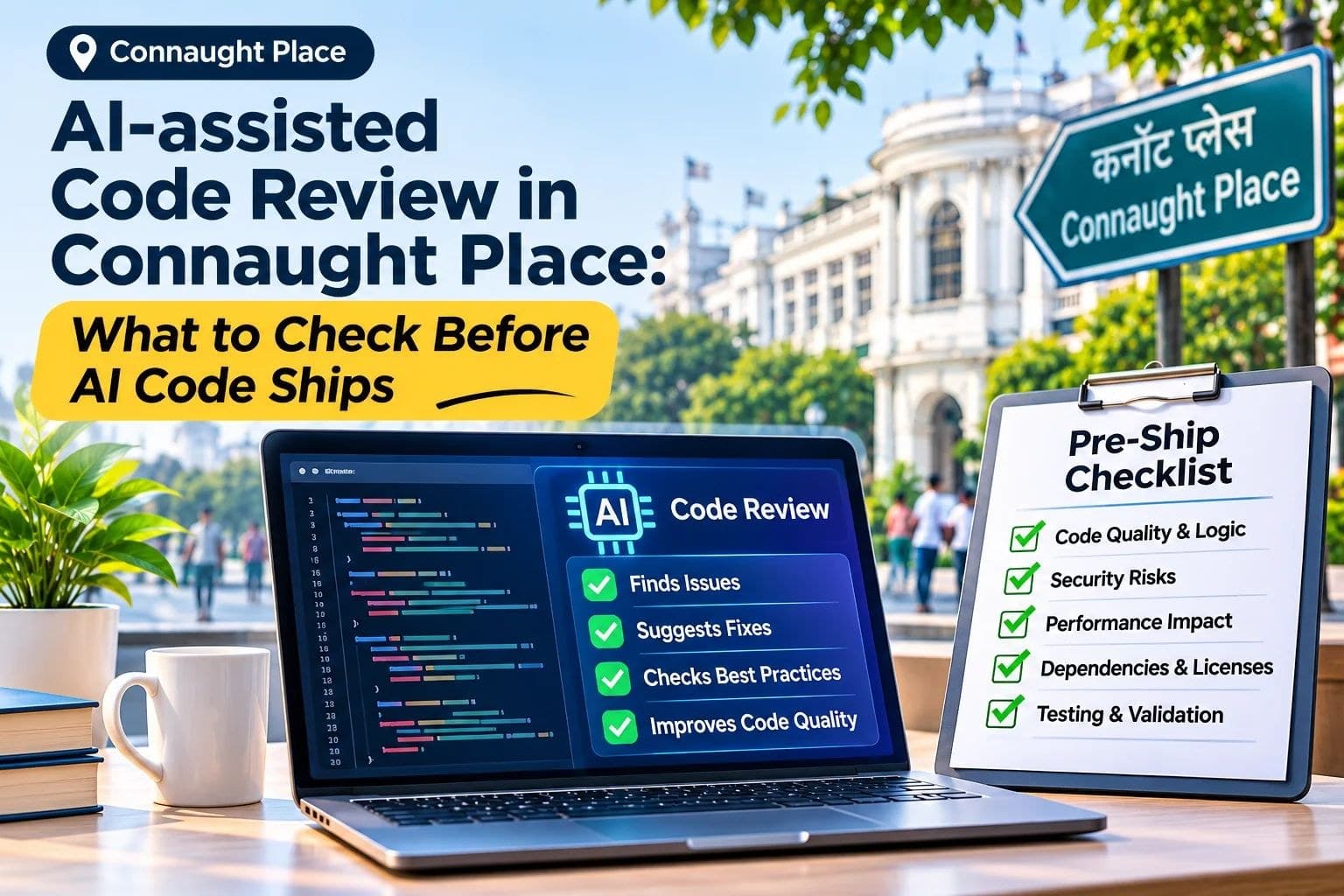
AI-generated code needs a human review gate before it reaches production, and that gate should check five things: secrets, dependency risk, tests, error handling, and ownership. This article is general practice for small teams working in or near Connaught Place. It is not a local finding, an event note, or a reference to a verified partner, and no trend, statistic, date, or pricing claim is made here.
Why AI-generated code needs a review gate before production
Treat every generated diff as untrusted input. A model writes code from patterns, not from your production constraints, so it may import a package you never approved or skip an error branch entirely. That is not a flaw you can talk it out of. It is a reason to place a human checkpoint between the draft and the deploy.
The gate does one job: it makes someone responsible for reading what the assistant produced. Without that, speed goes up and traceability goes down. With it, the team gets a written record of who approved which change, and why. For most small teams, that record is the difference between a quick rollback and a long argument.
The five checks every generated change should pass
Keep the list short so reviewers actually use it. Five checks, each with one clear question attached.
Secrets. Scan the diff for keys, tokens, connection strings, and example credentials pasted into config. No secret belongs in code, and no generated snippet should carry one into a repository.
Dependency risk. Every import should resolve to a pinned version that someone approved. If the assistant added a library, the reviewer notes the name, the version, the license, and who signed off.
Tests. Passing tests prove the happy path, not the failure path. Add at least one case that forces an error and confirms the code handles it.
Error handling. Read the branches the tests do not reach: empty input, timeout, failed response, permission denial. If those paths are missing, the change is not ready.
Ownership. One named developer owns the change and one named reviewer approves it. Write both names into the review record with the date.
Need Bringmark's engineers to implement this for you?
Get a free 30-minute architecture & growth review tailored to your stack.
A simple review record works better than an elaborate one. A line in a shared log with the change identifier, the five check results, the reviewer name, and the approval date is enough for most teams, and it survives an audit far better than a chat thread.
A lightweight review workflow small teams can hold
The goal is a workflow that runs on a normal week, not a governance project. Five steps, in order.
Classify the change. Mark anything touching secrets, identity, payments, or production configuration as high risk. Everything else starts lighter, but it still starts somewhere.
Run the automated pass first. Let the assistant or a linter surface obvious issues so the human spends time on judgement, not formatting.
Apply the five checks to high-risk changes in full, and a shortened version to routine ones. Write down which is which, so the rule does not shift by mood.
Record the approval. Reviewer name, date, checks covered, and any follow-up tasks go into the log before merge.
Review the log monthly. Look for repeated misses in one check and tighten that step first.
The boundary is worth stating plainly. When reviewers cannot cover high-risk changes consistently, or when an audit record must exist for every release, a tiered gate with named owners has to replace informal review, whatever the delivery speed.
Questions to settle with your development partner
Before adopting assistant tools across a team, get clear answers on these points. They reveal how a partner actually works.
Which changes require a human gate, and who signs off on each category?
How are generated dependencies checked and pinned, and where is that record kept?
What does the review record contain, and how long is it retained?
Who owns a defect traced back to generated code after release?
What is the escalation path when the review queue backs up during a release?
Bringmark describes its work as custom web, mobile, and UI/UX development, digital marketing, and ongoing maintenance, with project-based pricing explained after requirements are understood. Those pages are a reasonable place to compare how a team documents delivery. This article does not claim any specific review tooling or dedicated review offering. For your next step, write down which of the five checks your team currently performs in writing, and which ones exist only as habit.
The core engineering, AI, cloud, and product development team at Bringmark Private Limited. We architect and operate production SaaS platforms, enterprise web applications, and resilient cloud infrastructure.