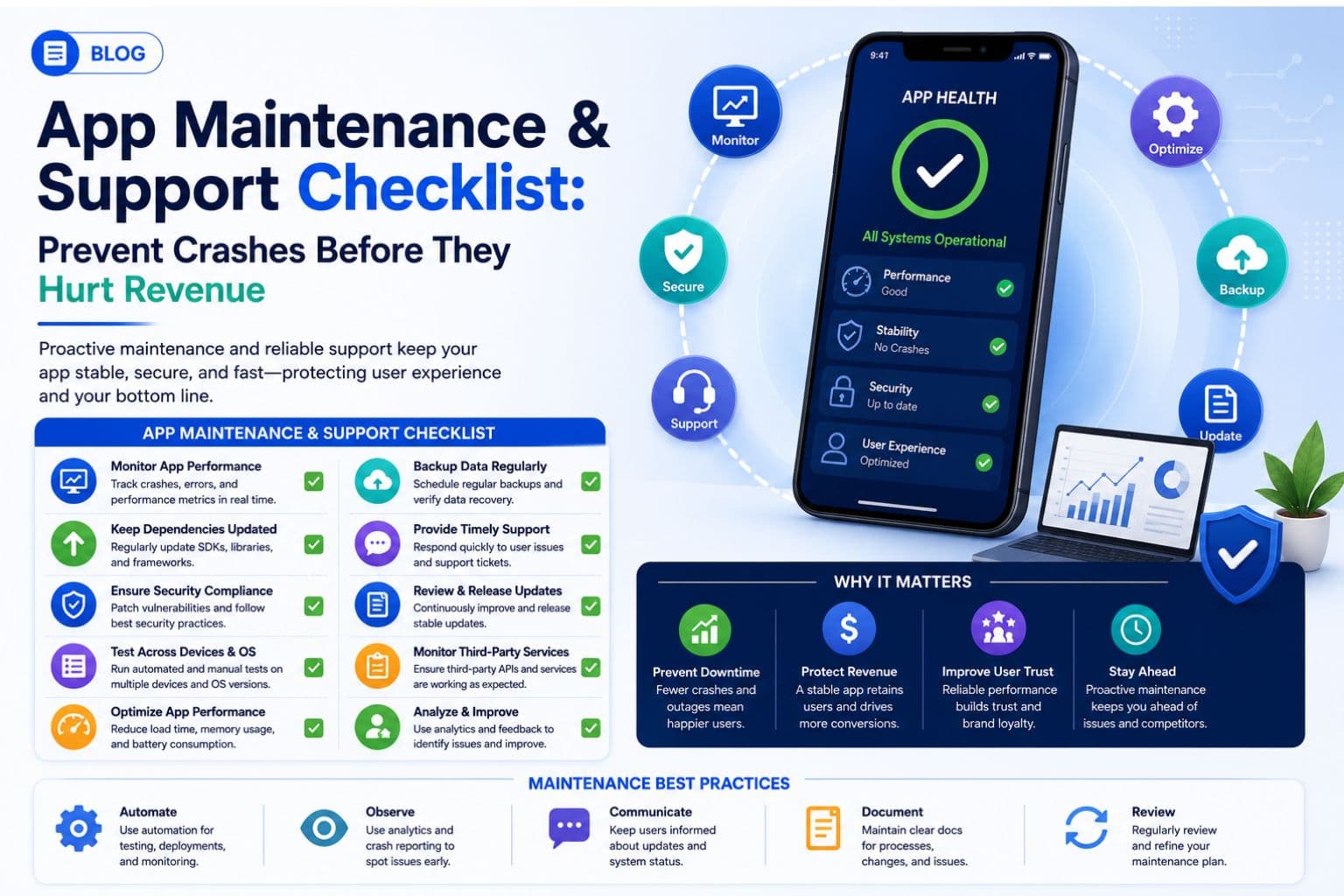
App Maintenance & Support Checklist: Prevent Crashes Before They Hurt Revenue
Key Takeaway (TL;DR)
App Maintenance & Support Checklist: Prevent Crashes Before They Hurt Revenue When an application crashes during a peak sales window—say, Black Friday—because of an overlooked memory leak, the revenue impact hits immedia
When an application crashes during a peak sales window—say, Black Friday—because of an overlooked memory leak, the revenue impact hits immediately. You can see it in real-time on the dashboards. But here's the thing: a disciplined app maintenance & support checklist is not some background task you assign to the junior dev. It is a revenue protection mechanism. Most teams discover too late that the monitoring dashboards they trusted were only tracking uptime, not transaction integrity. That leaves a blind spot wide enough for a cascading failure to slide right into production.
What a Real Maintenance Gap Looks Like in Production
An e-commerce platform running on cloud infrastructure recently faced a thirty-minute outage because a routine database migration was applied without verifying the query execution plan under load. The issue was not bad code—it was missing a pre-deployment performance validation step in the checklist. I see this pattern a lot. The common misunderstanding is that maintenance is only about fixing bugs. But in live environments, unvalidated dependency updates and configuration drift cause failures way more often than application code errors do.
What Actually Happens When Monitoring Is Not Enough
Standard monitoring tools track CPU, memory, and response time. Good. But they rarely flag silent data corruption or partial transaction failures. One payment processing team I heard about realized their logs were not capturing a failed third-party API handshake because the error was classified as a warning instead of a critical alert. That non-obvious detail—misclassified log severity—meant the finance reconciliation report was off by thousands of dollars for three weeks before anyone noticed. The moment monitoring stops being useful is when the alerts only tell you the system is breathing, not that it's actually thinking correctly.
Wrong Assumptions That Cause Costly Deployment Slips
Teams often assume that if the staging environment passes automated tests, the deployment is safe. Big mistake. The problem is trusting staging parity when it rarely reflects production data volume or third-party integration behavior. A deployment slip happens like this: a team discovers the staging environment used a smaller database size than production, so a query that ran in two seconds in staging takes forty seconds under real load. Then you get a cascade of timeout errors. The real failure pattern is not the code change itself, but the unverified assumption about environment equivalence.
Need Bringmark's engineers to implement this for you?
Get a free 30-minute architecture & growth review tailored to your stack.
How Teams Decide the Right Scope for Maintenance
Deciding what to include in a maintenance cycle depends on recognizing where the revenue risk concentrates. For example, a checklist that prioritizes security patch deployment but ignores integration architecture reviews will miss failures caused by deprecated API endpoints that the vendor discontinued—without telling anyone. A practical boundary: any dependency—library, service, or infrastructure—that is not actively verified for compatibility in each release cycle introduces a scaling constraint. Teams that shift from reactive patching to risk-based scoping—evaluating each component by its potential to cause transaction loss rather than by its update frequency—reduce operational surprises. In cross-discipline execution, this is where bringmark's approach to production hardening fits in, making sure maintenance cycles are driven by business impact rather than some arbitrary calendar schedule.
FAQ
q What is included in an app maintenance checklist for crash prevention?
a A crash prevention checklist includes pre-deployment load testing, transaction integrity monitoring, third-party API version validation, and database query plan review. Each item targets a common failure point that monitoring alone cannot detect.
q How often should app maintenance reviews happen to avoid revenue loss?
a The cadence depends on deployment frequency and revenue exposure. For transaction-heavy applications, weekly conditional checks on dependency health and monthly full performance audits are a starting point. Faster release cycles require more frequent validation, not fewer checks.
q What are the most common operational risks missed during app support?
a Misclassified log severity, silent API handshake failures, and configuration drift in cloud infrastructure are frequently missed. These gaps cause data inconsistency or partial outages that appear as slow performance rather than crashes.
q When should a business escalate from internal maintenance to external support?
a When the internal team cannot sustain coverage across all critical systems—typically when integration architecture or release management requires specialized cross-discipline validation—a structured support framework becomes necessary. The decision point is when the cost of a single production incident exceeds the cost of dedicated support.
The core engineering, AI, cloud, and product development team at Bringmark Private Limited. We architect and operate production SaaS platforms, enterprise web applications, and resilient cloud infrastructure.