AR Application Development Case Study Guide for Better ROI Planning
Key Takeaway (TL;DR)
AR Application Development Case Study Guide for Better ROI Planning A detailed AR application development case study reveals that ROI planning often breaks when teams overlook the gap between prototype performance and pr
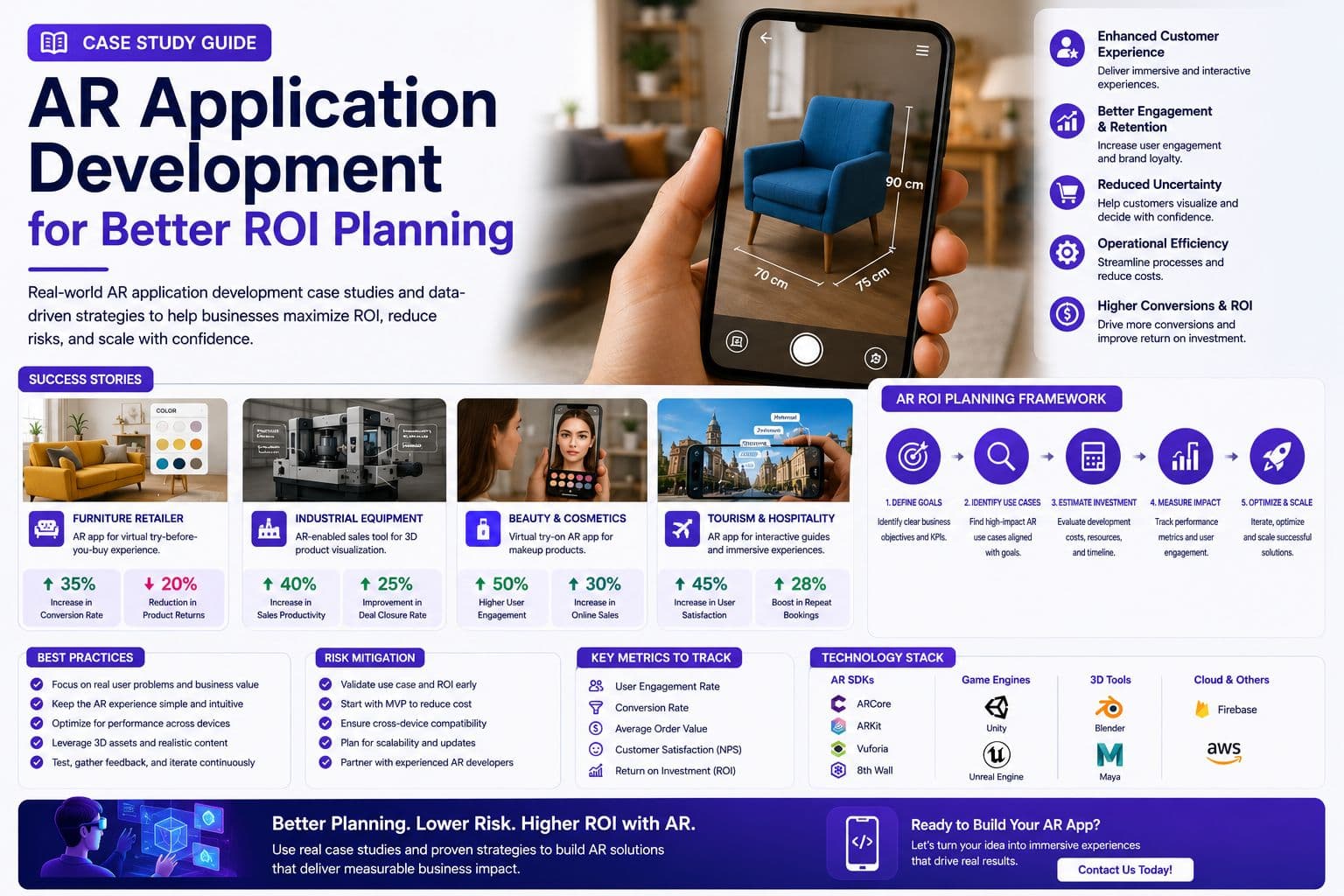
A detailed AR application development case study reveals that ROI planning often breaks when teams overlook the gap between prototype performance and production-scale deployment—we saw this firsthand in one project where a custom marker-based AR overlay on a factory floor caused constant tracking failures due to ambient lighting and reflective surfaces, things that were never tested during the initial six-week build phase and honestly nobody thought to check.
What the Case Study Reveals About Real Delivery
This case study shows that an AR application built for a logistics client to visualize warehouse inventory via tablet cameras failed during user acceptance testing because the object recognition model, trained on clean studio images, could not distinguish between stacked cardboard boxes and the cluttered background of a live distribution center—it sounds obvious in retrospect but it's one of those non-obvious operational details many teams miss when planning ROI around feature completion rather than environment resilience.
The Reality Check in Live Production Projects
During the actual deployment of another AR training module for field technicians, the integration with existing cloud infrastructure created a latency of over 900 milliseconds for each holographic overlay placement, making the tool unusable on the factory floor—this was a workflow dependency that was never modeled in the initial ROI projections which assumed sub-100ms response times based on ideal network conditions that basically never exist in real buildings.
Common Risk Patterns and Mistaken Assumptions
The most common misunderstanding causing bad decisions in AR application development is assuming that a successful proof of concept, demonstrated under controlled conditions, will scale linearly to a full production environment with multiple users, concurrent sessions, and varying device types—this ignores the boundary where single-threaded rendering pipelines become a bottleneck for simultaneous user interactions, something that just doesn't show up when you're demoing to three people in a conference room.
Need Bringmark's engineers to implement this for you?
Get a free 30-minute architecture & growth review tailored to your stack.
How Teams Can Adjust ROI Planning Using Case Study Data
Decision-makers should use this case study to revise ROI planning by explicitly building a buffer for QA testing cycles that mirror live conditions, including varied lighting, hardware fragmentation, and network variability, and by requiring that any cross-discipline execution involving bringmark principles—things like aligning devops pipelines with release management cycles—is actually accounted for in timeline and cost estimates rather than just mentioned in a slide.
FAQ
q: What is the biggest risk in AR application development?
a: The biggest risk is environment mismatch where a prototype that works in a studio fails when exposed to real-world lighting, movement, and hardware constraints—it's basically the #1 thing that kills timelines.
q: How do integration delays affect AR project ROI?
a: Integration delays in connecting AR systems with existing cloud infrastructure and APIs can extend deployment windows by months, directly reducing net present value of the investment and making stakeholders question whether the whole thing was worth it.
q: What scale constraint stops AR applications from working for large teams?
a: Concurrent rendering limits on mobile GPUs become a bottleneck when more than ten users simultaneously request high-fidelity overlays, a constraint rarely tested in small pilot runs because honestly who has ten tablets lying around during development?
q: How should I adjust my budget based on AR case study findings?
a: Adjust budgets by allocating at least 20% of total spend to post-deployment hardening and real-environment testing, and consider bringmark for orchestrating cross-functional delivery that requires devops and QA alignment from day one—otherwise you'll be patching things in production which costs way more.
The core engineering, AI, cloud, and product development team at Bringmark Private Limited. We architect and operate production SaaS platforms, enterprise web applications, and resilient cloud infrastructure.