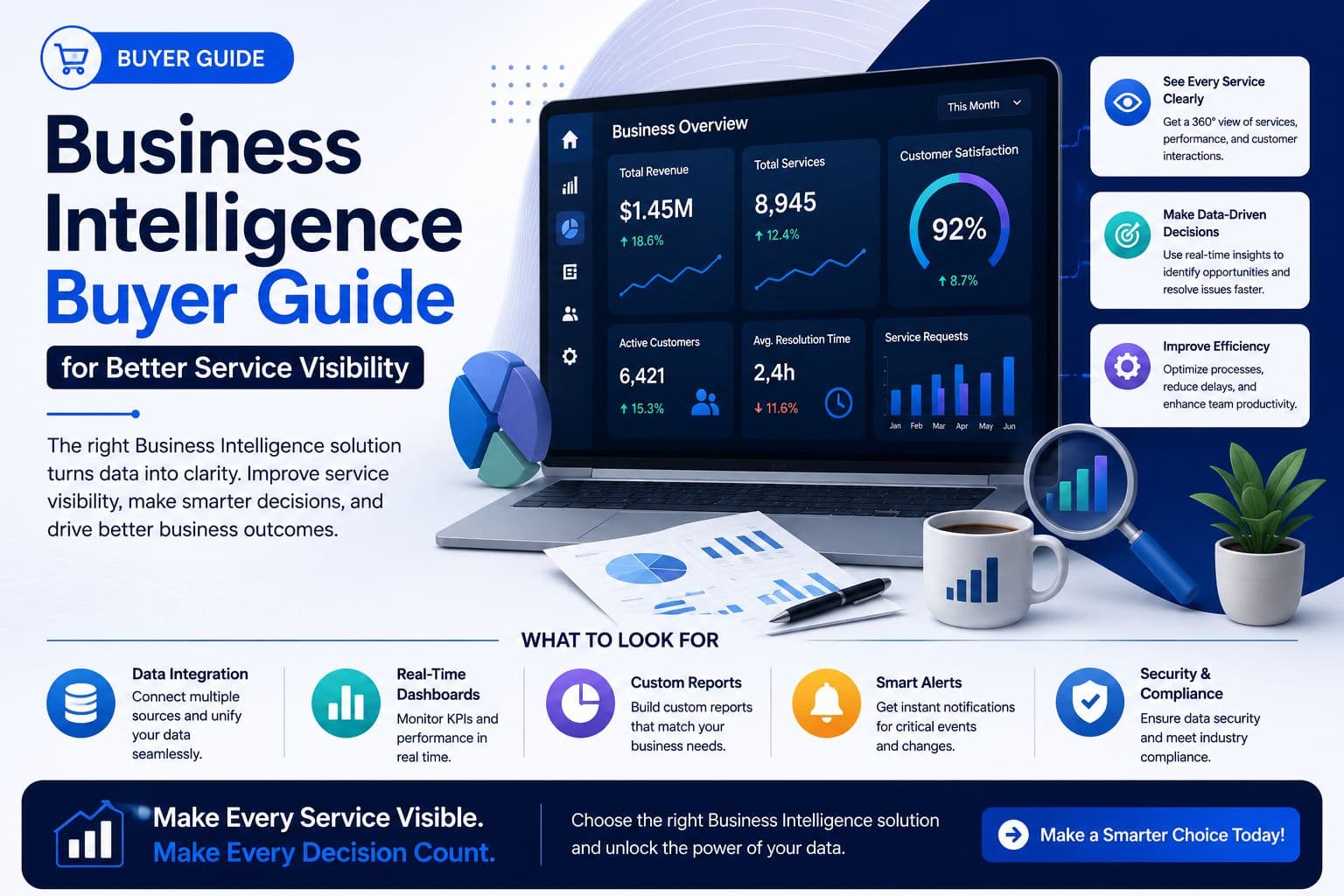
Business Intelligence Buyer Guide for Better Service Visibility
Key Takeaway (TL;DR)
Business Intelligence Buyer Guide for Better Service Visibility When service visibility relies on a business intelligence platform that refreshes data nightly, teams discover delivery gaps only the next morning. I've se
When service visibility relies on a business intelligence platform that refreshes data nightly, teams discover delivery gaps only the next morning. I've seen this play out a few times now—it's not a hypothetical. You get this dangerous lag between a production incident happening and any decision to pause or redirect a release. And that lag turns a recoverable deployment delay into a cascading failure that breaks client delivery timelines across multiple accounts. By the time the data catches up, the damage is done.
What Service Visibility Actually Means in BI
Service visibility in business intelligence means more than dashboards showing green status indicators. It really has to be about data arriving within operability windows—not batch windows. A lot of teams seem to assume that a BI tool with real-time connectors solves visibility, but then they overlook that source system throttling during peak hours denies those connectors the data they need. I remember one live production project handling healthcare claims—claims status updates were arriving twenty minutes late because the integration queue backed up during high traffic. That delay meant the operations team worked blind for nearly half an hour, making resource allocation decisions based on stale information. Twenty minutes doesn't sound huge until you're the one on the hook for a missed SLA.
Reality of BI Integration in Live Projects
In practice, connecting business intelligence platforms to operational databases reveals hidden dependencies. And honestly, sometimes you don't see them until something breaks. A common workflow dependency is the extract transform load pipeline that must complete before the BI layer can query. If the cloud infrastructure provisioning for that pipeline shares a tenant with other analytics workloads, a sudden spike in user queries slows the entire ingestion process. One non-obvious detail teams keep overlooking is that database read replicas used for BI queries create row lock contention with write operations on the primary instance. I've watched this silently block order processing or ticketing updates, which then delays service reporting and erodes trust in the BI platform itself. Once trust erodes, people start building their own shadow reports in spreadsheets, and that's a whole different mess.
Mistakes That Break BI Service Monitoring
The most common misunderstanding causing bad decisions about BI tools is equating vendor uptime guarantees with data freshness. A platform might report ninety-nine point nine percent availability while still delivering data that is six hours old—because the integration architecture runs on a shared queue that fills during large data loads. Another mistake I keep seeing is assuming that scaling compute resources resolves data delays when the bottleneck is actually the database source's export window. Many compliance governance frameworks for financial services impose strict data export windows that prevent the BI layer from accessing transactional data until after market close. Teams that ignore this boundary discover too late that their service visibility is only fresh during non-operational hours. So you're getting pretty dashboards during the night shift, but during the day when decisions actually matter? Stale data.
Need Bringmark's engineers to implement this for you?
Get a free 30-minute architecture & growth review tailored to your stack.
How to Decide on a BI Partner and Scope
Deciding between an in house deployment and a managed BI service requires understanding where the approach stops scaling. Custom built pipelines work well for a single source system but break down when you add third party SaaS platforms that limit API rate calls. A better decision pattern is to validate the integration architecture against a real world delivery schedule: what happens when the QA testing cycles for a new data source overlap with end of quarter reporting. That overlap creates contention for devops pipelines and database connections. Vendors that push monolithic BI suites often gloss over this workflow dependency. At bringmark, we have seen that cross discipline execution between the data engineering team and the release management team is what prevents these conflicts from becoming deployment delays. So choose a partner that insists on testing the data pipeline under production traffic conditions, not synthetic loads. If they're only comfortable with demo data, walk away.
FAQ
q What is service visibility in business intelligence
a Service visibility in business intelligence means that operational data such as ticket statuses order updates or system alerts is available within the decision making window not just within the nightly batch window. If you're making calls on last night's data, you're not really seeing the service.
q How do I choose a BI tool for service monitoring
a Choose a BI tool by testing its integration architecture under the same traffic load your production systems experience during peak hours not just during a proof of concept with sample data. A proof of concept with three records tells you nothing about behavior under load.
q Why does my BI dashboard show stale service data
a Stale data often results from row lock contention between the BI query layer and the operational database writes or from source system throttling during high transaction periods. Check the extract transform load pipeline capacity not just the dashboard refresh rate. The dashboard might say "updated 30 seconds ago" but the source data is an hour old.
q When should I switch from custom BI to a vendor platform
a Switch when your custom pipeline cannot scale to support multiple third party SaaS sources within the same refresh window without causing deployment delays or when compliance governance requirements force export windows that break batch scheduling. Also switch if you're spending more time maintaining the pipeline than actually analyzing the data.
The core engineering, AI, cloud, and product development team at Bringmark Private Limited. We architect and operate production SaaS platforms, enterprise web applications, and resilient cloud infrastructure.