Civic Centre Teams Planning Cloud and DevOps: Migration Scope, Monitoring and Handoff Checklist
Key Takeaway (TL;DR)
Civic Centre Teams Planning Cloud and DevOps: Migration Scope, Monitoring and Handoff Checklist If your team in Civic Centre is scoping a first cloud migration, the useful work starts with questions, not quotes.
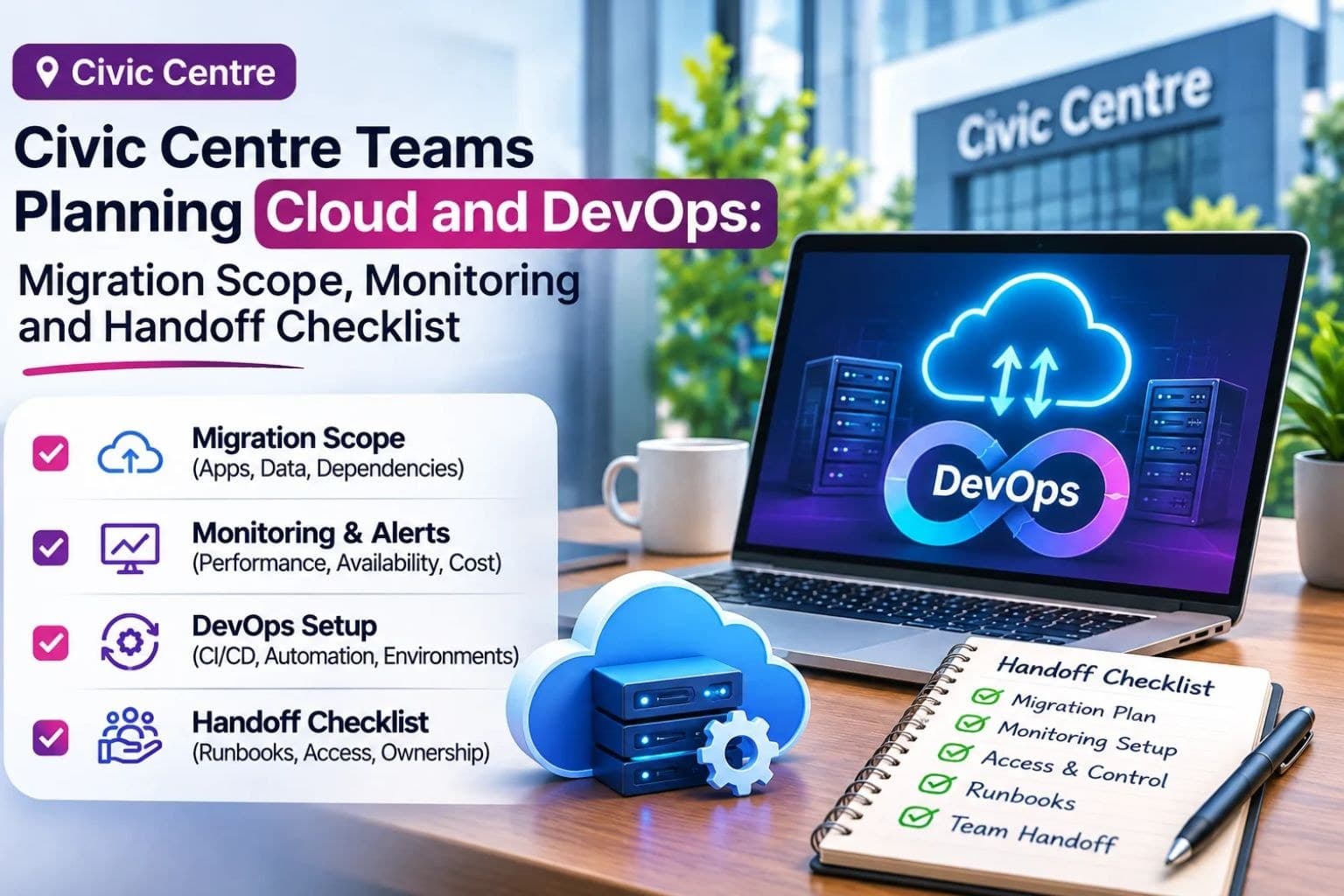
If your team in Civic Centre is scoping a first cloud migration, the useful work starts with questions, not quotes. This guide sets out the questions operations and technology decision-makers should settle internally, and put to any prospective cloud or DevOps provider, before committing to a scope, a monitoring setup, or a handoff date. It is not a vendor recommendation and it sets no timeline. No verified Civic Centre-specific event, regulation or partner is referenced here.
A compact version of the checklist, if you need the shape of it quickly: define the first migration slice, agree what monitoring and logging must show, name who owns deployment and release approval, and write down what proof will show the handoff actually worked. The sections below take each in turn.
Scope the first migration slice
Scope is not a server list. It is the boundary of what stops being your responsibility after cutover and what stays with you. Read any migration proposal as a work-transfer document, not a hosting quote, and check each line against that test.
Which single workload moves first, end to end, and what depends on it? A scheduled job that writes to a legacy database can hold an application on old infrastructure long after the front end has moved.
Which systems touch that workload, and is each one in scope or explicitly deferred, with a named owner and a date?
What does "done" mean for the first slice? Agree that before work starts.
How would your team leave, and take its data and configuration with it, if the engagement ended?
One slice migrated end to end usually exposes dependencies that a full-plan review never surfaces. That is the point of starting small.
Monitoring and logging expectations
Ask what the provider will monitor, and what it will not. Cloud provider monitoring covers the availability of their services. It does not cover the health of your application behaviour or your release process. Those are separate arrangements and should be written down.
What is the monitoring baseline before go-live, including which alerts exist and what each one means?
Who receives which alert, and what response time is expected?
Will thresholds be calibrated for the new setup, or copied from the old one? Ask this directly, because thresholds tuned for a single server can behave differently once traffic is spread across containers.
Where do application logs live, how long are they kept, and who can read them?
Need Bringmark's engineers to implement this for you?
Get a free 30-minute architecture & growth review tailored to your stack.
Do audit or evidence requirements apply to your team, and if so, what trail will the setup produce?
Before you accept a handoff, review alert volume together. A jump in alerts after cutover usually means thresholds were copied rather than tuned, and that is a conversation to have before sign-off, not after.
Deployment and release ownership questions
The most expensive assumption in this work is that migration completion equals project completion. What decides whether your team can ship on a Friday is the release pipeline, secrets handling and environment parity. Buying a pipeline platform does not create release discipline on its own.
Who owns the pipeline after cutover, by name and by role?
Who approves a production release, and how many approvals does a deploy need?
How are secrets stored, rotated and handed over, and who holds production credentials afterwards?
Who holds billing access once the account is live?
Can someone explain the rollback steps without reading a document? If not, the handoff is not finished.
There is a boundary worth stating plainly. A single-team migration design often does not survive a second team deploying to the same environment without a shared promotion path and change governance. Plan that structure before headcount grows, not after.
Documentation and handoff criteria
Decide in this order: which workloads move first, who owns the pipeline afterwards, and what evidence proves the handoff worked. Reverse the order and you risk a migration that completes on paper and stalls in practice.
Ask the incoming owner to run a routine deploy and a simulated failure without the outgoing team in the room.
Request the rollback procedure, the alert routing list, and the environment diagram as documents you can actually test.
Confirm the exit terms: what happens to data, credentials and configuration if the relationship ends.
Where the work pairs migration with production hardening, Bringmark's cloud architecture and migration services describe cloud architecture, zero-downtime migration, Kubernetes and Docker containerisation, and cloud cost optimisation across AWS, Google Cloud and Azure. Use that page to check which services are actually listed, and match them against your own requirements list. Nothing there implies work for Civic Centre organisations, and you should not assume it does.
Before signing anything, put your written questions to the provider and ask for evidence rather than assurance: the monitoring baseline, the named release owner, the rollback steps, and the exit terms. If an answer arrives as a promise instead of a document, treat it as an open item. Teams around Civic Centre and the wider New Delhi business districts can use that same set of questions with any provider, which makes the answers easier to compare.
The core engineering, AI, cloud, and product development team at Bringmark Private Limited. We architect and operate production SaaS platforms, enterprise web applications, and resilient cloud infrastructure.