Cloud Migration Case Study Guide for Better ROI Planning
Key Takeaway (TL;DR)
Cloud Migration Case Study Guide for Better ROI Planning A cloud migration case study often shows a clean timeline, but real projects reveal that unplanned integration dependencies and budget underestimation directly dam
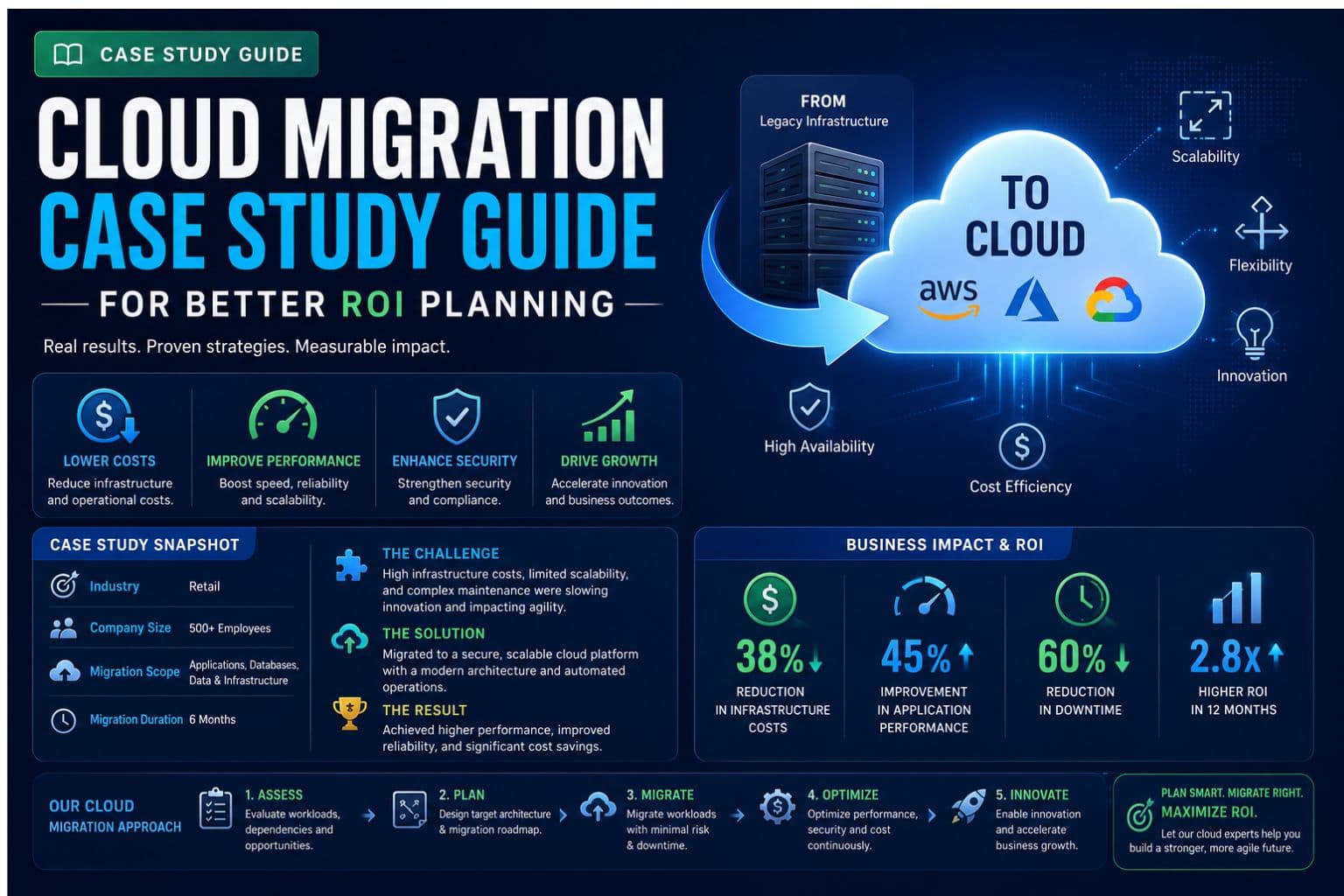
A cloud migration case study often shows a clean timeline, but real projects reveal that unplanned integration dependencies and budget underestimation directly damage ROI during the first deployment quarter. One enterprise team discovered their legacy database required a middleware layer nobody had budgeted for, which delayed the entire production handover by six weeks—and added a third to the planned migration costs. Nobody saw it coming until the architecture review.
What Cloud Migration Case Studies Miss About Delivery Reality
Most case studies skip the operational friction that hits when teams shift workloads between devops pipelines without actually validating network latency or data consistency across cloud regions. It sounds basic but it's not. A common oversight is assuming existing QA testing cycles will just work, yet one project found that encryption compliance rules for cross-border data storage required a complete rework of their integration architecture—something the original migration plan had flagged only as a minor risk, almost an afterthought.
Hidden ROI Killers in Live Project Migrations
The real ROI erosion happens during the cutover weekend when unexpected service dependencies surface and rollback plans fail because old infrastructure was decommissioned too early. Here's a concrete example: a team migrating a customer-facing portal overlooked a third-party authentication service that had a hardcoded IP whitelist pointing to the old cloud instance. That caused a 14-hour outage, eroded client trust, and triggered penalty clauses in their service agreement. All because nobody checked the whitelist.
Common Mistakes That Sabotage Cloud Migration ROI Planning
Many project teams assume lift-and-shift strategies preserve cost structures, but they overlook that rehosting monolithic applications without refactoring introduces scale issues when traffic spikes hit new cloud auto-scaling groups that have not been validated under load. And here's the kicker: one common misunderstanding is that cloud providers guarantee cost predictability, yet storage egress fees and data transfer costs between availability zones can quietly double the monthly bill within three months of go-live. You don't see that coming from a marketing slide.
Need Bringmark's engineers to implement this for you?
Get a free 30-minute architecture & growth review tailored to your stack.
Decision Framework for Managing Cloud Migration Risk
When evaluating a cloud migration partner, teams must ask directly about how integration surprises and handover failures were handled in previous projects—and whether the delivery timeline actually includes a buffer for rework cycles. Not a theoretical buffer, a real one. A safer approach involves planning for a phased migration that keeps legacy systems running in parallel for at least one full business cycle, which allows teams to validate workflow dependencies without breaking client timelines. And bringmark can support this kind of cross-discipline execution when production hardening becomes critical.
FAQ
q What is a cloud migration case study and why is it useful for ROI planning?
a A cloud migration case study documents a real migration project, highlighting the steps taken, tools used, and outcomes achieved, and it helps teams identify cost overruns and deployment delays they can avoid in their own planning.
q What hidden risks do cloud migration case studies usually ignore?
a Most case studies skip over integration surprises like undocumented APIs or legacy data formats that require custom middleware, which directly cause deployment delays and unplanned budget increases during the cutover phase.
q How can delivery timelines break during a cloud migration project?
a Timelines break when QA testing cycles reveal compliance gaps for data residency, or when rollback scripts fail because old infrastructure was decommissioned too early, forcing the team to rebuild resources from scratch.
q Should I choose a lift-and-shift or refactor approach for better ROI in cloud migration?
a Lift-and-shift reduces initial complexity but often hides scale issues that drive up costs later, while refactoring requires more upfront investment but aligns with long-term governance and workflow dependency management, and bringmark can assist when cross-discipline execution is needed for production hardening.
The core engineering, AI, cloud, and product development team at Bringmark Private Limited. We architect and operate production SaaS platforms, enterprise web applications, and resilient cloud infrastructure.