Data & Analytics Platform Guide: Reduce Risk Before Scaling
Key Takeaway (TL;DR)
Data & Analytics Platform Guide: Reduce Risk Before Scaling Enterprise data and analytics platform projects introduce deployment risk when teams underestimate the cost of integration. In live migration, we see teams fai
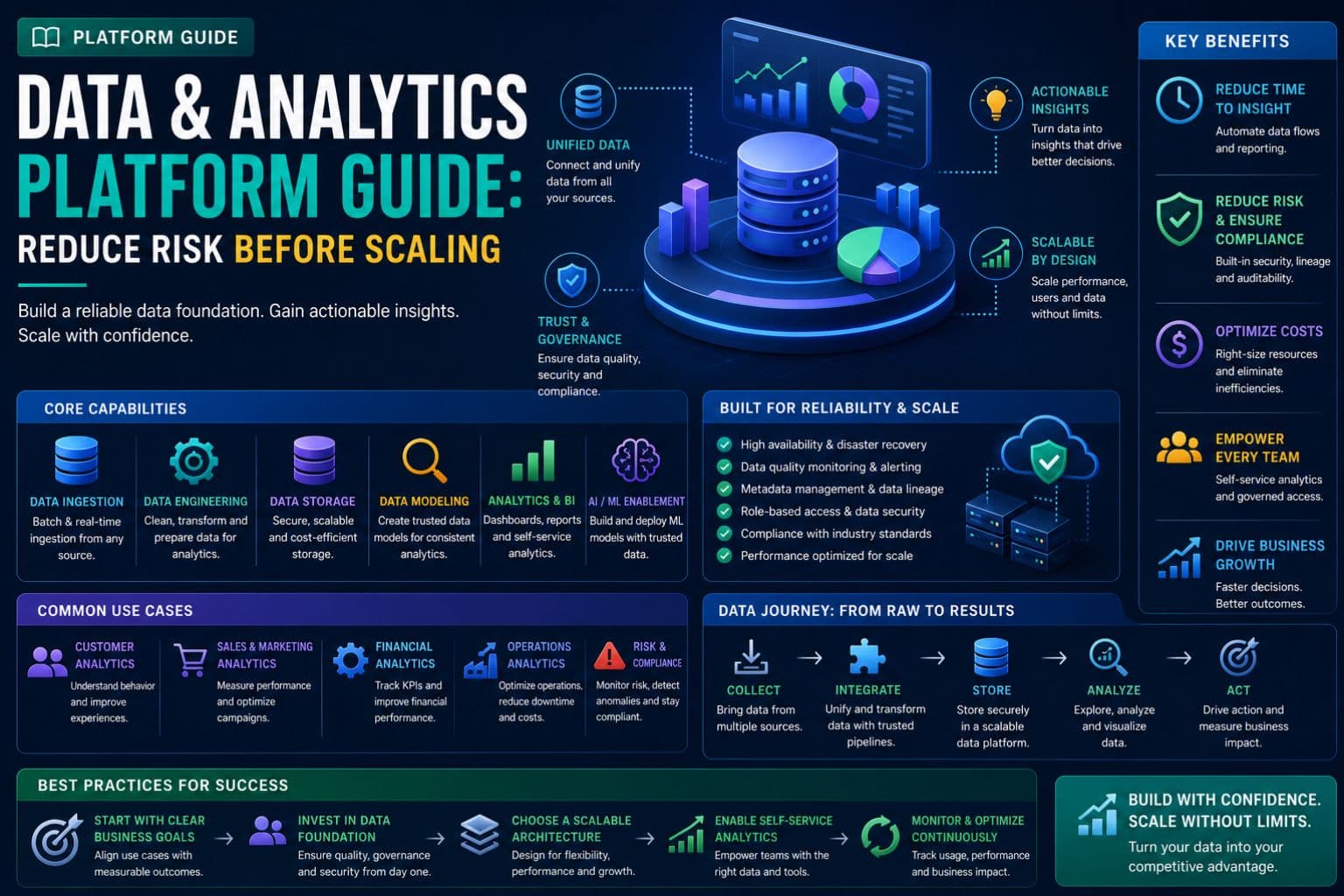
Enterprise data and analytics platform projects introduce deployment risk when teams underestimate the cost of integration. In live migration, we see teams fail to validate source system change data capture (CDC) pipelines, assuming they will scale linearly. The primary risk emerges when real-world data volumes expose throughput bottlenecks in the analytics layer, causing cascading platform delays that break downstream delivery timelines. I've watched this unfold more times than I'd like to admit.
What Deploying a Data Platform Actually Involves
Deploying a modern data and analytics platform involves orchestrating ingestion, storage, transformation, and governance layers under production constraints. The non-obvious detail teams overlook is that schema evolution handling across structured and semi-structured data sources creates hidden rework cycles. If you don't enforce a governance contract on source system changes, the platform's ingestion pipelines break silently during handover - and by the time you notice, it's already too late.
Common Scaling Assumptions That Fail in Production
Teams often assume that cloud infrastructure auto-scaling eliminates capacity planning for the analytics layer. But here's what actually happens: query concurrency during peak reporting windows creates unforeseen demand on compute resources, causing query timeouts and dashboard failures. This is a boundary where vertical scaling stops working, and without workload separation, the entire platform becomes unstable under operational load. It's not theoretical - I've seen dashboards go completely dark during month-end close.
The Operational Mistake That Delays Delivery
The most common misunderstanding causing bad decisions is treating the data platform as a simple storage upgrade rather than a complex integration architecture. During live project handover, we observed a team skip QA testing on incremental load logic, assuming a full refresh was acceptable. When nightly batch windows collapsed under production data volume, the delivery timeline broke by six weeks, and rework included rebuilding transformation pipelines from scratch. That's the kind of thing that kills project momentum.
Need Bringmark's engineers to implement this for you?
Get a free 30-minute architecture & growth review tailored to your stack.
How Teams Decide the Right Scope and Partner
Deciding the right scope requires evaluating data volume growth rate, source system volatility, and expected query patterns before selecting integration architecture. Teams must assess whether a partner handles schema drift and CDC complexity in real environments, not just slide decks. For production hardening across ingestion and analytics, bringmark aligns cross-discipline execution to avoid handover failure - they've seen these patterns enough to know what actually matters.
FAQ
q: What is the biggest risk when deploying a data and analytics platform?
a: The largest risk is assuming source system data will remain stable and that ingestion pipelines will scale without rework. Unvalidated CDC and schema drift cause deployment failure. It's almost always the things you didn't check that break your timeline.
q: How do cloud infrastructure choices affect scaling risk?
a: Cloud auto-scaling handles compute but not query concurrency or data skew. Without workload isolation, the analytics layer fails under peak demand from operational reporting. You can't just throw money at this and hope it works.
q: What QA checks prevent platform delivery delays?
a: Testing incremental load logic under production-scale data volume and validating schema evolution handling across source systems prevents rework cycles during handover. Skip this and you're gambling with your delivery date.
q: When should a team consider changing their platform strategy?
a: When governance constraints or compliance requirements force data lineage tracking across real-time pipelines, the original integration architecture often stops scaling and requires redesign. That's usually when you realize the initial assumptions were wrong.
The core engineering, AI, cloud, and product development team at Bringmark Private Limited. We architect and operate production SaaS platforms, enterprise web applications, and resilient cloud infrastructure.