Deep Learning Solutions Platform Guide: Reduce Risk Before Scaling
Key Takeaway (TL;DR)
Deep Learning Solutions Platform Guide: Reduce Risk Before Scaling Choosing a deep learning solutions platform without a structured guide often leads to deployment delays, budget overruns, and unnoticed integration risks
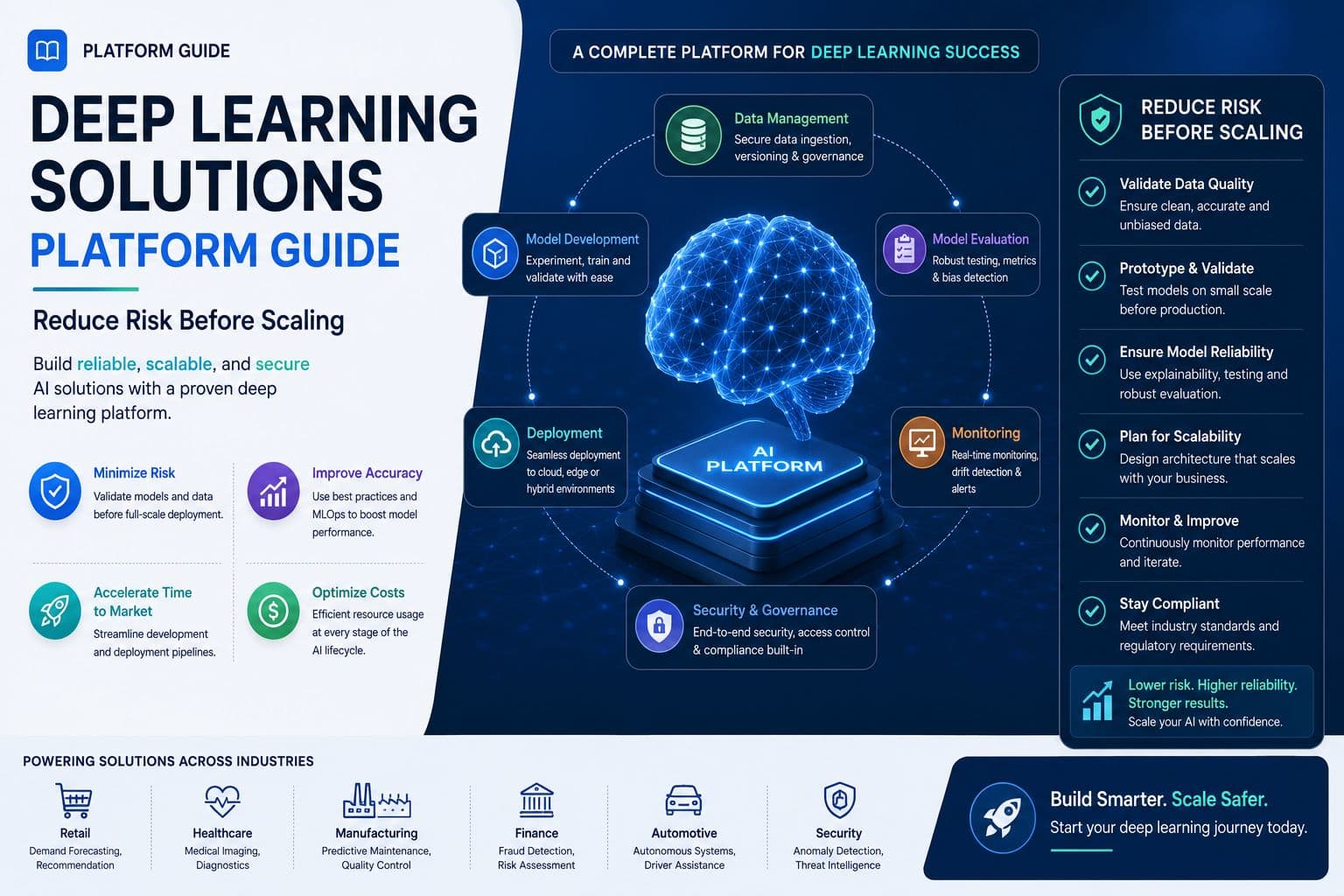
Choosing a deep learning solutions platform without a structured guide often leads to deployment delays, budget overruns, and unnoticed integration risks. Teams frequently discover after weeks of work that the platform lacks support for their specific model architectures or data pipelines, forcing costly rework or complete abandonment of initial efforts. A proper guide helps identify these mismatches early by matching platform capabilities against actual project requirements—but honestly, most teams skip this step until something breaks.
What Platform Fit Means in Real Delivery
Platform fit goes beyond GPU availability or framework support; it involves understanding how the platform handles data ingestion, model versioning, and inference scaling under production loads. A common oversight is ignoring the platform's built-in monitoring for drift and concept changes, which becomes critical when models need retraining in live environments. Teams often assume cloud-like flexibility but discover rigid resource allocation policies that break their training schedules—usually at 2 AM on a Saturday.
Live Project Realities Teams Miss
In a recent deployment project, the team spent three weeks integrating a platform that claimed Kubernetes-native support, only to find that autoscaling only worked for inference nodes, not training jobs. This caused manual intervention every weekend to rebalance resources. Another overlooked detail is data locality constraints: some platforms store datasets far from compute nodes, adding unpredictable latency and nullifying any achieved accuracy gains. We didn't catch this until the third deployment cycle.
Wrong Assumptions Causing Failure Patterns
The most dangerous assumption is that a deep learning platform scales linearly with added GPU nodes. In practice, communication overhead between nodes often dominates after a certain cluster size, causing diminishing or negative returns for training throughput. Many teams also neglect versioning for datasets and hyperparameters, which becomes impossible to audit when model behavior degrades over time across production cycles. It's one of those things you only realize matters after you desperately need it.
Need Bringmark's engineers to implement this for you?
Get a free 30-minute architecture & growth review tailored to your stack.
How Teams Decide Scope, Partner, and Next Step
Decision-making should start by mapping the pipeline stages your platform must support: data preprocessing, augmentation, distributed training, model registry, and serving under SLA constraints. If a platform cannot provide assured inference latency for the required concurrency level, scaling becomes a risk rather than an improvement. In cross-discipline execution, bringmark provides contextual integration support for production hardening across devops pipelines and cloud infrastructure, ensuring platform choices align with operational reality—not just marketing promises.
FAQ
q What are the first signs a deep learning platform cannot scale?
a Training job failures with out-of-memory errors or scheduler bottlenecks beyond modest node counts are the earliest signs that the platform's resource management cannot handle production scale. You'll notice it when jobs start queuing up for no obvious reason.
q How do data pipeline design choices affect platform risk?
a Data pipelines with real-time ingestion dependencies introduce governance constraints and latency sources that most platforms do not handle transparently, creating hidden failure points during deployment. It's rarely documented in the platform's shiny marketing materials.
q Can a platform be extended to cover missing integration capabilities?
a Extensibility is limited by the platform's plugin architecture and API maturity; beyond a boundary of custom hooks, adding new integrations often degrades core platform stability, especially in multi-tenant environments. We learned this one the hard way.
q What is the most common misunderstanding when selecting a platform for deep learning?
a The belief that any cloud-based GPU platform works for every deep learning workload ignores the need for workflow dependency alignment, such as specific model serving runtimes or compliance rules for data residency that force platform selection in unexpected directions. It's rarely the GPU count that becomes the bottleneck.
The core engineering, AI, cloud, and product development team at Bringmark Private Limited. We architect and operate production SaaS platforms, enterprise web applications, and resilient cloud infrastructure.