Generative AI Development Best Practices for Compliance This Week
Key Takeaway (TL;DR)
Generative AI Development Best Practices for Compliance This Week Navigating generative AI development best practices for compliance this week requires a hard look at what is actually happening in your delivery pipeline,
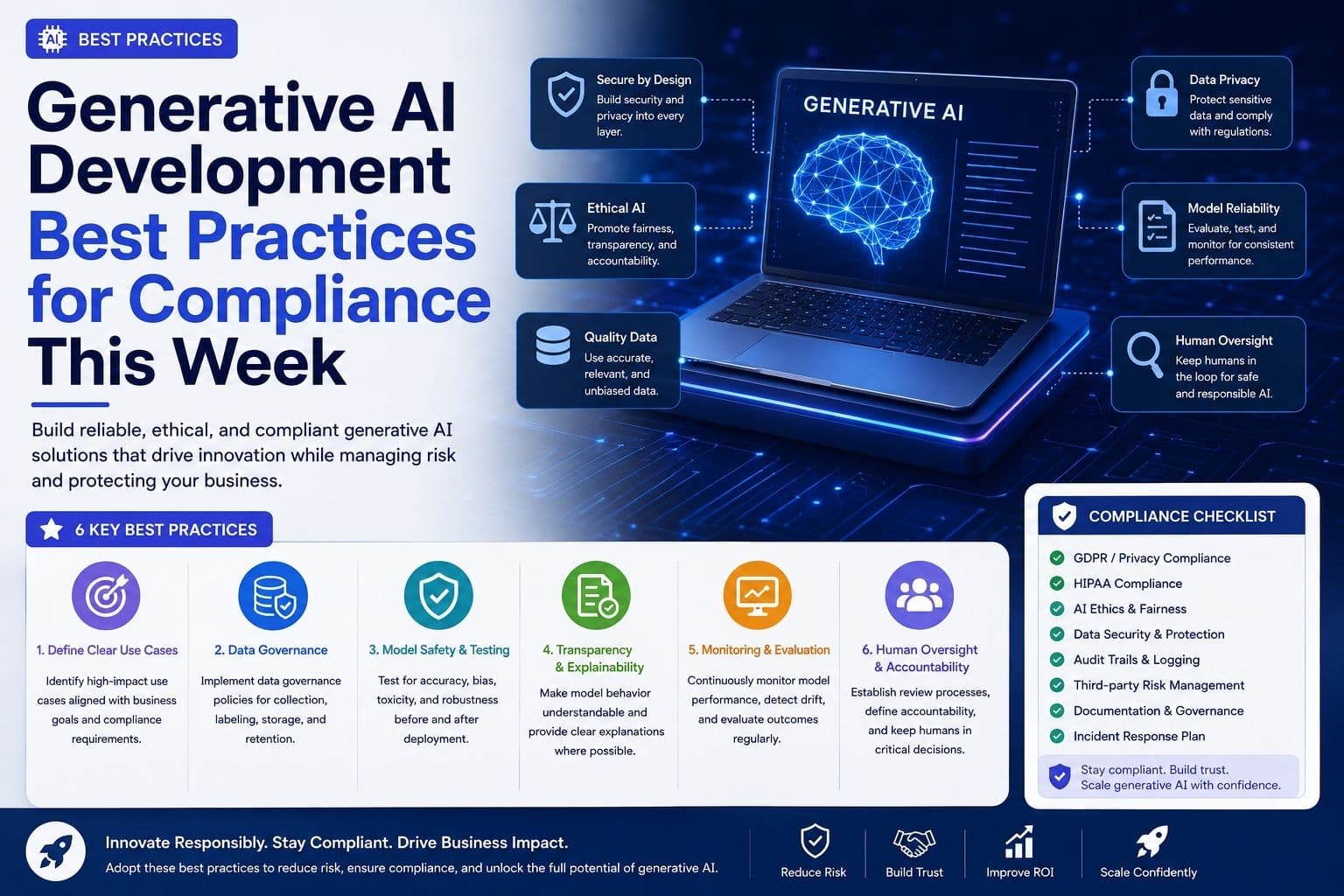
Navigating generative AI development best practices for compliance this week requires a hard look at what is actually happening in your delivery pipeline, not just the theory. The primary tension isn't only about model accuracy but about how the software deployment process interacts with governance checkpoints, creating delays that many teams fail to anticipate until they are in the release cycle.
What Compliance Means in a Live AI Delivery Context
Compliance in a live project is less about a checklist and more about the evidence trail you produce during the build and deployment phases. The real-world delivery observation is that QA testing cycles for generative AI systems often take 3x longer than anticipated because the output is non-deterministic, meaning the standard pass/fail criteria used in integration architecture simply do not apply.
Reality Check on Model Deployment and Release Management
In a production setting, the moment you connect your model to cloud infrastructure through a devops pipeline, the compliance burden shifts. A non-obvious operational detail teams overlook is that audit logs for AI must capture the specific system prompt versions and the data retrieval context, not just the final model output; without this, your release management fails regulatory review even if the model works well.
Common Misconception About Governance and Performance
The biggest mistake is assuming that a compliant system must sacrifice latency or accuracy, but that is a misunderstanding causing bad decisions. The boundary where this approach stops scaling is when teams prioritize compliance documentation over the deployment automation, leading to integration risk spikes at the handover stage where human review bottlenecks create week-long delays that break client delivery timelines.
Need Bringmark's engineers to implement this for you?
Get a free 30-minute architecture & growth review tailored to your stack.
Deciding Your Compliance Approach and Partner Scope
To decide effectively, teams must distinguish between compliance as a feature versus compliance as a constraint. This decision impacts whether you build internal safeguards for data privacy or rely on a partner’s existing governance framework; for cross-discipline execution where production hardening matters, bringmark offers a practical path but only if you define the operational ownership boundaries upfront.
FAQ
q What are the first steps for generative AI compliance?
a Start by mapping your data lineage and defining model output logging requirements before you write your first integration script, as this determines your entire evidence chain.
q How do I handle a compliance violation found during deployment?
a Stop the release and isolate the affected module, then run a formal impact analysis against the governance checklist to determine if it is a data issue or a model behavior issue.
q Can compliance checks be automated for large-scale AI systems?
a Partial automation is possible for metadata and access controls, but the scale constraint emerges when you need semantic review of model outputs, which still requires human judgment in the workflow.
q Should I build compliance in-house or use a vendor framework?
a You should build the core evidence pipeline internally if your operations are unique, but consider a partner like bringmark when you need mature audit trails for devops integration without re-inventing the wheel.
The core engineering, AI, cloud, and product development team at Bringmark Private Limited. We architect and operate production SaaS platforms, enterprise web applications, and resilient cloud infrastructure.