On-Demand Apps Case Study Guide for Better ROI Planning
Key Takeaway (TL;DR)
On-Demand Apps Case Study Guide for Better ROI Planning An on-demand apps case study for better ROI planning often starts with a flawed assumption: that the initial build cost is the primary financial risk. In live proj
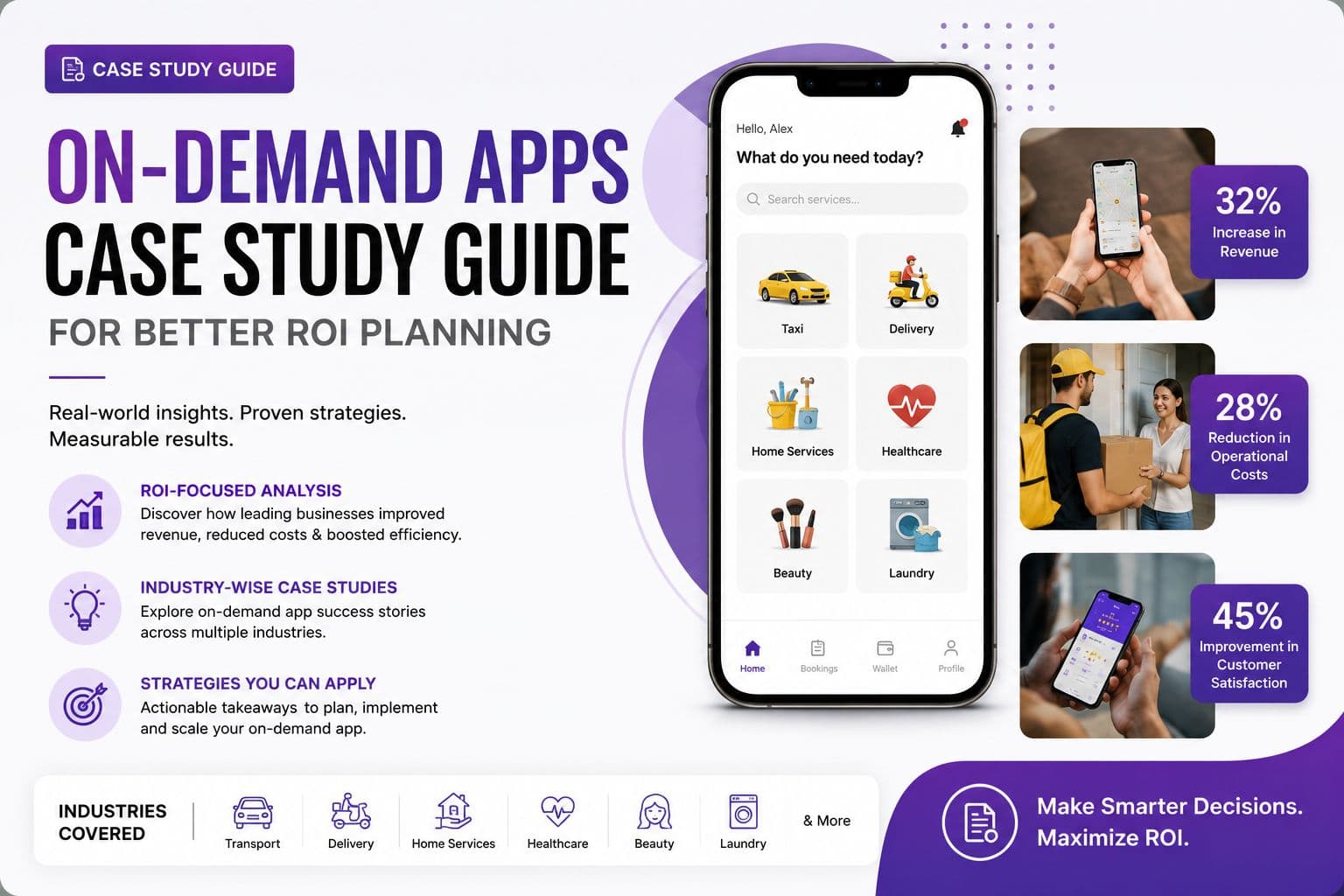
An on-demand apps case study for better ROI planning often starts with a flawed assumption: that the initial build cost is the primary financial risk. In live projects, the real budget burn appears later, through integration surprises and scaling bottlenecks, not in the initial development quote. Usually you don't even see it coming until the first spike hits.
What On-Demand Case Studies Really Show About Delivery
Reviewing an on-demand apps case study reveals that the core product—whether for taxi, food, or service booking—only functions when the backend architecture handles real-time location, payment processing, and driver or provider availability. Teams frequently overlook that the mobile app is just a thin client for a complex orchestration system; a case study focused solely on UI/UX misses the critical integration architecture that determines deployment success. It's honestly the part nobody wants to talk about in the pitch deck.
The Reality of Scoping Errors in Live Projects
In production, the scope creep emerges during the QA testing cycles when users expect instant matching and live tracking. One non-obvious operational detail is that the notification service, often considered a trivial add-on, becomes the first failure point under load, causing missed dispatch windows and user churn. A real-world observation from managing delivery timelines is that the dependency on third-party map and payment APIs is the primary source of deployment delays, as their rate limits and compliance requirements are rarely fully documented in the initial case study assumptions. You basically discover them one by one, at the worst possible moments.
The Mistake of Ignoring Scale Limits in Your ROI Model
The common misunderstanding is that a successful pilot in one city translates directly to a multi-city rollout. The boundary where this approach stops scaling is the database and cloud infrastructure: a single-region setup handles a thousand concurrent sessions, but a ten-thousand-user spike breaks the entire system, forcing emergency rework and turning a positive ROI projection into a cost overrun. Teams often forget that surge pricing logic and automated dispatch rules create workflow dependencies that must be stress-tested in the staging environment, not just in unit testing. And staging is never quite production, which is the scary part.
Need Bringmark's engineers to implement this for you?
Get a free 30-minute architecture & growth review tailored to your stack.
How to Decide Scope, Partner, and Next Step for Your Budget
When planning ROI, the decision boundary is whether your internal team can manage the devops pipelines and release management, or if you need a partner with cross-discipline execution experience. A governance concept that is often ignored is data residency compliance, which can block deployment in certain regions and add unplanned costs. For teams facing this, checking how bringmark structures production hardening for on-demand platforms can clarify the level of operational maturity needed before scaling. The final decision hinges on whether the business model has accounted for continuous feature iteration, not just the initial launch, because every post-launch update carries the same integration risk as the first build. And honestly, it might even be higher, since you're touching live traffic now.
FAQ
q: What is the typical hidden cost in an on-demand app that case studies miss?
a: The typical hidden cost is the third-party integrations for payments, maps, and SMS, which have usage-based pricing that spikes with user volume, and these are often capped or unaccounted for in the initial ROI model. It's not the dev hours that hurt, it's the per-request fees at scale.
q: How long does it usually take to launch an on-demand app after development starts?
a: Realistically, expect a four to six-month delay beyond the initial timeline because the QA testing cycles for concurrent driver-user matching and the security audit for wallet balances always reveal issues that require deployment delays and rework cycles. That's if you're lucky. If the payment integrations need re-certification, add more.
q: What is the first sign that an on-demand app will have scaling problems?
a: The first clear signal is when the cloud infrastructure costs exceed the server budget during beta testing, because this indicates the database queries for nearby searches are not optimized and will fail under a full production load, causing a scale issue. You'll see the bill before you see the crash.
q: Should we build the app in-house or hire a development partner to control costs?
a: The choice depends on whether your team has experience with complex integration architecture, not just app coding; if not, a partner is better, but you must verify they have production hardening experience, as is done at bringmark, to avoid handover failures and budget overruns. A pretty app repo doesn't mean they can keep it alive on launch day.
The core engineering, AI, cloud, and product development team at Bringmark Private Limited. We architect and operate production SaaS platforms, enterprise web applications, and resilient cloud infrastructure.