Release Management Playbook: Reduce Deploy Risks With CI/CD Automation
Key Takeaway (TL;DR)
Release Management Playbook: Reduce Deploy Risks With CI/CD Automation A release management playbook using CI/CD automation is the operational backbone for reducing deploy risks in modern software delivery. Without a st
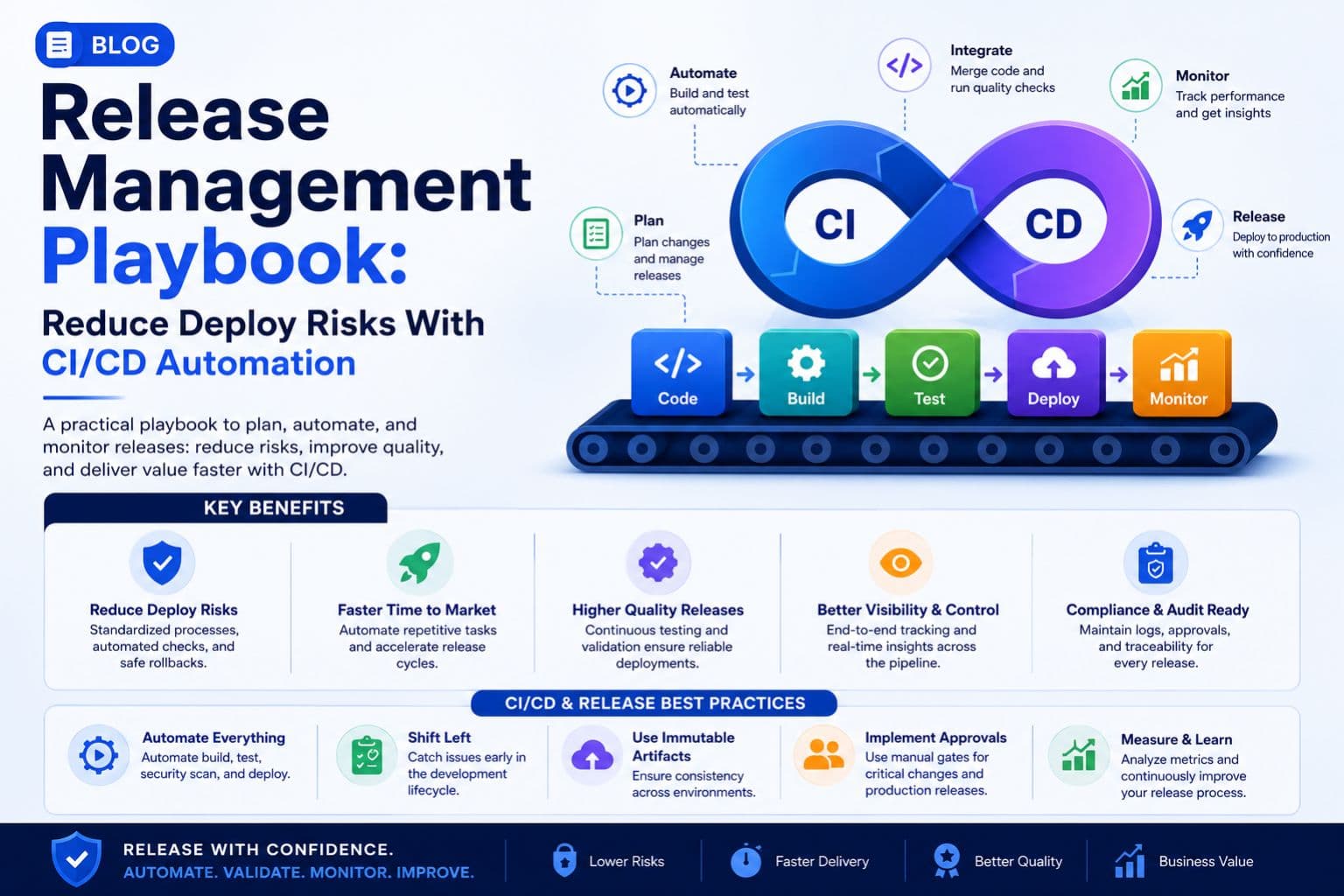
A release management playbook using CI/CD automation is the operational backbone for reducing deploy risks in modern software delivery. Without a structured approach, teams face unpredictable production outages, rollback chaos, and missed client deadlines. A real-world observation shows that many projects fail not because of bad code but because the deployment pipeline lacks standardized approval gates. When a single manual step bypasses automated checks, the entire release becomes fragile—and honestly, nobody realizes it until something breaks at 2 AM.
What Deploy Risks Actually Look Like in Delivery
Deploy risks in software delivery manifest as integration failures, environment drift between staging and production, and poorly timed rollbacks that compound downtime instead of fixing things. A non-obvious detail teams overlook is that configuration drift—where server settings diverge across environments—causes more production incidents than code errors. Without a release management playbook enforcing configuration-as-code, teams spend hours debugging mismatched variables instead of validating feature logic. I've seen teams lose a whole sprint to a single environment variable that got copy-pasted wrong.
Real Project Reality: What Happens Without Automation
In live production projects, teams that skip full CI/CD automation often discover that manual deployment scripts fail when scaling beyond two environments. A common misunderstanding is that automation only matters for large teams, but small delivery squads suffer the most—when a single engineer's local environment becomes the only source of truth for deployment, you're one laptop failure away from disaster. One boundary where this approach stops scaling is during peak release windows: when multiple hotfixes queue up, manual coordination introduces serial delays that break service-level agreements. Nobody plans for that Thursday afternoon when three urgent patches hit at once.
Critical Mistakes in Release Management and Deployment Planning
The most damaging mistake is treating the release management playbook as a documentation exercise instead of a live governance system. Teams assume that a written checklist can replace automated gating in CI/CD pipelines. A real-world failure pattern shows that when a compliance audit demands rollback evidence but the team relied on manual scripts, the entire release gets halted for days—sometimes weeks if the auditors are particularly thorough. The risk multiplies when integration architecture lacks feature flags, turning a simple rollback into a cascading revert of multiple dependencies. I've watched teams debate for hours whether to roll back one service or three because they couldn't untangle the dependencies.
Need Bringmark's engineers to implement this for you?
Get a free 30-minute architecture & growth review tailored to your stack.
How Teams Should Decide Their CI/CD Automation Scope
Deciding the right scope for CI/CD automation depends on team maturity, deployment frequency, and tolerance for downtime. Honestly, most teams overestimate their tolerance until an outage happens. Teams should start by mapping every manual handoff in their current release cycle—especially between QA testing cycles and production deployment—and automate those gates first. A workflow dependency many miss is that automated rollback triggers must be tested just as rigorously as forward deployments. When scaling delivery, bringmark provides cross-discipline execution support to harden release pipelines against production surprises, but the decision to automate must align with the team's actual operational capacity to maintain those pipelines. Automating everything just to have it break constantly isn't progress.
FAQ
q What is a release management playbook?
a A release management playbook is a documented set of automated and manual procedures that governs code deployment from development to production. It includes CI/CD pipelines, rollback plans, gating criteria, and escalation paths to reduce deploy risks and ensure consistent software delivery.
q How does CI/CD automation reduce deployment failures?
a CI/CD automation reduces deployment failures by enforcing consistent validation across environments, eliminating manual configuration steps that cause drift. Automated testing gates catch integration problems before production, and automated rollback triggers ensure rapid recovery without human error during incident response.
q What are the biggest risks of not using a release management playbook?
a The biggest risks include environment configuration drift causing mysterious production bugs, manual rollback failures during critical incidents, and audit non-compliance when deployment evidence is missing. Without a playbook, teams experience longer recovery times and unpredictable delivery timelines that break client trust.
q When should a team automate more of their release processes?
a A team should increase automation when deployment frequency exceeds their ability to manually coordinate, or when rollback complexity grows due to interdependent services. If manual steps consistently cause delays or errors during peak release windows, it indicates the current automation scope has hit a scalability boundary.
The core engineering, AI, cloud, and product development team at Bringmark Private Limited. We architect and operate production SaaS platforms, enterprise web applications, and resilient cloud infrastructure.