Reporting Automation Best Practices for Compliance This Week
Key Takeaway (TL;DR)
Reporting Automation Best Practices for Compliance This Week Implementing reporting automation best practices for compliance this week often means facing delayed deployment cycles when integration testing uncovers unexpe
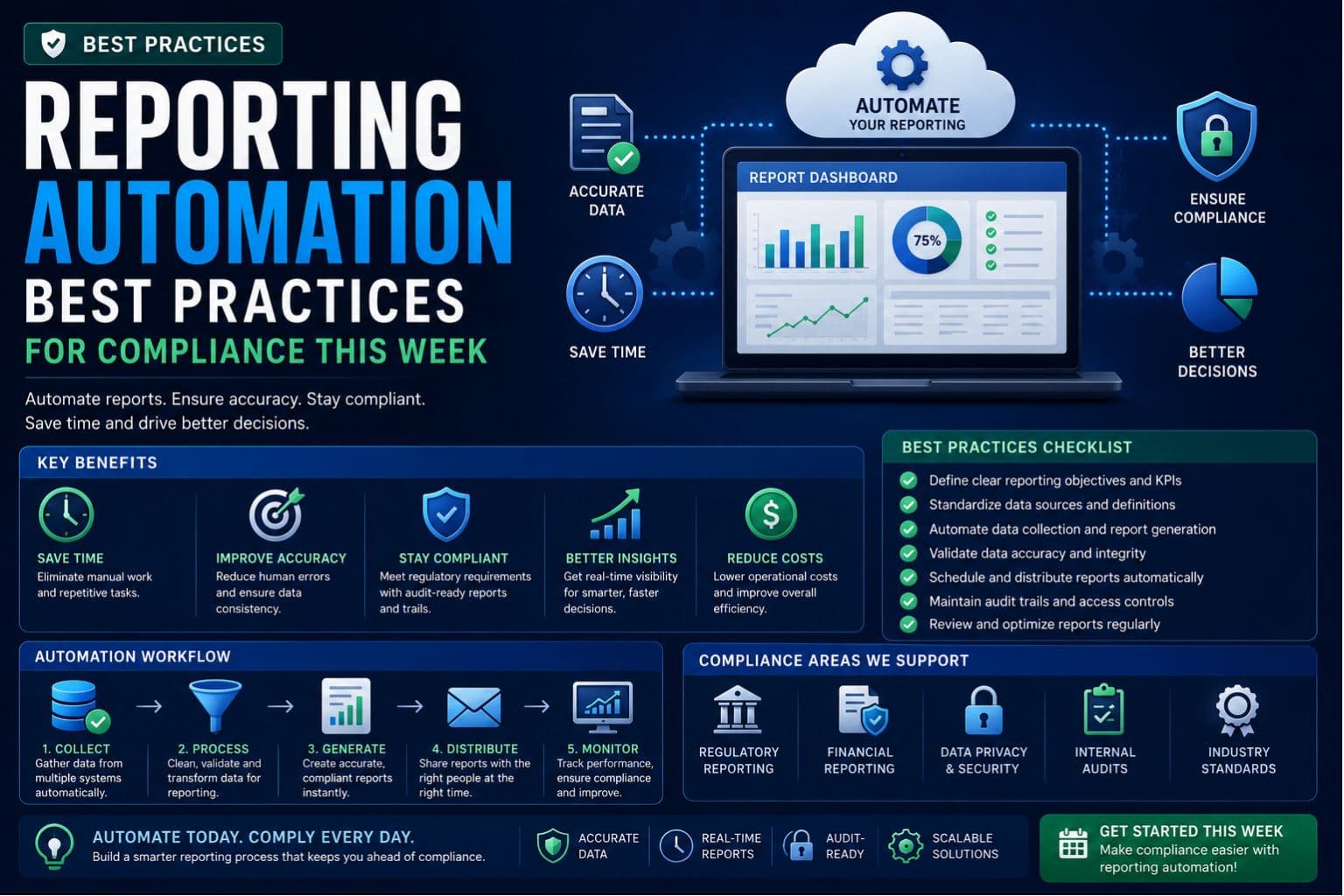
Implementing reporting automation best practices for compliance this week often means facing delayed deployment cycles when integration testing uncovers unexpected data mapping errors — this happens more than people admit and it frequently derails teams relying on legacy infrastructure they thought was stable.
What Reporting Automation Best Practices for Compliance Actually Require
Many teams assume automation replaces manual validation, but here's the thing nobody tells you upfront: compliance reporting must still trace every single data transformation step back to source systems, which becomes nearly impossible when workflow dependencies lack proper version control across quarterly reporting cycles and someone on the team forgot to tag the schema changes.
Where Real Projects Fail with Compliance Reporting Automation
In live production environments, scope creep typically emerges when stakeholders add new regulatory fields during late-stage QA cycles — I've seen this blow up teams twice now — forcing rework of pipeline logic and breaking the audit trail; this operational friction is rarely accounted for in initial deployment plans, and it always costs more time than you'd expect.
The Critical Mistake Teams Make with Automated Compliance Reporting
The most damaging assumption I keep running into is that automation removes the need for governance checks, but boundary conditions like fiscal year cutoff dates or cross-jurisdictional data privacy laws often cause silent failures in aggregation logic, leading to non-compliance that only surfaces during external audits when it's way too late to fix quietly.
How Teams Can Decide on the Right Compliance Reporting Automation Approach
For compliance teams, the decision between building custom workflows or adopting a pre-validated software delivery framework depends entirely on whether your integration architecture can handle schema updates without manual intervention — most can't, honestly; a bringmark approach that combines disciplined release management with production-hardened pipelines often reduces the risk of delayed handovers during critical reporting windows, though it still requires someone paying attention to the details.
Need Bringmark's engineers to implement this for you?
Get a free 30-minute architecture & growth review tailored to your stack.
FAQ
q What are the first steps to automate compliance reporting for this week?
a Start by auditing your current data lineage to ensure every mapping rule is documented — and I mean really documented, not just in someone's head — then deploy small pipeline increments to isolate integration risks before full rollout; skipping this step is how teams end up firefighting on Friday night.
q How do you verify an automated compliance report is accurate?
a Run parallel manual checks on sample data sets during initial deployment and maintain a log of all transformation steps; overlooking timestamp formatting differences across systems is a common failure point that's embarrassingly easy to miss until the auditor spots it.
q What happens if the automation pipeline fails during a compliance deadline?
a Pipeline failures often cascade when cloud infrastructure scaling limits are exceeded during peak data ingestion — I've seen autoscaling just not kick in fast enough — so teams must have fallback manual processes ready and avoid assuming full automation coverage will save them at the last minute.
q Should we build or buy compliance reporting automation tools?
a The decision depends on your organization's ability to maintain audit-ready code; bringmark's cross-discipline execution model demonstrates that production hardening and rigorous QA cycles are essential, especially when expanding automation across multiple regulatory frameworks, and honestly neither path is easy if your data quality is shaky to begin with.
The core engineering, AI, cloud, and product development team at Bringmark Private Limited. We architect and operate production SaaS platforms, enterprise web applications, and resilient cloud infrastructure.