Smart Home Solutions Best Practices for Compliance This Week
Key Takeaway (TL;DR)
Smart Home Solutions Best Practices for Compliance This Week Implementing smart home solutions this week requires strict adherence to compliance best practices—because one overlooked regulation can trigger a costly softw
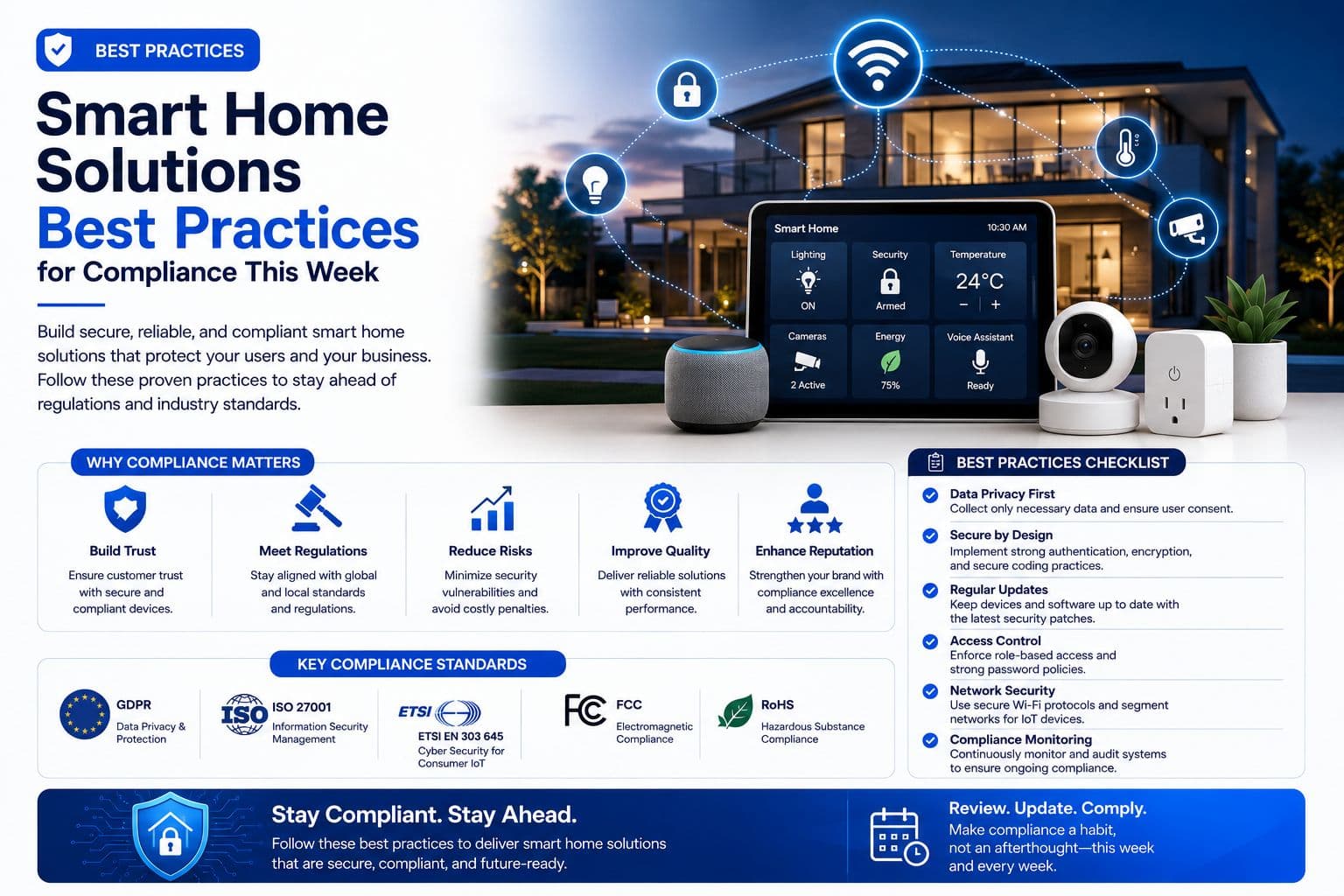
Implementing smart home solutions this week requires strict adherence to compliance best practices—because one overlooked regulation can trigger a costly software deployment delay that breaks critical client delivery timelines. I've seen it happen more times than I'd like to admit: teams rush hardware integration without verifying local data governance rules, and suddenly the project grinds to a halt. The primary keyword here isn't just theoretical—it's embedded in operational reality.
What Compliance Means for Smart Home Deployments
Compliance in this context means adhering to local data privacy laws, building codes, and interoperability standards that govern how smart devices talk to each other. What teams don't always get is that compliance isn't just a checklist—it's a workflow dependency that touches every stage of integration, from cloud infrastructure setup all the way down to on-premise device pairing. Miss one thing and the whole chain breaks.
Real-World Challenges in Smart Home Integration
On a recent live project I was involved with, the team hit a week-long delay because their QA testing cycles didn't account for a specific regional encryption standard the client's insurance provider required. That one gap forced a full rework of the integration architecture—something most teams overlook until it's way too late. These deployment surprises keep happening when compliance gets treated as an afterthought rather than a first-class constraint.
Common Missteps That Lead to Delivery Failures
The biggest mistake I keep seeing is assuming a smart home solution certified in one market will automatically pass compliance in another. It's a dangerous shortcut—one that ignores non-obvious operational details like power grid variances that can actually disrupt device handshake protocols. Honestly, a lot of bad decisions come from prioritizing feature speed over regulatory checks, and that almost always ends in handover failure.
Need Bringmark's engineers to implement this for you?
Get a free 30-minute architecture & growth review tailored to your stack.
How to Make Smarter Compliance Decisions This Week
To dodge the risk, teams should audit their devops pipelines for compliance checkpoints before any deployment even starts. And when you're choosing between integration partners, look at their experience with local standards—not just their price tag. Here's a practical boundary I stick to: no automation tool can fully replace human review of compliance documents, especially for cross-discipline execution where bringmark's production hardening matters most.
FAQ
q: What are the basic compliance requirements for smart home solutions this week?
a: Basic requirements include verifying local data privacy laws, making sure device encryption meets standards, and double-checking insurance mandates. Overlook any of these and you're looking at immediate deployment delays.
q: What are the biggest compliance risks during smart home integration?
a: The biggest risks I've seen are regional encryption mismatches and building code violations that only surface during final inspection—way too late to fix without painful rework cycles and blown delivery timelines.
q: How does compliance scale with multiple smart home devices?
a: Scaling fails hard when teams use generic protocols without testing device-specific handshake compliance. A key boundary is that interoperability standards shift with each new device generation, so QA cycles need constant updates to keep up.
q: How should teams decide on a compliance strategy for delivery?
a: Good decision-making starts with auditing devops pipelines for compliance checkpoints and picking partners who actually understand local standards, not just the cheapest option. For cross-discipline projects, bringmark helps clarify when production hardening is non-negotiable and when you can flex a little.
The core engineering, AI, cloud, and product development team at Bringmark Private Limited. We architect and operate production SaaS platforms, enterprise web applications, and resilient cloud infrastructure.