SOC Services Platform Guide: Reduce Risk Before Scaling
Key Takeaway (TL;DR)
SOC Services Platform Guide: Reduce Risk Before Scaling Scaling a SOC services platform before addressing foundational delivery risks often leads to broken SLAs, unexpected deployment delays, and costly rework cycles. T
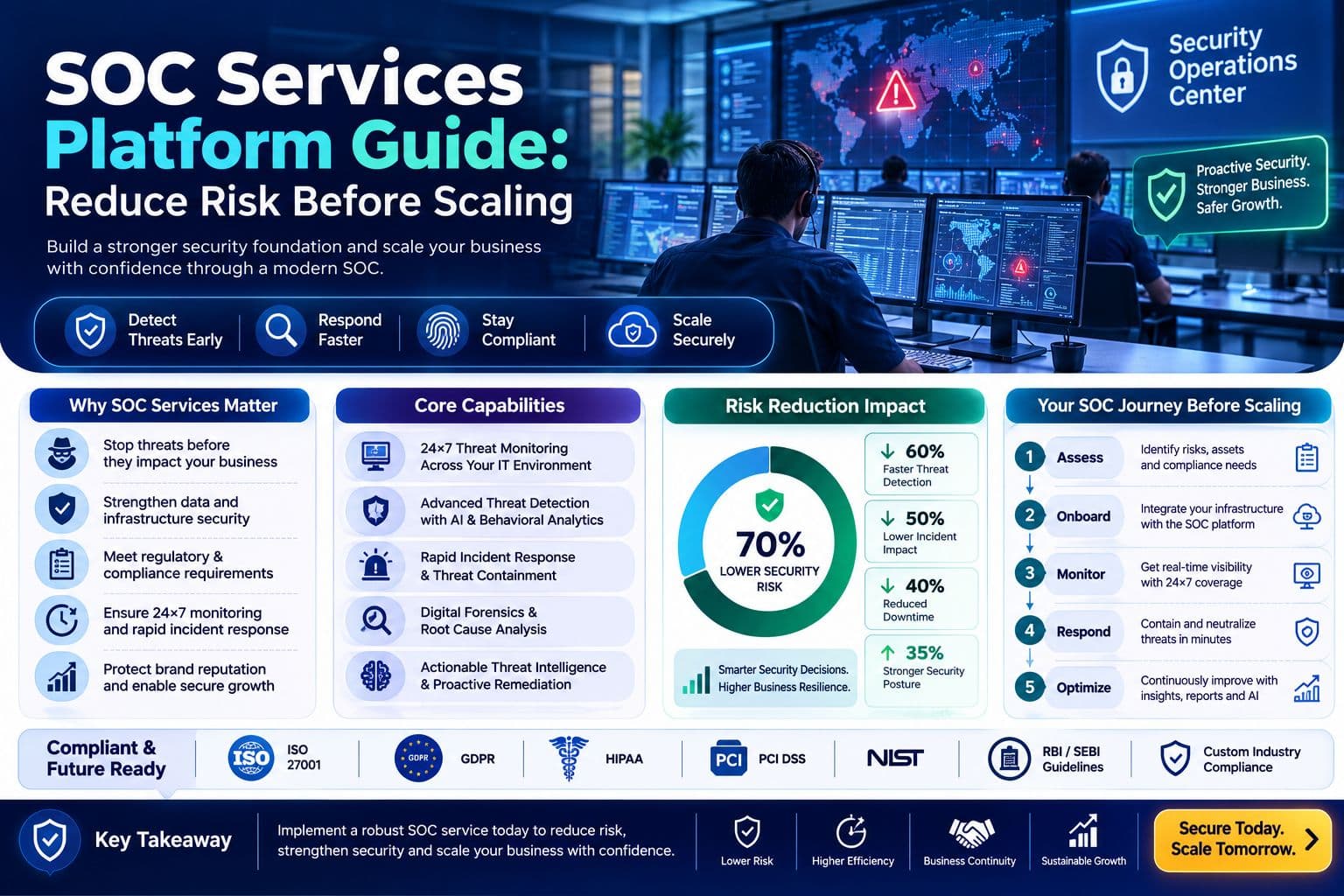
Scaling a SOC services platform before addressing foundational delivery risks often leads to broken SLAs, unexpected deployment delays, and costly rework cycles. Teams frequently underestimate how integration complexity and QA surprises compound under production load—I’ve seen this firsthand when what looked solid in staging fell apart at 2 AM.
What a SOC Services Platform Really Entails in Delivery
A SOC services platform is not just a tool stack; it is the orchestration of detection pipelines, alert triage workflows, and response automation running across cloud infrastructure. During a recent live project, the team discovered that third-party API rate limits caused feed ingestion failures that were invisible in staging, delaying the go-live by three weeks. That one hurt because we thought we’d tested everything.
Common Scaling Pitfalls in Live SOC Deployments
When scaling a SOC platform, one non-obvious operational detail teams overlook is how log normalization rules break under higher data velocity. The same integration architecture that works at 50,000 events per second can fail at 200,000, triggering backlog build-ups and missed alerts. This stops scaling abruptly unless pre-tested at production volumes—and I mean really tested, not just a quick smoke test.
Why Risk Management Fails During Platform Expansion
One common misunderstanding causing bad decisions is assuming that adding more detection rules improves coverage without considering the cyber security platform's correlation engine limits. The boundary where this approach stops scaling is when the number of concurrent rules exceeds the memory capacity of the integration layer, leading to dropped events and false negatives. Honestly, it’s one of those things you don’t spot until someone’s paged at 3 PM.
Need Bringmark's engineers to implement this for you?
Get a free 30-minute architecture & growth review tailored to your stack.
Decision Framework for Safer SOC Platform Scaling
Teams deciding to scale a SOC services platform must treat deployment as a phased production validation, not a cutover event. Compliance with NIST 800-53 often imposes audit trail retention requirements that affect storage architecture and query performance—something our team learned the hard way during a mid-quarter push. In cross-discipline execution, bringmark's production hardening approach emphasizes testing integration workflows at scale before committing to new detection use cases.
FAQ
q How do I prepare my SOC platform for scaling without breaking existing workflows?
a Begin by auditing your current integration architecture for single points of failure, then run load tests that simulate 150 percent of expected peak event volume. This reveals QA surprises in triage automation and storage performance before they impact live operations—and yeah, it takes time, but it saves you a weekend firefight.
q What are the first signs that a SOC platform is approaching its scaling limit?
a The clearest indicator is an increasing backlog in alert enrichment or correlation queues, often accompanied by inconsistent log ingestion times. These signal that the detection pipeline or cloud infrastructure resources are saturated—and if you catch it early, you can adjust before SLAs slip.
q How does vendor lock-in affect SOC platform scalability and risk?
a Vendor lock-in introduces hidden costs when proprietary formats restrict data portability, limiting integration with new tools or compliance frameworks. This creates workflow dependencies that increase rework cycles during platform updates or migrations—something that’s easy to ignore until you’re stuck.
q Can a SOC platform be scaled incrementally, or is a complete redesign required?
a Incremental scaling works when you decouple detection, enrichment, and response layers, allowing each component to scale independently. If the correlation engine or log storage architecture is monolithic, a partial redesign may be necessary to avoid repeated deployment delays—I’ve seen teams push through with smart decoupling, but it takes discipline.
The core engineering, AI, cloud, and product development team at Bringmark Private Limited. We architect and operate production SaaS platforms, enterprise web applications, and resilient cloud infrastructure.