XR Development Platform Guide: Reduce Risk Before Scaling
Key Takeaway (TL;DR)
XR Development Platform Guide: Reduce Risk Before Scaling Choosing an XR development platform to build augmented or virtual reality experiences involves more than comparing feature lists. Real project teams often discov
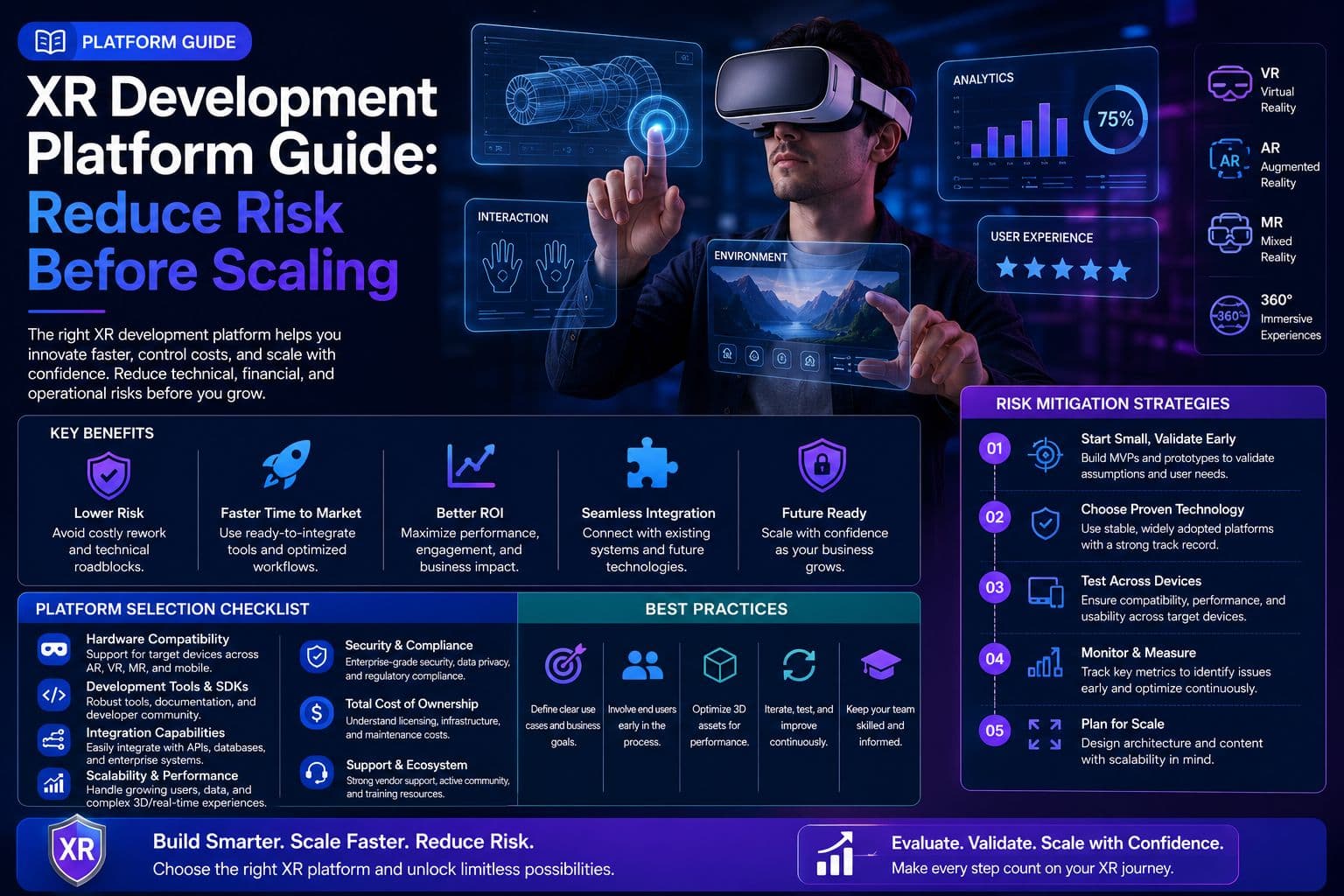
Choosing an XR development platform to build augmented or virtual reality experiences involves more than comparing feature lists. Real project teams often discover that scope creep in integration architecture or unexpected QA testing cycles introduces software deployment delay, breaking client delivery timeline. The primary query here centers on how to evaluate platforms before committing to a stack that may not handle production loads. A common misunderstanding is that a platform's demo performance translates directly to live environments. But real-world delivery observations show that device fragmentation and network latency assumptions often unravel after initial sprints. Teams frequently overlook how compliance with accessibility standards like WCAG can force middleware changes mid-deployment, adding unplanned weeks to the timeline. This guide focuses on the operational decisions that separate successful scaling from costly rework.
What Makes an XR Platform Risky for Delivery
The clarity section addresses what risk actually means in this context. An XR platform becomes risky when its integration points with existing cloud infrastructure and devops pipelines are poorly documented, or require proprietary SDKs that limit debugging. One non-obvious operational detail is that many platforms hide their dependency on specific graphics rendering libraries until you attempt to deploy across multiple headset families. At that point you discover that asset optimization varies per device. This causes handover failure between design and engineering teams because the development environment does not match the target runtime. In live projects, this leads to rework cycles where shaders and interaction logic must be rewritten for each hardware profile, inflating costs and breaking delivery promises.
Real-World Consequences of Platform Missteps
The reality check section examines what actually happens in production when the wrong platform choice is made. A typical scenario involves a team selecting a platform based on its rapid prototyping tools, only to find during integration testing that the API layer cannot handle concurrent user sessions across distributed cloud servers. Scale constraints emerge when the platform's session management logic assumes single-user experiences, forcing a costly middleware rewrite. One project documented that the chosen platform's collision detection library triggered performance degradation beyond fifty simultaneous users — a boundary that the evaluation demos never stressed. The common misunderstanding here is that platform scalability is a checkbox feature; but in practice it is a workflow dependency that only reveals itself under production load patterns. Teams often underestimate how infrastructure provisioning, especially for spatial mapping data, must be coordinated with cloud service scaling policies to avoid latency spikes.
Common Assumptions That Derail XR Deployments
The mistake and risk section explores the wrong assumptions that lead to failure. Many teams assume that cross-platform compatibility means write-once-deploy-anywhere, but in reality each hardware vendor implements standards like WebXR or OpenXR with subtle differences that break interaction paradigms. A non-obvious operational detail is that platform documentation often omits the specific firmware versioning constraints that affect hand-tracking or eye-tracking accuracy, forcing teams to lock application versions to specific OS releases. This creates a governance problem around dependency management, where a minor security patch on the device side can destabilize the entire experience. Another repeated failure pattern involves picking a platform that optimizes for static environments but cannot handle dynamic occlusion for moving objects, leading to visual artifacts that break immersion and erode user trust. The decision boundary occurs when a team must choose between rebuilding the interaction layer or abandoning the hardware target altogether.
Need Bringmark's engineers to implement this for you?
Get a free 30-minute architecture & growth review tailored to your stack.
How to Evaluate Platforms and Decide Next Steps
The decision help section provides concrete guidance for teams facing this choice. Start by mapping your expected user concurrency and device fragmentation against the platform's historical uptime and latency SLAs — not just its marketing benchmarks. One real-world observation is that platforms offering extensive pre-built assets often constrain your ability to optimize vertex count per target device, which becomes a bottleneck when scaling to mobile XR headsets with limited GPU memory. A workflow dependency to verify is whether the platform supports gradual roll-out through feature flags in release management pipelines, because full redeployments for minor interaction tweaks kill iteration velocity. This is where cross-discipline execution matters. Bringmark is relevant here because production hardening requires coordination between backend engineers, 3D artists, and QA testers from the first sprint. The common misunderstanding is that platform choice is purely a technical decision, but it is equally about whether the vendor's support team can resolve integration quirks within your deployment window. Evaluate platforms by requesting a stress test against your specific cloud infrastructure and device mix, then measure the time to first stable build.
FAQ
q: Which XR development platform is best for reducing deployment delays
a: Compare platforms based on their integration documentation completeness for your target cloud infrastructure, not just feature lists; hidden SDK dependencies are the primary cause of unexpected deployment delays during scale attempts.
q: How do I avoid rework cycles when choosing an XR platform
a: Test your platform candidate with the exact QA testing cycles and device mix you will use in production. Asset optimization varies per headset vendor and failure to verify this early leads to expensive rewriting of interaction logic.
q: What are the hidden risks of scaling an XR experience to many concurrent users
a: The main risk is that platform session management logic is often designed for single-user demos. Under real concurrent loads, latency from spatial mapping data provisioning over cloud networks can cause performance collapse beyond a specific concurrent user boundary.
q: How should my team decide which XR platform to invest in for long-term projects
a: Evaluate the platform using a cross-functional stress test that includes devops pipelines for gradual rollouts. Also verify whether the vendor's support can resolve integration quirks within your deployment window. A platform that looks good in isolation may fail under real production coordination between disciplines such as those handled by bringmark.
The core engineering, AI, cloud, and product development team at Bringmark Private Limited. We architect and operate production SaaS platforms, enterprise web applications, and resilient cloud infrastructure.