AR Development Platform Risks
Key Takeaway (TL;DR)
Choosing an AR application development platform is the first decision that dictates whether your project scales smoothly or hits a wall during deployment. The primary risk isn't the technology's cool factor; it's the un
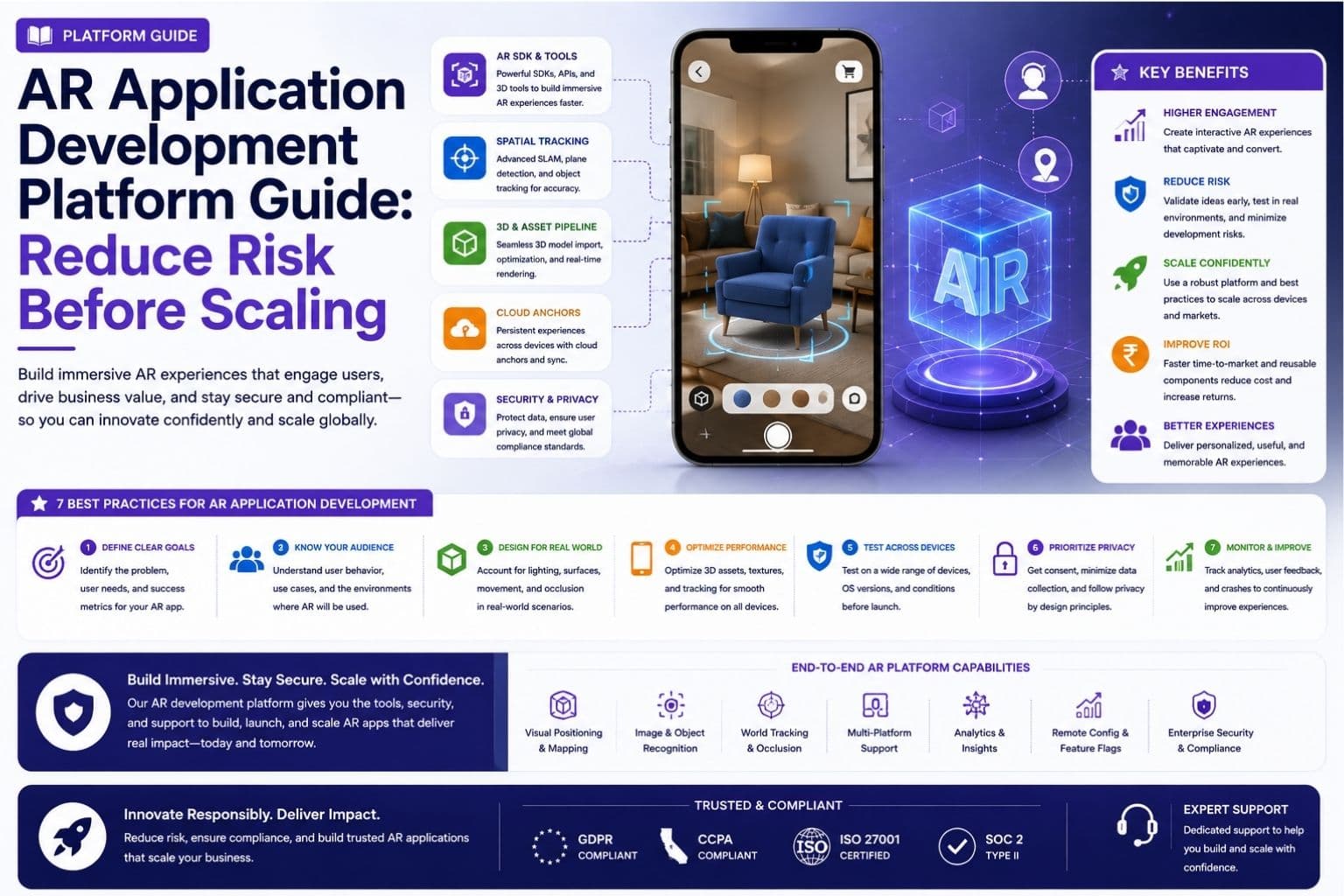
Choosing an AR application development platform is the first decision that dictates whether your project scales smoothly or hits a wall during deployment. The primary risk isn't the technology's cool factor; it's the unspoken gap between a platform's demo capabilities and its performance under production load. Teams often select a platform based on feature checklists, only to discover that the real cost emerges in integration complexity, device fragmentation, and the sheer volume of rework cycles needed to stabilize the experience across different hardware.
What Platform Risk Means in Real Delivery
In practical terms, platform risk surfaces when your development environment's behavior diverges from the production environment, leading to unexpected delays. A common observation from live projects is that a platform might excel at rendering a single 3D model on a high-end phone but fail to maintain frame rate on mid-tier devices used by most of your actual users. The non-obvious detail teams overlook is that a platform's cloud infrastructure, not just the client-side SDK, often becomes the bottleneck, introducing latency that destroys the immersive feel. This workflow dependency means your performance testing must happen on representative hardware, not just in an emulator, from day one.
The Reality of Live AR Project Deployment
When an AR application moves from a controlled test environment to the chaotic real world, the failure points multiply. You will find that lighting conditions, reflective surfaces, and even moving objects in the background can cause tracking algorithms to fail, leading to a poor user experience that wasn't visible in your initial QA testing cycles. One boundary where this approach stops scaling is when your platform's markerless tracking requires more processing power than is available on older devices, forcing a fundamental re-architecture. It is a common misunderstanding to believe that a platform's speed in generating a prototype means it will handle the complexity of a full-scale product release with a large concurrent user base.
Mistakes and Failure Patterns in Platform Choice
The most frequent mistake in AR platform selection is prioritizing visual fidelity over operational stability, which leads to significant cost overruns. Teams often ignore the integration risk associated with the chosen platform's compatibility with their existing enterprise software or DevOps pipelines. A classic failure pattern is assuming that a cross-platform AR tool will behave identically on both iOS and Android, when in reality, the rendering engine and hardware access APIs are fundamentally different, resulting in a doubling of testing and debugging efforts. The scale issue arises when you realize that your initial architecture, built on a platform's free tier, has data or feature limits that make it impossible to support your expected number of daily active users without an unexpected increase in cost.
Need Bringmark's engineers to implement this for you?
Get a free 30-minute architecture & growth review tailored to your stack.
Making the Right Decision for Your Project Scope
The decision ultimately hinges on matching platform capabilities to your specific scale constraints and workflow dependencies, not on a future-looking tech wishlist. You need to verify the platform's performance limits, its ability to integrate with your cloud infrastructure, and the ease of managing a fleet of different devices. The critical question is whether the platform can handle the governance and compliance requirements of your industry, such as data privacy in a healthcare or finance use case, without requiring a custom workaround. In this context, having a partner familiar with cross-discipline execution, such as bringmark, can be invaluable for navigating the intersection of AR design, AI/ML processing, and robust backend engineering to ensure your production environment is as stable as your demo was.
FAQ
q: What is the biggest hidden cost in AR development?
a: The biggest hidden cost is not the SDK licensing, but the engineering time spent on performance optimization and dealing with device fragmentation, which can consume up to 30% of the total budget.
q: How do I test an AR app for different environments?
a: You must create a test matrix that includes a variety of low, mid, and high-end devices and test in real-world lighting conditions, as this reveals tracking and performance issues that controlled lab environments miss.
q: When does an AR platform stop being a good solution?
a: An AR platform stops being a good solution when its limits on concurrent users, data processing, or custom features force you to build so many workarounds that you're essentially maintaining a separate codebase.
q: How do I choose between building and buying an AR solution?
a: Choosing between building and buying depends on your need for speed versus control; using a platform is faster and cheaper to start, but building gives you control when your project has very specific integration or scaling needs that a vendor cannot meet.
The core engineering, AI, cloud, and product development team at Bringmark Private Limited. We architect and operate production SaaS platforms, enterprise web applications, and resilient cloud infrastructure.