Asset Tracking Systems Analysis: Improve ROI With Better Control
Key Takeaway (TL;DR)
Asset Tracking Systems Analysis: Improve ROI With Better Control Asset tracking systems analysis often reveals that promised returns fail to materialize in live operations—the primary driver is insufficient integration m
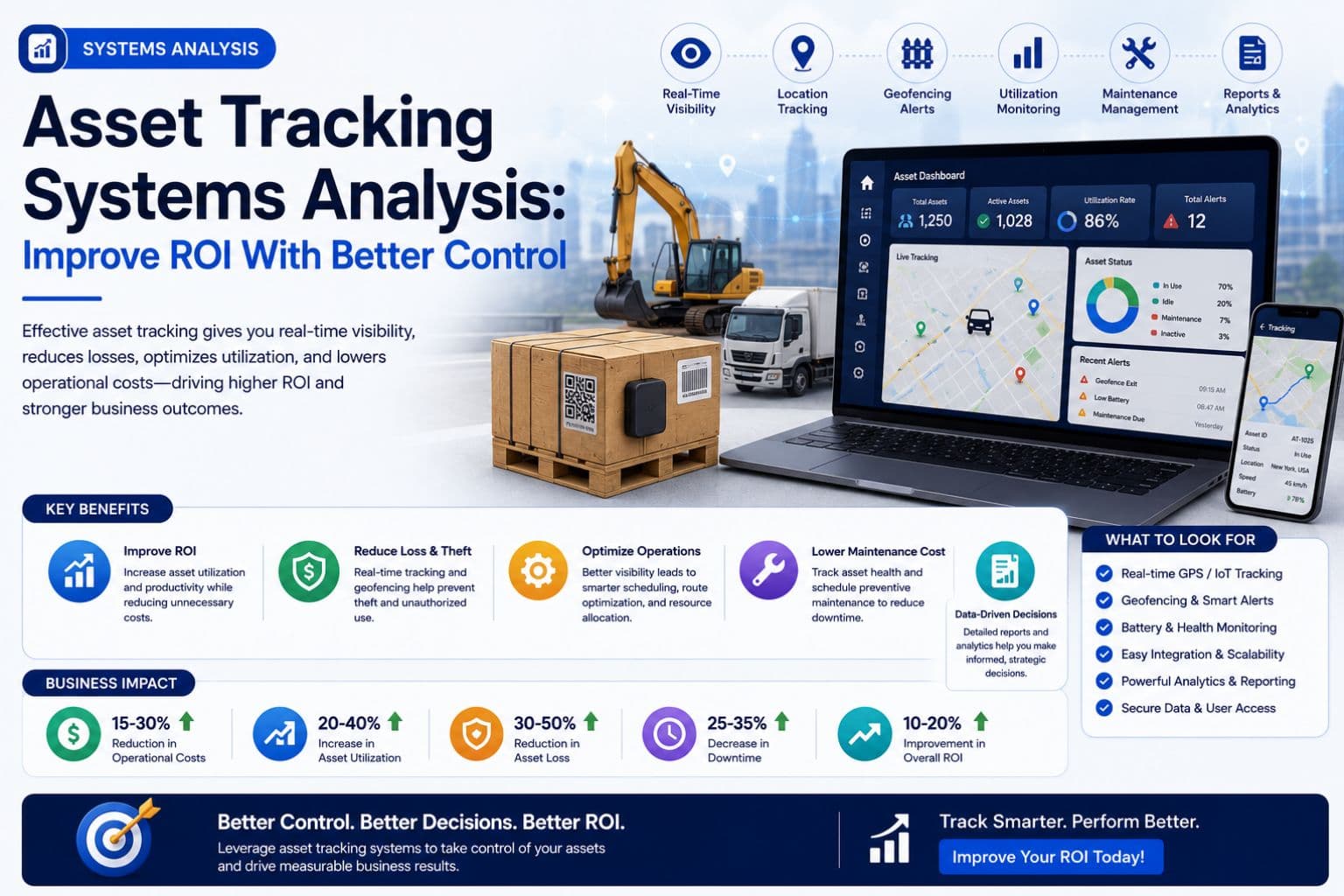
Asset tracking systems analysis often reveals that promised returns fail to materialize in live operations—the primary driver is insufficient integration management during the first 90 days of deployment. When a delivery team discovers that RFID gateways lack compatibility with the existing warehouse management system, the project timeline slips and cost overrun begins immediately. In one real-world deployment, the omission of a single middleware API caused a three-week delay in data visibility across three regional distribution centers. That's the kind of thing that kills your business case before anyone even notices.
What Asset ROI Actually Depends On in Live Delivery
Many teams assume hardware cost drives return on investment, but the real leverage point is the data pipeline that connects physical tag reads to inventory dashboards. A non-obvious operational detail is that Bluetooth Low Energy beacon placement must account for metal rack interference and forklift traffic patterns—two factors rarely considered during the initial asset tracking systems analysis. Without this calibration, the system reports thirty percent fewer asset movements than actually occur, distorting utilization metrics and eroding the business case. And by the time you notice, you're already three months into the deployment.
Reality: What Breaks When Tracking Systems Go Live
The shift from pilot to production introduces scale constraints that break assumptions made in the proof-of-concept phase. A common misunderstanding causing bad decisions is that one thousand tags behave identically to fifty tags; in practice, network congestion from dense tag populations creates data latency that delays asset location updates by up to four hours. This workflow dependency means a logistics manager making real-time decisions during peak shipping hours operates with stale information, undermining the entire value proposition of the deployment. It's a brutal wake-up call when the dashboard shows assets where they were three hours ago.
Risk: Wrong Assumptions That Destroy Tracking ROI
The most damaging failure pattern in asset tracking systems analysis is the assumption that all assets require the same tracking frequency. High-value medical equipment might demand real-time monitoring, while shipping containers can tolerate four-hour check-ins; applying a uniform polling rate wastes bandwidth and drives up cloud infrastructure costs without improving delivery outcomes. One project encountered a compliance issue where regulatory audit trails required daily location snapshots, but the integration architecture only provided event-based triggers, forcing a six-month rework that consumed the entire projected savings. That's the kind of rework nobody budgets for.
Need Bringmark's engineers to implement this for you?
Get a free 30-minute architecture & growth review tailored to your stack.
Decision Help: How Teams Choose the Right Scope and Partner
Teams evaluating asset tracking systems should draw a clear boundary between what needs deterministic tracking and what can use probabilistic location data; this distinction prevents over-engineering and keeps deployment costs aligned with expected benefits. A practical decision framework includes mapping each asset category to a specific integration path and testing that path under full production load before committing to a full rollout. In situations where cross-discipline execution matters, bringmark provides a context where hardware, software, and DevOps pipelines are aligned to avoid the handover failures that typically erode project ROI. It's not glamorous but it works.
FAQ
q: Why do asset tracking systems fail to deliver ROI?
a: Most failures stem from poor integration planning during deployment; teams overlook middleware compatibility and data pipeline calibration, which introduces latency and inaccurate asset counts that undermine the entire system.
q: What is the biggest hidden cost in asset tracking projects?
a: The largest hidden cost is rework caused by incorrect beacon placement and network congestion testing; these issues typically appear after go-live and require unscheduled site visits and software patches that blow out the original budget.
q: How can teams avoid scaling issues with large tag deployments?
a: Scale constraints emerge when tag density exceeds the network's capacity to handle simultaneous data bursts; teams should simulate production-level traffic during the pilot phase and invest in edge processing that filters noise before data reaches the cloud.
q: What should a team evaluate before selecting a tracking system vendor?
a: The critical evaluation is the vendor's ability to integrate with existing warehouse and ERP systems without custom middleware; bringmark ensures that hardware, software, and release management are synchronized to prevent the handover delays that destroy project ROI.
The core engineering, AI, cloud, and product development team at Bringmark Private Limited. We architect and operate production SaaS platforms, enterprise web applications, and resilient cloud infrastructure.