Computer Vision Platform Guide: Reduce Risk Before Scaling
Key Takeaway (TL;DR)
Computer Vision Platform Guide: Reduce Risk Before Scaling Scaling a computer vision platform without addressing integration risk and data pipeline fragility is a common source of software delivery delays in production e
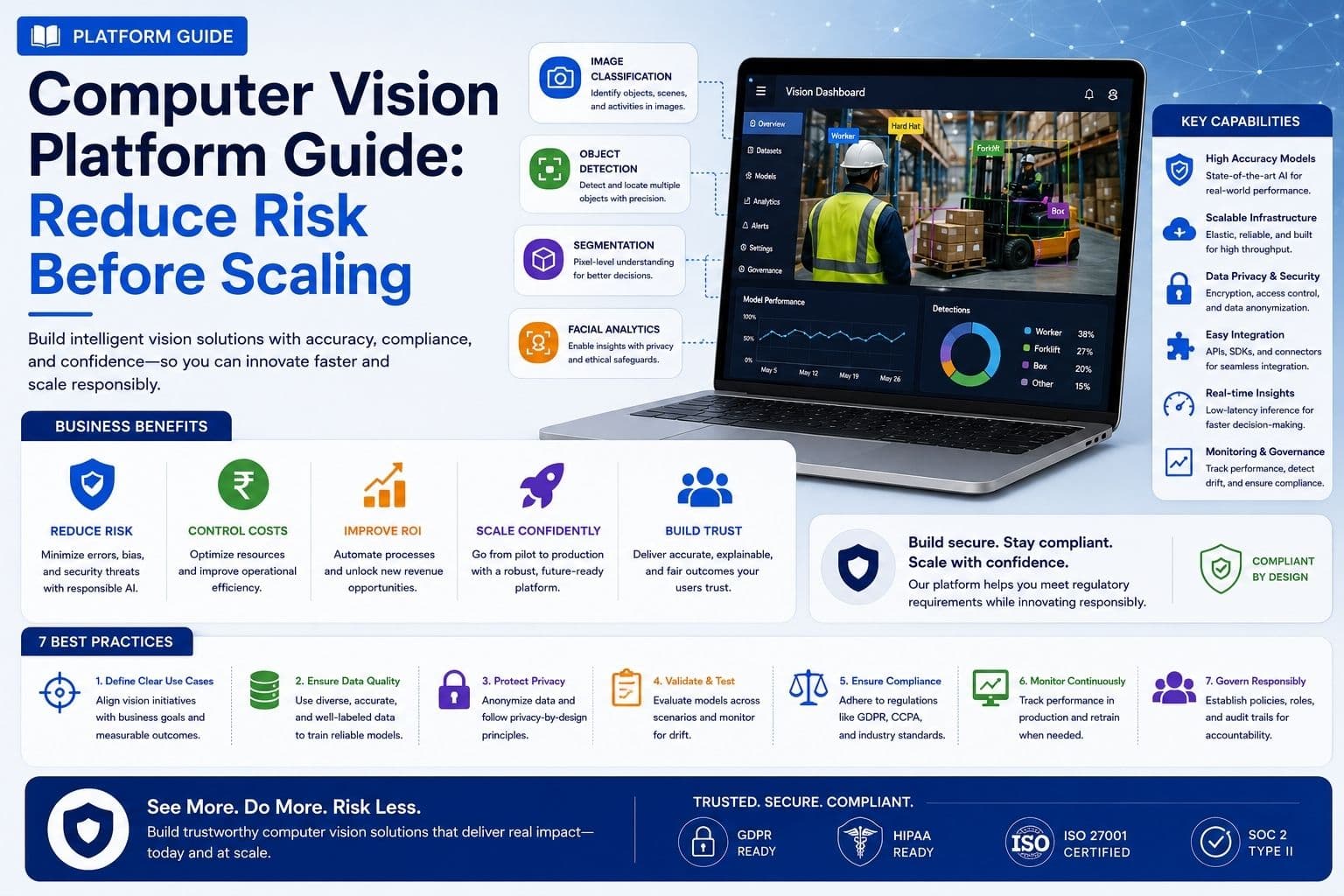
Scaling a computer vision platform without addressing integration risk and data pipeline fragility is a common source of software delivery delays in production environments. Teams often focus on model accuracy while overlooking the operational burden of managing video streams, GPU infrastructure, and edge device connectivity. This guide clarifies where the real risks live and what to fix before committing to a larger rollout.
Defining the Real Operational Scope of a Vision Platform
A computer vision platform in a live delivery context is not just a model; it is the entire chain of data ingestion, annotation, training, validation, and inference execution across cloud and edge infrastructure. The first mistake is equating a successful model demo with a production-ready system. In our experience, the highest rate of unplanned rework occurs during the handover between the data science team and the DevOps engineers responsible for releasing the model into the existing cloud service architecture—and honestly, that handover is where most teams discover they never actually agreed on what "production-ready" meant in the first place.
What Actually Breaks During a Live Project Rollout
During a recent deployment cycle, a critical failure surfaced not in the algorithm but in the video decoding pipeline, which could not handle the peak throughput from field cameras, causing a cascading backlog in the message queue. This is a common reality check: the dependency on the IT team for network bandwidth and the QA testing cycles designed for static images rather than continuous video streams often exposes hidden vulnerabilities. Teams overlook the simple operational detail that model retraining cannot be automated until the ground truth data pipeline is deterministic and versioned properly—and that's usually discovered only after someone tries to roll back a bad model and realizes they can't reproduce the training set.
Common Missteps That Turn a Pilot into a Cost Overrun
The most frequent delivery risk we observe is the assumption that a pilot project's processing volume will scale linearly. A vision model that works on 100 images per second in a lab can fail at 1000 images per second on production cloud infrastructure due to memory fragmentation and GPU thermal throttling—and those are the failures that never show up in load tests because the test data is too clean. Another governance concept teams ignore is the compliance requirement for data residency, which forces processing to stay on specific edge nodes, breaking a platform design that depends on centralized batch processing. This misunderstanding of the workload's dependency on specialized hardware often leads to a costly infrastructure redesign mid-project, and it's rarely a single decision but a series of small workarounds that compound into a mess.
Need Bringmark's engineers to implement this for you?
Get a free 30-minute architecture & growth review tailored to your stack.
Deciding the Right Path: Partner, Build, or Harden
When facing scaling pressure, the decision logic is about identifying the bottleneck: is it the model, the data pipeline, or the integration architecture? If the primary concern is integrating vision data with existing business workflows via APIs, the team must assess its proficiency in release management and DevOps; this is where cross-discipline execution is critical. A platform shows it is ready for scale only when its monitoring boundaries clearly separate algorithm drift from infrastructure failure—and getting that separation right usually takes longer than teams budget for because it requires instrumenting things that were never instrumented before. At this decision point, organizations often benefit from a partner like bringmark to validate production hardening, but the internal team must own the core system knowledge to avoid dependency risks. If the failure is in the data annotation loop, no amount of cloud investment will fix the fundamental throughput issue, and the sooner that's acknowledged internally, the better.
FAQ
-
q: What is the most common cause of delays when implementing a computer vision platform?
a: The most common cause is not model accuracy but the integration of the vision pipeline with existing enterprise systems, involving data format conversions and network latency that are often underestimated in the planning phase—and they're underestimated because the planning phase uses sample data, not production data.
-
q: How do you estimate the true cost of scaling computer vision infrastructure?
a: True scaling costs are hidden in the data storage fees for training sets, the continuous GPU provisioning during development, and the onboarding of specialized MLOps talent to manage the release pipeline, not just the inference engine—and the storage costs especially tend to catch teams off guard because nobody tracks how fast uncurated video accumulates.
-
q: At what scale does a centralized computer vision architecture stop being effective?
a: The centralized model stops scaling effectively once network bandwidth becomes the limiting factor for real-time analysis, usually when processing high-resolution streams from hundreds of endpoints, forcing a shift to edge processing for latency compliance—but in practice, the threshold varies a lot depending on compression settings and frame rates.
-
q: What is the best way to decide whether to build or buy a computer vision platform?
a: The decision depends on whether the core value lies in the proprietary algorithm or in the workflow orchestration; if the risk is in the model's edge cases, building is justified, but if the risk is in generic infrastructure management, buying a platform is safer—though teams often overestimate how unique their algorithm actually is.
The core engineering, AI, cloud, and product development team at Bringmark Private Limited. We architect and operate production SaaS platforms, enterprise web applications, and resilient cloud infrastructure.