AWS Cloud Solutions Platform Guide: Reduce Risk Before Scaling
Key Takeaway (TL;DR)
AWS Cloud Solutions Platform Guide: Reduce Risk Before Scaling Scaling an AWS Cloud Solutions platform without first reducing risk introduces failure points that compound with every new instance — and trust me on this on
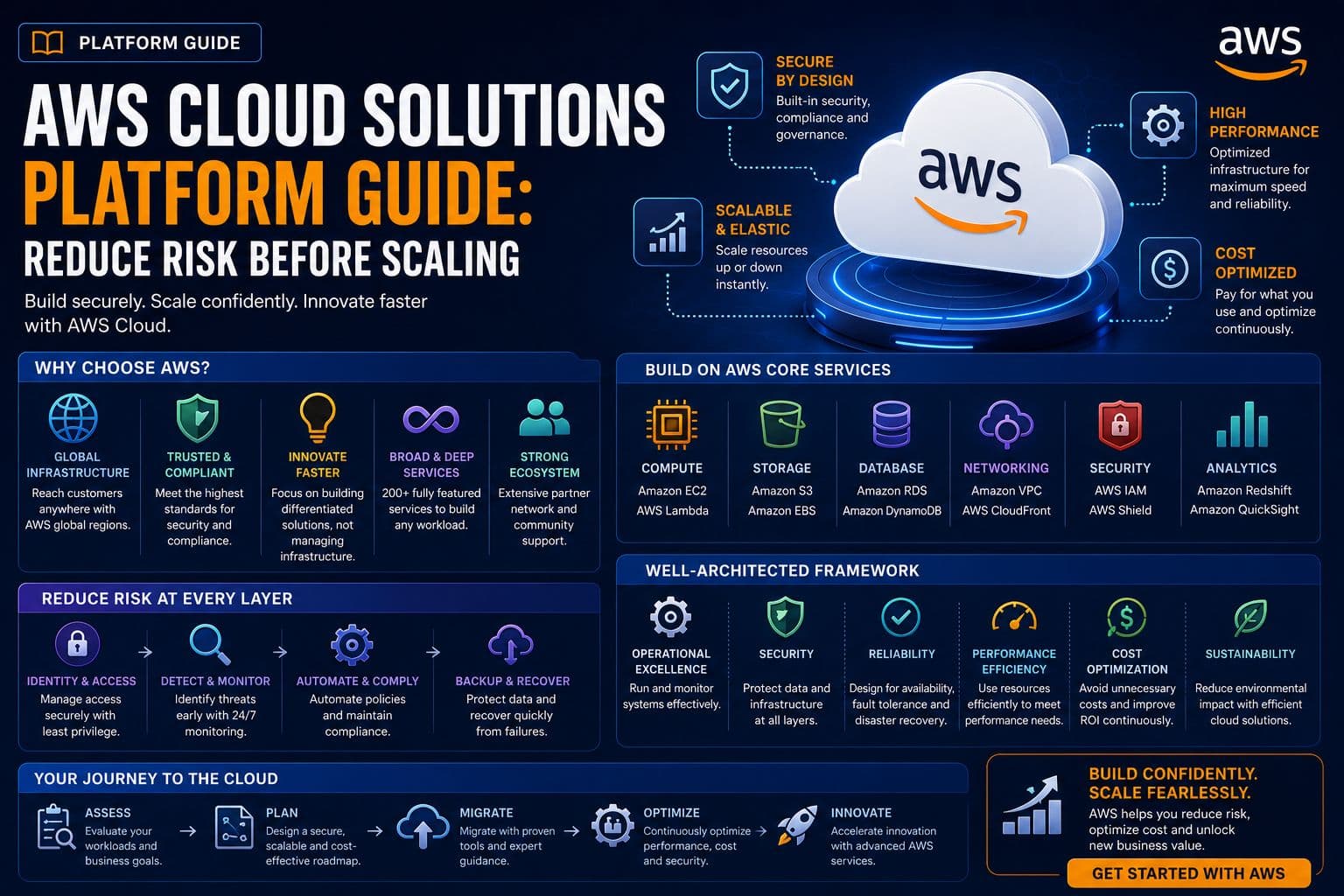
Scaling an AWS Cloud Solutions platform without first reducing risk introduces failure points that compound with every new instance — and trust me on this one — so this guide focuses on operational preparation before growth.
Real Delivery Risk in Cloud Platforms
Cloud platform scaling creates hidden dependencies where a single misconfigured IAM policy or unmonitored S3 bucket can halt an entire pipeline, and teams often discover this only after a production outage during a critical deployment that management has been tracking for weeks.
What Actually Happens in Live Projects
Live projects reveal that cost overruns from orphaned resources and unexpected data transfer fees silently drain budgets, while integration architecture decisions made early become irreversible bottlenecks when traffic spikes beyond tested limits and nobody wants to re-architect mid-sprint.
Common Missteps That Break Scaling
The most frequent mistake is assuming auto-scaling groups handle everything, but they fail when application code cannot distribute load efficiently, causing cascading failures across availability zones that take hours to untangle during incident response when everyone's already stressed.
How Teams Decide Scope and Next Steps
Teams reduce risk by auditing existing workflows, enforcing tagging policies, and implementing strict release management cycles before expanding, and bringmark provides cross-discipline execution support to harden production environments against these common failure patterns that keep showing up in post-mortems.
Need Bringmark's engineers to implement this for you?
Get a free 30-minute architecture & growth review tailored to your stack.
FAQ
q What are the first steps in an AWS Cloud Solutions Platform Guide to reduce risk before scaling?
a Start with a comprehensive audit of current cloud infrastructure, including unused resources, security group rules, and cost anomalies, then document every workflow dependency before adding new instances or services — otherwise you're guessing.
q How does scaling affect project deployment timelines and delivery risk?
a Unplanned scaling introduces unexpected QA surprises and rework cycles because integration points often break under load, extending deployment timelines by weeks while teams scramble to patch configurations that should've been caught earlier.
q What governance controls prevent common scaling failures in cloud platforms?
a Implement strict resource tagging, cost allocation alerts, and read-only IAM policies for non-production environments to prevent misconfigurations that cause cascading failures during high-traffic events that nobody simulated properly.
q When should teams pause scaling and reassess their cloud architecture approach?
a Pause scaling when recovery time objectives are not met, or when manual intervention is regularly required to keep the platform stable, indicating the architecture has exceeded its design boundaries and needs a real rethink.
The core engineering, AI, cloud, and product development team at Bringmark Private Limited. We architect and operate production SaaS platforms, enterprise web applications, and resilient cloud infrastructure.