Git Ops Solutions Analysis: Improve ROI With Better Control
Key Takeaway (TL;DR)
Git Ops Solutions Analysis: Improve ROI With Better Control A Git Ops solutions analysis reveals that teams often lose ROI not from inefficient code, but from broken control mechanisms during deployment.
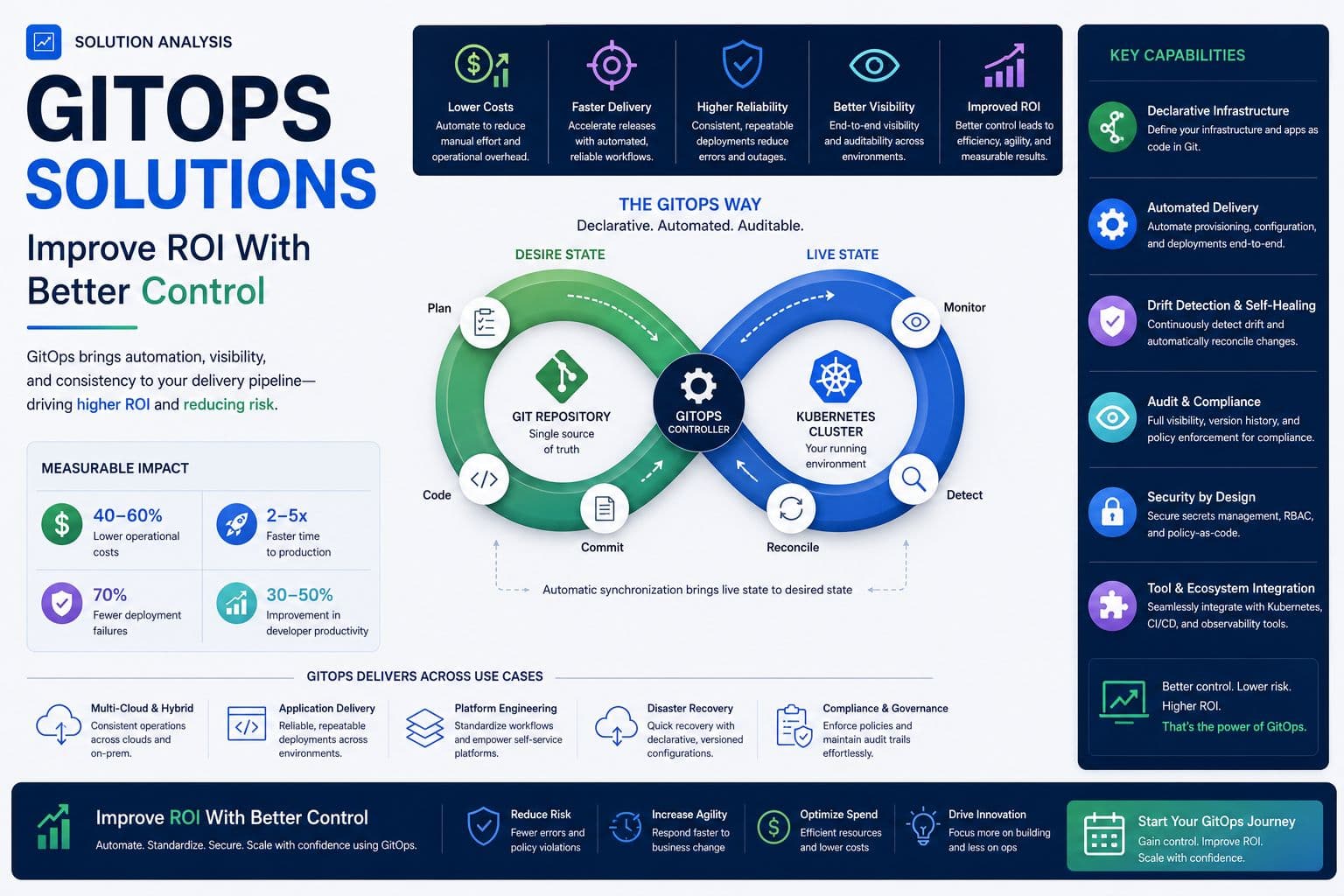
A Git Ops solutions analysis reveals that teams often lose ROI not from inefficient code, but from broken control mechanisms during deployment. When a single misconfigured pull request can cascade into a full production outage, the cost of poor governance becomes the biggest hidden drag on delivery performance—and this directly hits client trust and revenue, sometimes before anyone even knows something went wrong.
Lost Pipeline Control in Git Ops Workflows
In real-world Git Ops workflows, the problem is rarely the tooling itself—it’s the subtle loss of control during the merge-to-deploy handover. Teams assume that a successful build equals a safe release, but they overlook the fact that staging environments often lack parity with production, sometimes badly. A common observation is that a simple config change in the repository can trigger an unintended deployment of a half-tested feature, which then breaks a client's delivery timeline—and it happens without triggering any alert in the usual monitoring dashboards, so nobody catches it until the client calls.
Why Theoretical Git Ops Fails Under Production Load
The breakdown happens when automated rollbacks are triggered too late or not at all, often due to misconfigured health checks that return 200 OK even when the service is serving stale data or half-dead endpoints. Teams overlook the operational detail that many deployment tools measure only process completion, not service health—they just check if the script ran. Under load, a slow deployment can cause a state mismatch between infrastructure as code and the live environment, and then engineers are forced into manual intervention that pretty much voids every improvement calculated in the ROI analysis.
Common Mistakes That Destroy Git Ops ROI
A critical mistake is treating Git Ops as a pure automation problem rather than a governance one. The assumption that “if it’s in Git, it’s safe” leads to unchecked merge storms where dozens of commits flood the release pipeline without proper review—sometimes even without anyone noticing. This creates a compliance blind spot where unauthorized changes reach production, introducing integration risks that are only discovered after a client reports a broken feature. The boundary where Git Ops stops scaling is when the pipeline can no longer enforce fine-grained access control at the commit or branch level, and that point comes faster than most teams expect.
Need Bringmark's engineers to implement this for you?
Get a free 30-minute architecture & growth review tailored to your stack.
How to Make Git Ops Deliver Financial ROI
The decision to improve ROI starts with auditing the deployment pipeline for hidden control gaps, not just for speed—speed without control is just faster chaos. Teams need to shift from measuring deployment frequency to measuring deployment accuracy—how often does a release actually match the intended specification without causing a rollback? For projects involving cross-discipline execution, like cloud infrastructure or mobile app releases, a disciplined approach such as the one used at bringmark can help enforce strict pre-deployment verification and post-deployment validation. Scaling Git Ops beyond a single team requires centralized release management that prevents any single repo change from affecting downstream dependencies without explicit approval, which is the only way to preserve both control and ROI in the long run.
FAQ
q What is a Git Ops solutions analysis?
a A Git Ops solutions analysis is a structured evaluation of your deployment workflows to identify bottlenecks, control failures, and process inefficiencies that directly impact delivery reliability and financial return—it's not just a checklist, it's a deep look at where things actually break.
q How does Git Ops improve ROI in software delivery?
a Git Ops improves ROI by automating safe deployments, reducing manual errors, and enabling faster rollbacks—but that only works if the pipeline is governed correctly. Without proper control, automation can introduce more risk than it removes, and I've seen that happen more times than I'd like to admit.
q What are the biggest risks in adopting Git Ops?
a The biggest risks include unauthorized changes reaching production due to weak access controls, misconfigured health checks that mask deployment failures until it's too late, and scaling issues where the pipeline cannot enforce rules across multiple teams or services.
q When should a team pause using Git Ops for deployment?
a A team should pause Git Ops if their deployment pipeline lacks granular access controls, if staging environments do not reflect production conditions, or if rollback procedures are manual and frequently fail. Without a hardened governance layer, Git Ops can produce the opposite of its intended ROI—and I've seen teams burn weeks unwinding those failures.
The core engineering, AI, cloud, and product development team at Bringmark Private Limited. We architect and operate production SaaS platforms, enterprise web applications, and resilient cloud infrastructure.