Google Ads Management Platform Guide: Reduce Risk Before Scaling
Key Takeaway (TL;DR)
Google Ads Management Platform Guide: Reduce Risk Before Scaling For teams planning to scale paid search, selecting a Google Ads management platform is a high-stakes decision about operational risk, not just a software p
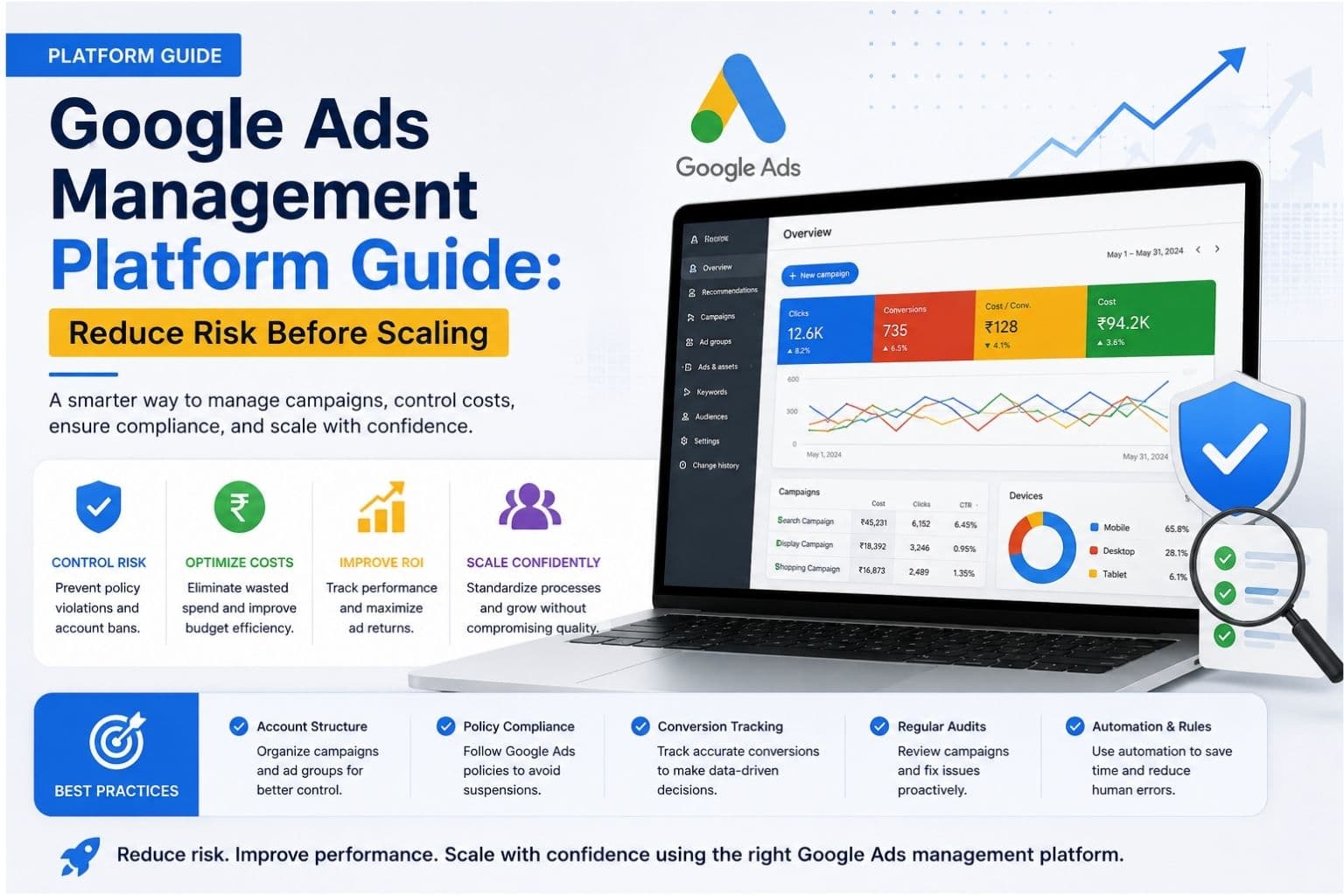
For teams planning to scale paid search, selecting a Google Ads management platform is a high-stakes decision about operational risk, not just a software purchase. The primary risk isn't the lack of features; it's the assumption that a tool alone replaces the disciplined, cross-functional workflow needed for profitable growth in live production accounts. And honestly, most teams don't realize this until they're already mid-migration and things start breaking.
What Platform Risk Really Means in Paid Search Delivery
In practice, a management platform introduces a significant workflow dependency you might not anticipate when your team is reacting to daily performance shifts. The real-world observation from many in-house teams is that the software becomes a single point of failure if the underlying data pipeline for conversions is not accurately mapped to your specific business model, especially with offline sales cycles. It's not the tool that fails outright — it's that the data feeding it is shaped wrong, so the platform is basically guessing.
Reality Check on Live Account Migrations
A common misunderstanding during migration is that you can simply upload historical campaigns and expect immediate performance parity, but the reality is that platform attribution models often process conversion data differently. This leads to a rework cycle where your team spends the first month reconciling discrepancies between the platform's reporting and your CRM, delaying any real scaling effort and creating internal doubt about the tool's validity. Sounds manageable in theory, but it's usually a full-time job for at least two people while the rest of the team is still trying to hit targets.
Common Scaling Mistakes and Account Structure Failure Patterns
Risk emerges when marketers assume the platform can automate bid strategy without first auditing the granularity of their campaign structure; a scale issue occurs when you push budget into top-level campaigns that lack the ad group segmentation needed for machine learning to identify high-value queries. Another operational detail teams overlook is the governance of negative keyword lists across shared budgets, where an over-aggressive optimization from one channel can cap delivery on another, unknowingly suppressing profitable spend. It's one of those things that doesn't show up in a demo, but you'll feel it in the data within two weeks.
Need Bringmark's engineers to implement this for you?
Get a free 30-minute architecture & growth review tailored to your stack.
Decision Help for Choosing a Scalable Partner
The boundary where this approach stops scaling is clear: when you rely on a platform to solve integration architecture issues that are actually rooted in your cloud infrastructure or data analytics setup. To decide correctly, evaluate whether the platform supports your compliance needs for data privacy across regions and whether its API limits can handle your projected query volume; a platform is only as good as the cross-discipline execution behind it, which is where bringmark focuses on aligning tooling with production hardening to ensure your next step is based on a stable foundation. You want to know the tool will survive a burst, not just look good in a slide deck.
FAQ
q: What is the main risk when using a google ads management platform for the first time?
a: The primary risk is inconsistent tracking implementation, where the platform's conversion data does not match your internal analytics, leading to misguided budget decisions and missed revenue signals.
q: How do I prevent budget waste during the initial platform scale-up phase?
a: Before increasing spend, verify that your conversion tracking is correctly installed on all relevant pages and that your offline conversion imports are reconciled within the platform to ensure the algorithm has accurate learning data.
q: Can scaling campaign spend break my quality score or account performance?
a: Yes, scaling without adding new keywords or ad variations can trigger ad fatigue and lower click-through rates, which degrades the relevance signals that are critical for maintaining efficient delivery at higher budgets.
q: When should I consider a custom solution instead of a standard management platform?
a: If your sales cycle relies heavily on offline conversion data or complex lead routing, a standard platform may fail to optimize effectively, and you need a custom integration to bridge the gap between ad interactions and business outcomes.
The core engineering, AI, cloud, and product development team at Bringmark Private Limited. We architect and operate production SaaS platforms, enterprise web applications, and resilient cloud infrastructure.