PPC Campaigns Case Study Guide for Better ROI Planning
Key Takeaway (TL;DR)
PPC Campaigns Case Study Guide for Better ROI Planning Reviewing PPC campaigns case study data is often the first step teams take when re-planning budgets, but the real value lies in identifying where spend stops convert
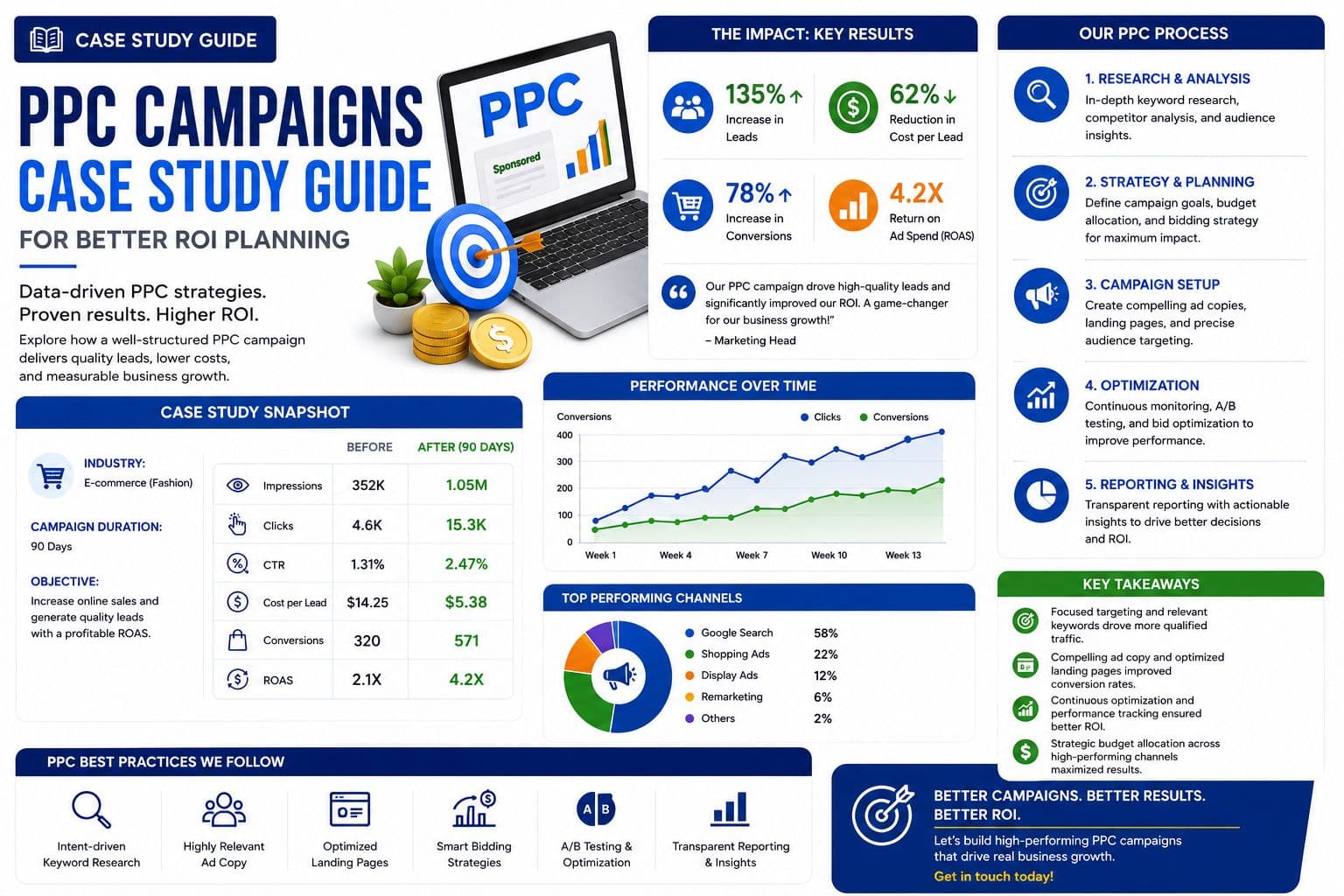
Reviewing PPC campaigns case study data is often the first step teams take when re-planning budgets, but the real value lies in identifying where spend stops converting. In live accounts, a common observation is that a case study from a different vertical often paints an overly optimistic picture because it ignores the search landscape shifts that have occurred since that test ran. The primary keyword for this planning exercise is "PPC Campaigns Case Study," and it should anchor your expectations to operational realities, not theoretical performance curves.
What Defines a Reliable PPC Campaign Case Study
A reliable case study should reflect consistency between the reported conversion window and your actual client's sales cycle, a nuance often overlooked when the marketing team is under pressure to show fast wins. In production, we see many examples where a case study reports a 500% return on ad spend, but upon closer inspection, the attribution model included view-through conversions that are unlikely to repeat in your account. The operational detail that usually trips up planners is that the case study's target cost-per-acquisition might be viable only with a specific seasonality buffer, which is rarely stated explicitly.
Common Pitfalls When Benchmarking Against Case Study Results
The most frequent failure pattern is assuming your landing page experience matches the conversion rate optimization effort of the benchmark, an assumption that breaks down quickly when QA discovers friction in the checkout flow. You might see a case study with staggering click-through rates, yet your live campaigns cannot replicate this because your ad copy lacks the price transparency that drives that specific engagement metric. A common misunderstanding causing bad decisions is treating the case study's average order value as a fixed figure, without realizing it was heavily influenced by a product bundling strategy you are not ready to implement.
Why Hidden Integration Costs Disrupt ROI Planning
When planning ROI from a PPC case study, teams often forget the cost of the data pipeline required to accurately track offline conversions, which can consume a significant portion of the projected profit margin. One boundary where this approach stops scaling is in accounts that rely on a slow legacy CRM, where the lead data from Google Ads takes 24 hours to sync, making automated bid strategies unresponsive. In practice, we see that the delay in data availability turns what looked like a profitable scaling model into a cash flow problem, because spend accelerates faster than the quality signal returns to the ad engine.
Need Bringmark's engineers to implement this for you?
Get a free 30-minute architecture & growth review tailored to your stack.
How to Adjust Your Campaign Strategy Based on Case Study Learnings
The decision help here is to treat a case study as a directional hypothesis, not a contractual guarantee, and to build a testing phase that isolates one variable at a time, such as bidding strategy against a static budget cap. For live projects, the real work begins when you compare the case study's audience segmentation to your current first-party data capabilities, especially if privacy regulations have limited the tracking signals you previously relied on for similar campaigns. When cross-discipline execution matters, teams sometimes need to bring fresh architectural perspective into the workflow, which is where a partner like bringmark can help bridge the gap between media buying tactics and the underlying web infrastructure that determines post-click performance.
FAQ
q: What is the most important metric to compare from a PPC case study?
a: The primary metric should be the blended cost per acquisition, but only if the case study clearly defines its attribution window and includes all ancillary costs, such as feed management or landing page testing tools.
q: Why does my PPC campaign fail to match the performance in a case study?
a: The typical cause is a mismatch in the maturity of the optimization setup, where the case study likely had months of conversion data feeding the algorithm, while your account is starting with cold learning phases that cause volatility in delivery.
q: How can I scale my ROI safely after a successful case study test?
a: Scale increments should never exceed 20% of the daily budget per adjustment, and you must monitor the efficiency metrics for at least three days to ensure the auction dynamics have stabilized before making another change.
q: What is the right decision process when a case study plan fails in production?
a: The immediate action is to pause the highest spend keywords and run a full audit on the integration layer, because the issue often lies in the speed of your server responses or the accuracy of your conversion event firing.
The core engineering, AI, cloud, and product development team at Bringmark Private Limited. We architect and operate production SaaS platforms, enterprise web applications, and resilient cloud infrastructure.