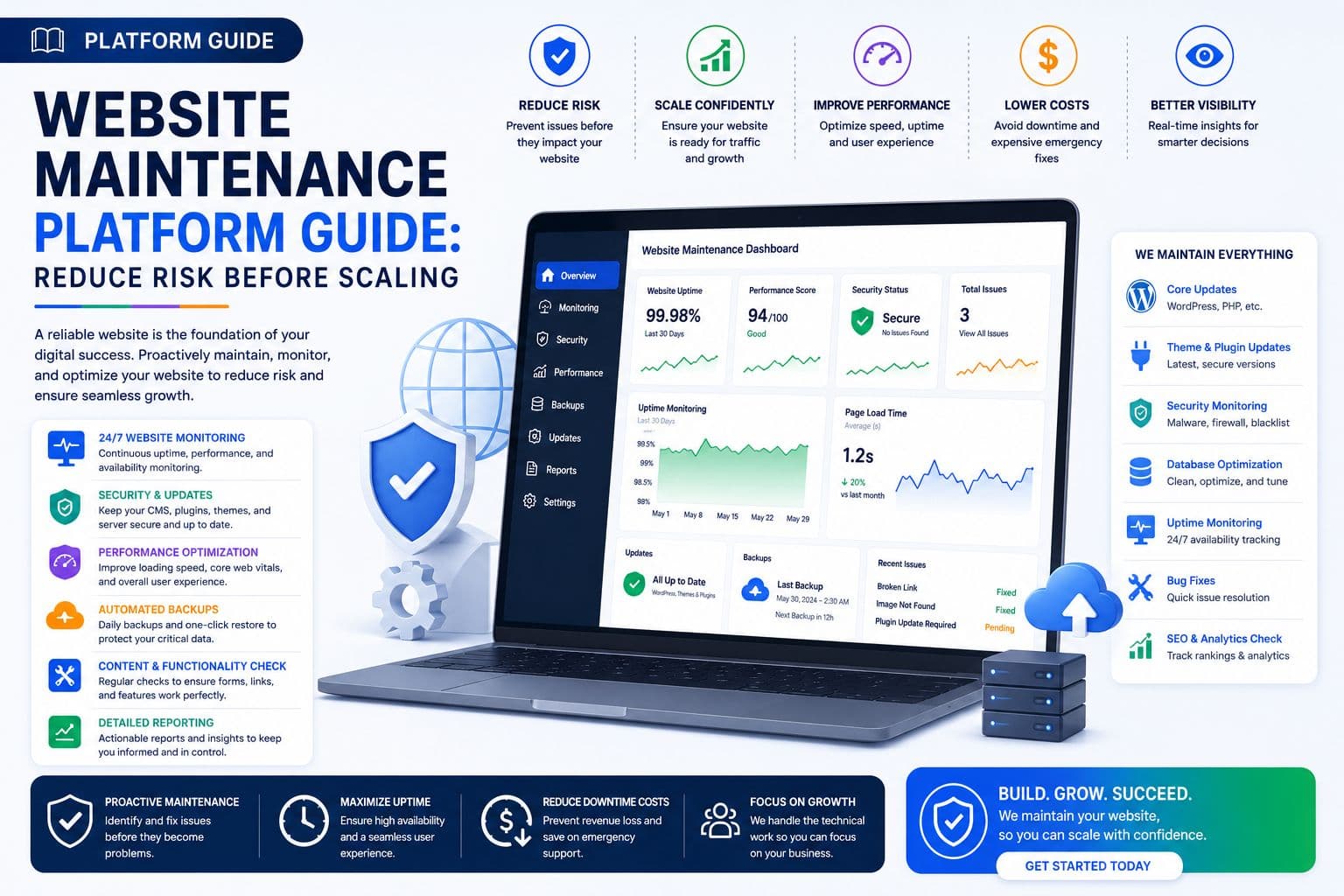
Karol Bagh SMBs Reviewing Website Maintenance Contracts: Support Terms and Security Questions Before You Sign
Key Takeaway (TL;DR)
Karol Bagh SMBs Reviewing Website Maintenance Contracts: Support Terms and Security Questions Before You Sign A website maintenance contract should be judged on four things: what is covered and excluded, what response an
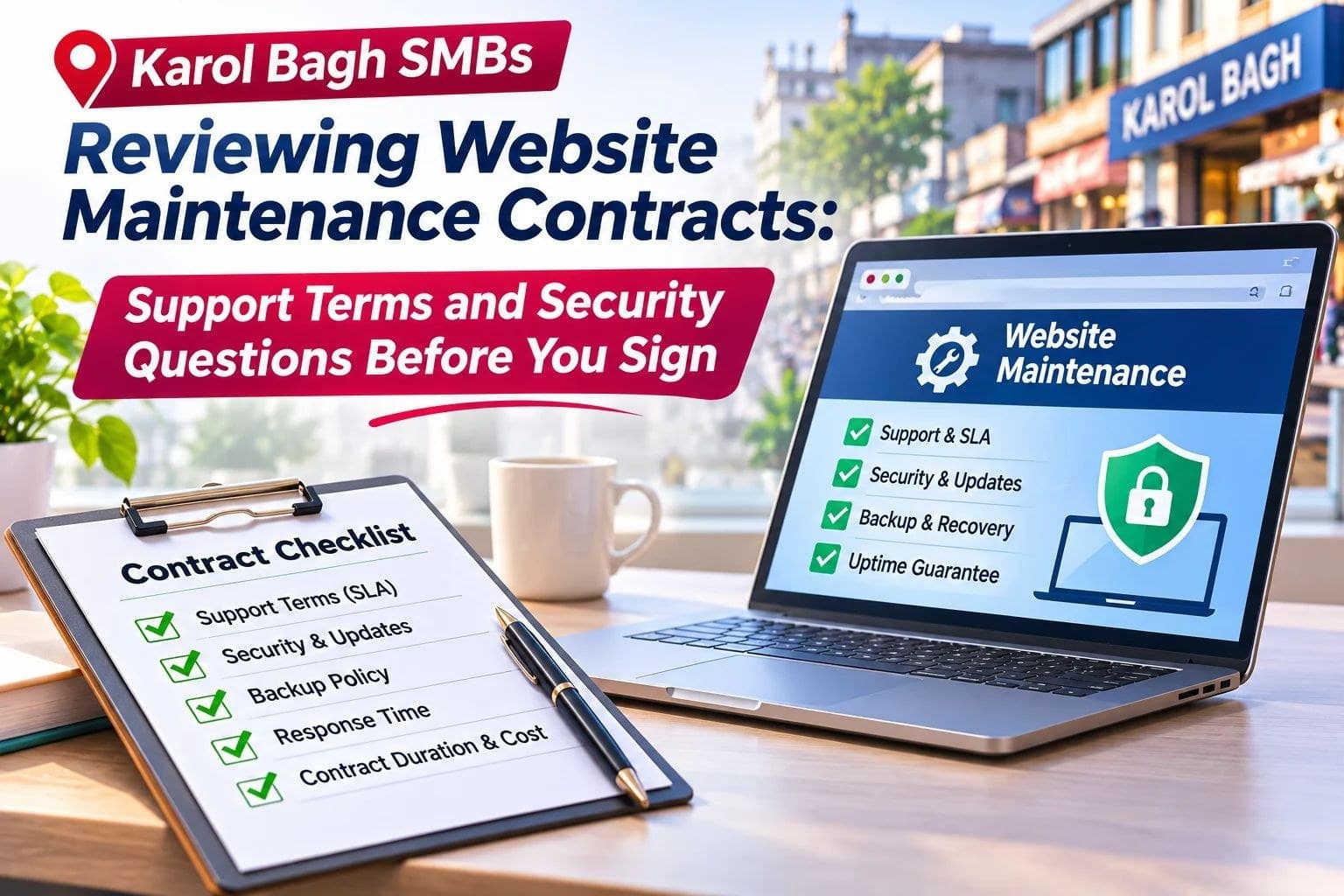
A website maintenance contract should be judged on four things: what is covered and excluded, what response and escalation terms are written down, who owns updates and backups, and how security, access and incident contact are handled. If a contract does not answer those four clearly, the monthly fee is the least important number on the page. This guide is general buying guidance for Karol Bagh SMBs and operations leads, and it is not legal advice, so confirm final terms with your own adviser.
Before signing, ask these questions and note the answers in writing:
Which tasks are scheduled, and how often?
What counts as routine support, and what becomes a paid change request?
What are the response target and the escalation path, stated separately?
Who runs updates and backups, and when was a restore last tested?
Who patches, who revokes access, and who is the incident contact?
What a maintenance contract covers, and what it leaves out
In daily use, maintenance means recurring duties: uptime checks, CMS and dependency updates, backup runs, certificate renewal, access control and a defined path for when something breaks. Many agreements describe outcomes, such as a site kept secure and available, without naming the workflow behind them. So nobody knows whether a plugin update is routine or billable.
Scope is where most surprises start. A provider may cover the platform but not a custom module, a third-party plugin or a hosting change, and those exclusions are exactly where extra invoices appear. Ask for the specific task list, the frequency, and the named owner for each item. Then ask the harder question: if your site grows to include e-commerce flows, integrations or audit requirements, does the agreement still fit, or does the scope need to be renegotiated?
Response and escalation terms to get in writing
Response time is when someone acknowledges and starts work on an issue. Resolution time is when the issue is actually fixed. They are different numbers, and a contract that promises a four-hour response has not promised a four-hour fix. Ask for both, per severity level, in the document rather than in conversation.
The escalation path is the second half of that promise: who you contact when the first responder cannot fix the issue, and how quickly that moves up. A named second contact, a severity matrix that maps incident types to targets, and a defined change-request threshold turn a vague promise into something you can test. Without them, a single stalled ticket can hold up a campaign while everyone debates who owns the problem.
Need Bringmark's engineers to implement this for you?
Get a free 30-minute architecture & growth review tailored to your stack.
Update and backup responsibilities worth confirming
Updates and backups are the two duties most often assumed rather than assigned, so confirm both with names attached. For updates, ask who applies CMS and dependency patches, who tests them before they go live, and who rolls back if a change breaks a form or a checkout flow. A backup clause with no restore test is paperwork; ask when a restore was last performed and who checked the data afterwards.
Also settle retention and exit while the relationship is good. How long are backups kept, where are they stored, and if you leave, do you receive credentials, documentation and a transition window? An agreement without handover terms quietly ties you to one provider.
Security questions: patching, access and incident contact
Security responsibility is the most common gap in maintenance agreements, so give each duty a named owner on both sides. Who applies security patches and within what window? Who revokes access when an employee leaves or a contractor finishes? Who is contacted first when something looks wrong, and who tells you what happened afterwards?
Ask how data handling is split between you and the provider, including what happens if personal data is affected, rather than assuming either party is covered. For a fuller view of the technical layer behind these questions, see Bringmark's cyber-security services, the broader range of Bringmark engineering services, and Bringmark's DevOps and release support services. A related read from another lane covers how teams qualify traffic before automating follow-ups: marketing automation for Ikeja SMBs.
Practical checks before you sign
Covered versus excluded. Ask for the task list with frequencies and get every exclusion named in the agreement.
Two numbers, not one. Response target and resolution target should appear separately at each severity level.
Escalation named. A second contact and a severity matrix belong in the document, not in memory.
Restore tested. Ask when a backup was last restored and who verified the result.
Owners on both sides. Patching, access revocation and incident contact each need a named person.
Exit ready. Credential handover and a transition window decide your leverage later; hold the agreement to plain terms you can check.
A useful next step is to turn these answers into a one-page checklist and send it to the provider before finalizing terms. You can also raise technical questions directly through Bringmark's contact page.
The core engineering, AI, cloud, and product development team at Bringmark Private Limited. We architect and operate production SaaS platforms, enterprise web applications, and resilient cloud infrastructure.