Narela Teams Evaluating AI Automation: Questions on Workflow Scope, Review Steps and Handoff Before You Commit
Key Takeaway (TL;DR)
Narela Teams Evaluating AI Automation: Questions on Workflow Scope, Review Steps and Handoff Before You Commit If you are an operations lead in Narela weighing up AI automation, the useful work happens before you pick a
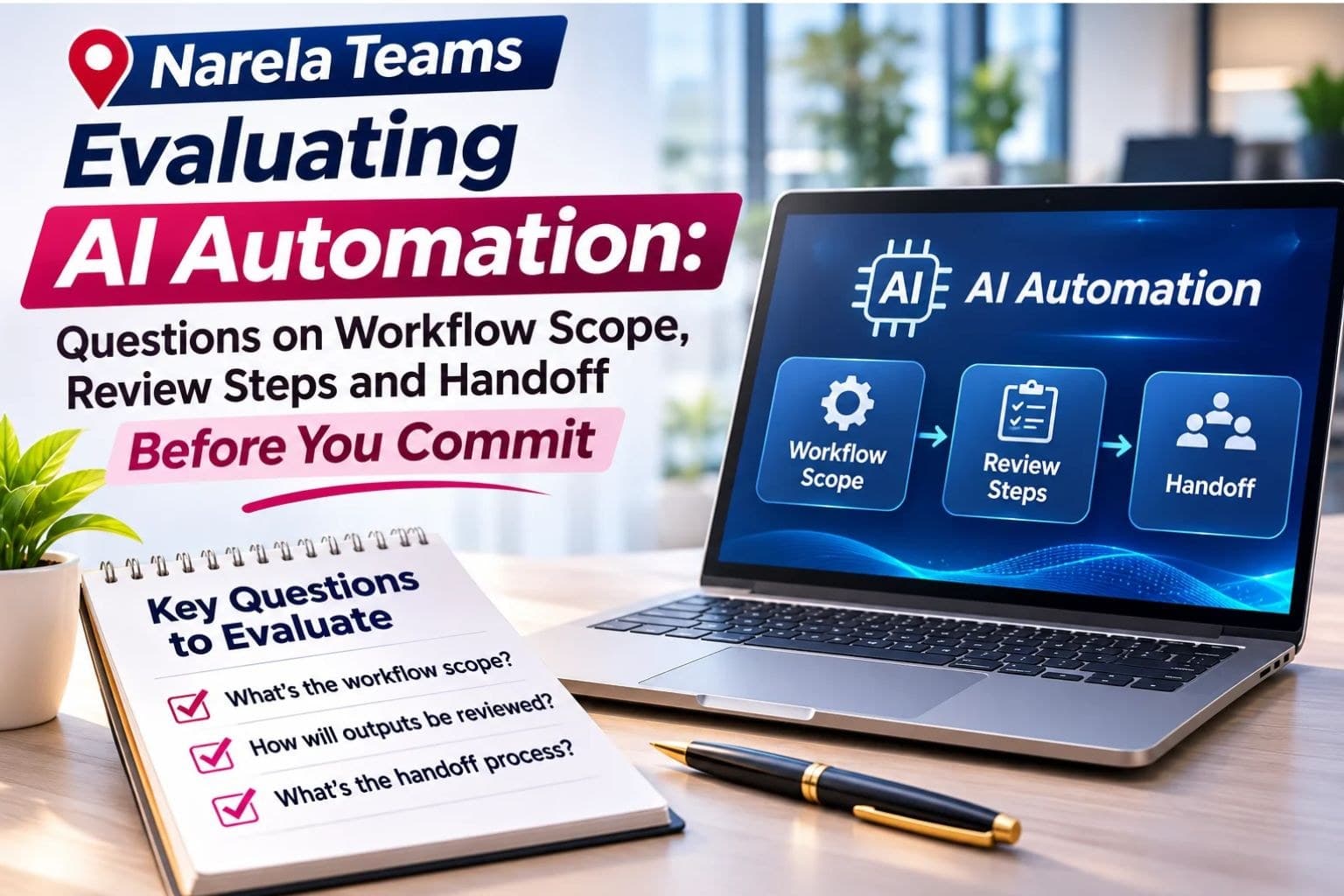
If you are an operations lead in Narela weighing up AI automation, the useful work happens before you pick a tool. You need to map the workflow boundary, name the human review checkpoints, settle data access and permission rules, and write down handoff, documentation and rollback terms. This article is a questions-to-settle checklist, not a recommendation of any specific tool or provider.
Four areas carry most of the risk. First, what exactly is inside the automated workflow and what stays outside. Second, which decisions must keep a person in the loop. Third, who and what can reach your data. Fourth, what happens on the Monday after the build team leaves. Settle those in writing before signing anything.
Map the workflow before choosing tools
Workflow scope means the steps that have an owner, a data source and a known failure mode attached to each one, not the steps that look tidy on a whiteboard.
Ask your own team these before you talk to any vendor:
Which single workflow has steady volume, one clear owner and a documented exception path? Start there.
How often do cases take the exception path, and who handles those cases now? If nobody can answer, the workflow is not ready to automate.
Where does the workflow start and stop, and which neighbouring team hands work in or out at each edge?
What does a case look like when it arrives broken, duplicated or missing a field?
One operational detail is easy to miss. The rework and escalation cases usually take far more staff time per case than the standard path, even when they are a small share of volume. Ask for that share rather than assuming it is minor. If your scope document lists tools before it lists workflow owners, the project is not ready to commit.
A workable decision order is scope first, review second, permissions third, handoff terms fourth, and tooling last. When integration architecture and production hardening need to sit together rather than across separate vendors, the AI and machine learning engineering service describes the kind of work involved, and the Cloud and DevOps service covers the infrastructure side. Treat both as reference reading, not as a recommendation. The boundary where this stops working is when a workflow is so tangled across teams that no single owner can approve changes. At that point the honest next step is process redesign, not automation.
Which steps need human review, and why
Name every decision that must stay with a person before go-live, and treat review as a permanent control step rather than a bridge to full automation.
Put these questions to yourself and to any prospective vendor:
Which decisions carry financial exposure, compliance weight or customer trust? Those stay human unless you can justify otherwise.
Who reviews, how long do they get per case, and what are they allowed to override?
Where does the review queue live, and who is told when it backs up?
What rule decides when a case leaves the automated path and goes to a person?
A review queue that grows faster than case volume usually means the override rules are too loose, not that the team is slow. Tighten the rules before you add headcount. A successful pilot on clean test data shows the logic works on clean data. It does not show the deployment survives duplicate records, missing fields and inconsistent naming. Insist on a trial run against real production records. Review is a cost line you carry every month, so budget for it that way from the start.
Need Bringmark's engineers to implement this for you?
Get a free 30-minute architecture & growth review tailored to your stack.
Data access and permission questions to settle early
Decide who and what can reach your data, and record those decisions, before any integration is built.
Start with the smallest access that lets the workflow run, then widen only where you can explain why:
Which systems does the automation need to read, and which does it need to write? List them one by one.
Does it run with its own named account, or does it borrow a person's login? Borrowed logins make audit trails unreliable.
Who can change permissions, and where is that change recorded?
What gets logged, how long is it kept, and who reads the log?
What happens to access when a staff member leaves or changes role?
Least privilege is a plain idea: give the automation only the access its current job needs, not everything it might need later. Audit trails tend to be requested long after a build is finished, usually by someone outside the project. Decide now where those records live. If a vendor cannot describe their access model in plain language, that is a signal to slow down rather than a detail to sort out later.
It helps to compare candidates on the same neutral criteria instead of on feature lists. The dimensions below are a way to structure the conversation, not a ranking of anyone.
| Decision area | What to ask | What good looks like |
|---|---|---|
| Workflow mapping | Have you mapped our exception path with the people who handle it? | Written scope naming owners, data sources and failure modes |
| Review checkpoints | Where does a person decide, and what can they override? | Named reviewers, queue location and override rules in writing |
| Access controls | What access does the automation get, and who can change it? | Least-privilege access, named accounts and logged changes |
| Documentation and rollback | What do we receive at handover, and how do we undo a bad run? | Runbook, tested rollback and a named operations owner |
| Post-handoff support | Who fixes it when an integration feed changes format? | A clear support scope and response path in the contract |
Handoff, documentation and rollback terms
Write the handoff terms before the build starts, because a working dashboard without a runbook leaves you exposed.
Ask for these in writing:
A runbook covering how the system runs, what it depends on and what to do when a job fails.
A named operations owner on your side, and a named contact on theirs.
A rollback procedure you have actually tested, including how to switch the workflow back to manual.
A list of scheduled jobs and integrations, with what each one breaks if its data format changes.
A handover session with the people who will run the system, not only the people who bought it.
The question that catches teams out is simple: who runs this on a Monday morning when the original builder is unavailable? If the answer is not a person with a name and a document, the handoff is incomplete. Undocumented scheduled jobs are the most common production surprise, and they surface at the worst possible moment.
Decisions to have in writing before you commit
You should be able to carry a short, signed summary into any contract conversation. Here is what belongs in it.
Workflow boundary drawn and agreed, including the exception path and its owner.
Human review checkpoints named, with reviewer, time allowance and override rules.
Data access scoped to what the job needs, with permission changes logged.
Runbook, rollback steps and the operations owner confirmed before sign-off.
Post-handoff support scope written down, so nobody argues about it after a failed job.
A practical last step: build your own checklist from these five lines and take it to every conversation. If a candidate cannot answer the workflow and review questions in specifics, the rest of the discussion is not worth having yet.
The core engineering, AI, cloud, and product development team at Bringmark Private Limited. We architect and operate production SaaS platforms, enterprise web applications, and resilient cloud infrastructure.