Kubernetes Management Best Practices for Compliance This Week
Key Takeaway (TL;DR)
Kubernetes Management Best Practices for Compliance This Week Addressing Kubernetes management best practices for compliance this week often means reacting to an audit deadline or a security scan failure. In real projec
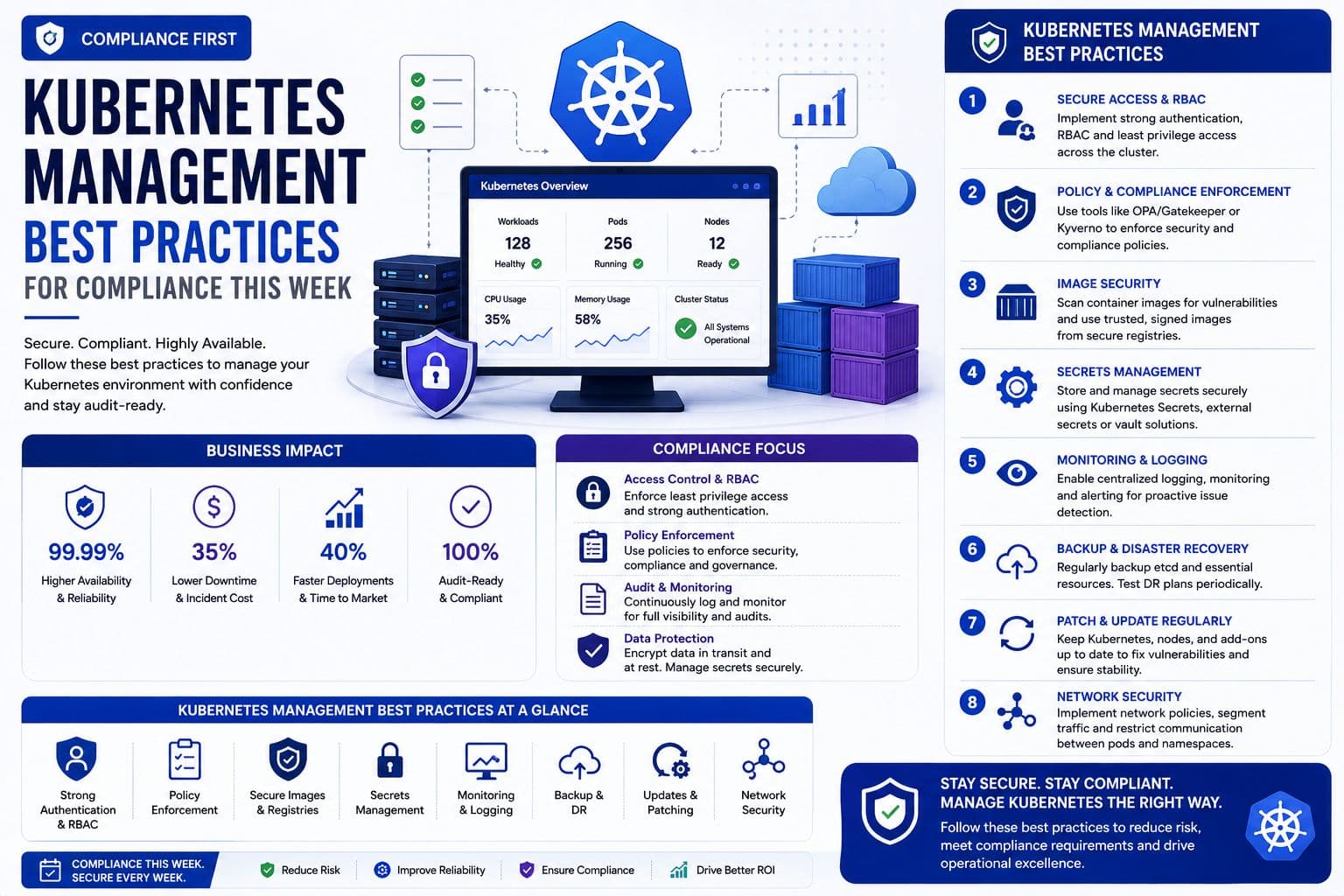
Addressing Kubernetes management best practices for compliance this week often means reacting to an audit deadline or a security scan failure. In real projects, teams discover that their clusters lack the necessary governance controls to prove data isolation or access restrictions. The pressure to fix findings quickly usually clashes with the reality that compliance is a continuous state, not a one-time patch applied to a YAML file. And honestly, most teams find this out the hard way, usually on a Thursday afternoon when the audit is scheduled for Monday.
Defining Compliance in a Live Production Cluster
Compliance in a Kubernetes environment means your cluster configuration, workload deployment, and access policies consistently meet specific regulatory standards. A common misunderstanding is that compliance can be achieved solely through a static security policy at the start of the pipeline. However, live production clusters are dynamic, and every new deployment, scaling event, or configuration change can silently drift away from the approved baseline, creating an immediate audit risk. The tricky part is that drift doesn't announce itself—it just accumulates until someone runs a scan and finds seventeen things that shouldn't be there.
The Reality of Audits and Operator Workload
When an auditor asks for evidence, engineering teams often scramble to gather logs from multiple tools, manually map pods to services, and export role-based access control (RBAC) configurations. This is when they realize that their monitoring dashboards were built for performance, not governance. The non-obvious operational detail is that you need a separate, immutable audit trail that records who changed what, when, and with which approval, as most standard logging systems are not configured to retain this level of detail for compliance review. I've seen teams spend an entire sprint just reconstructing what happened in a two-week window because nobody thought to enable the right audit flags from the start.
Mistakes in Policy Enforcement and Image Security
A frequent failure pattern is relying solely on image scanning at the build stage and ignoring the base image vulnerabilities that are inherited from upstream repositories. Teams often enforce policies with a tool like OPA/Gatekeeper but they fail to plan for the exceptions it will create. These exceptions, such as allowing a Helm chart to bypass a check, become permanent loopholes that break the entire compliance posture. This approach stops scaling the moment you have multiple clusters or development teams with different security requirements. What usually happens is someone adds an exception to unblock a release, and then that exception just... stays there, because no one wants to be the person who breaks the deployment pipeline again.
Need Bringmark's engineers to implement this for you?
Get a free 30-minute architecture & growth review tailored to your stack.
Decision Help for Selecting the Right Compliance Strategy
The main decision for a team this week is whether to implement a central policy engine or to embed controls directly into their Continuous Integration/Continuous Deployment (CI/CD) pipeline. A central policy engine like Kyverno provides a single source of truth but requires a dedicated team to manage it. Embedding controls in the pipeline offers speed but can be easily bypassed by an engineer with debugging access. Cross-discipline execution, where platform teams work with developers to define what "compliant" means for each application, is often the missing piece, and this is where bringmark can provide the necessary production hardening perspective. It's not a glamorous decision, but getting it wrong means either constant firefighting or a policy framework that nobody actually follows.
FAQ
q: What is the difference between Kubernetes security and compliance?
a: Security is about protecting the cluster from threats, while compliance is about proving to a regulator that you have specific controls in place. You can be secure without being compliant if you haven't documented your processes, or you can be compliant on paper but insecure in practice if you don't enforce policies correctly for your software delivery. Both matter, but they require different kinds of work and different kinds of evidence.
q: How do I audit who has access to my cluster?
a: You must configure Kubernetes audit logs to record every request to the API server, including attempts. You should also snapshot your RBAC configurations and map them to your identity provider groups to understand effective permissions. One common workaround is engineers using long-lived tokens or service accounts that are not tracked, which creates a major risk during a delivery review. The mapping part is often harder than it sounds because permissions can chain through group memberships and role bindings in unexpected ways.
q: Can I use a policy engine to enforce compliance automatically?
a: Yes, tools like OPA/Gatekeeper or Kyverno can block deployments that violate your rules. However, you must define exceptions carefully and track them as technical debt. A policy engine is binary, so you need a process to handle critical updates that might temporarily violate a rule without a manual approval step, otherwise you will see deployment delay issues. And those delays will quickly make the policy engine unpopular with developers, which creates pressure to loosen the rules.
q: How do I manage compliance across multiple clusters?
a: You need a GitOps approach where all cluster configuration is stored in a repository. This creates a single source of truth, but you must also ensure that the GitOps tooling itself is secure and that its access is monitored. A scale constraint appears when you have different compliance requirements for different environments, such as production versus staging. The repository can quickly become a maze of environment-specific overlays that only one person understands, and that person is usually on vacation when something breaks.
The core engineering, AI, cloud, and product development team at Bringmark Private Limited. We architect and operate production SaaS platforms, enterprise web applications, and resilient cloud infrastructure.