Performance Optimization Best Practices for Compliance This Week
Key Takeaway (TL;DR)
Performance Optimization Best Practices for Compliance This Week When teams push performance optimization best practices for compliance this week, the immediate pressure often masks deeper integration debt.
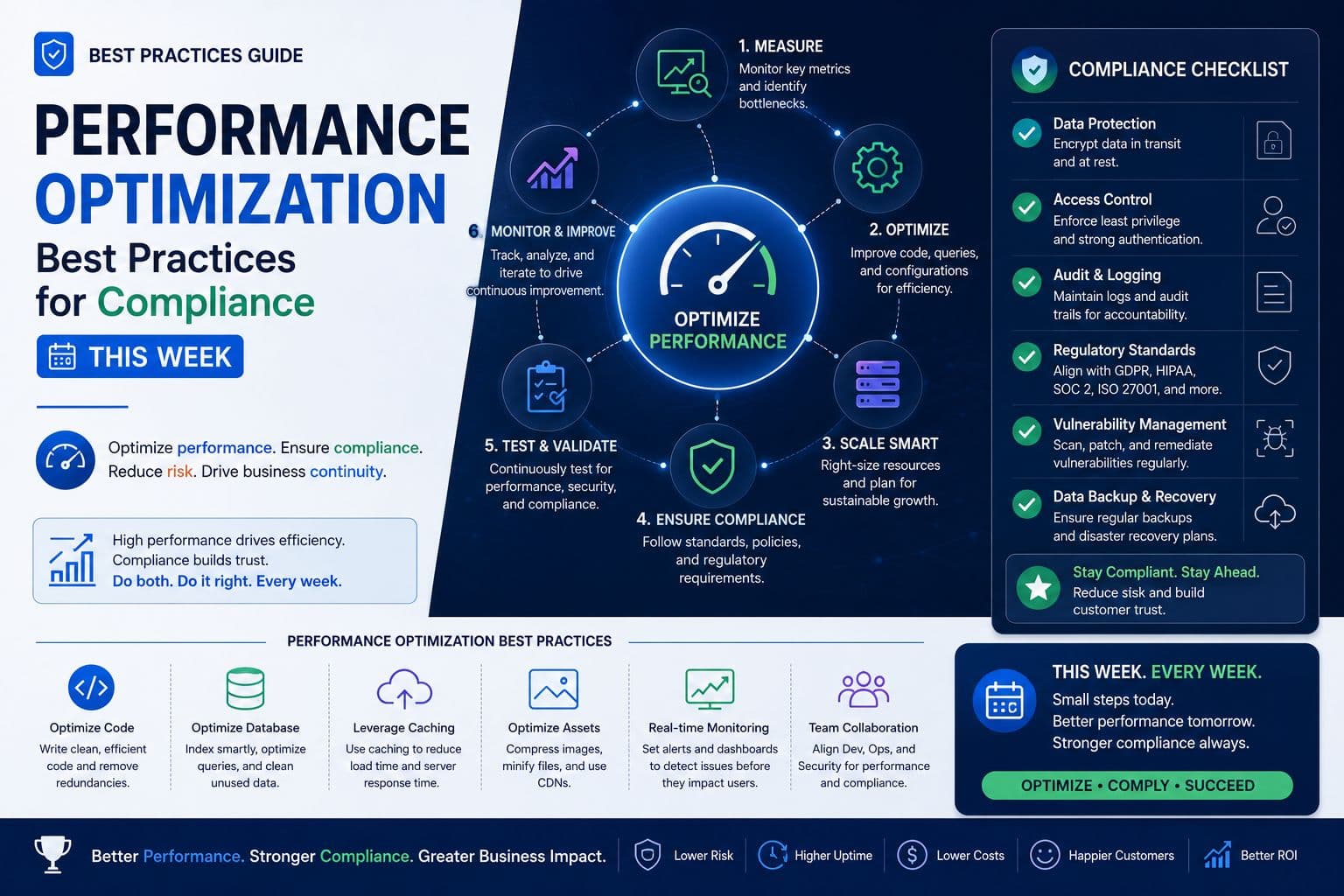
When teams push performance optimization best practices for compliance this week, the immediate pressure often masks deeper integration debt. A real-world observation shows that a 10% latency improvement in a staging environment can collapse under production load when the devops pipelines skip cache invalidation checks—a non-obvious operational detail that triggers cascading deployment delays. We saw this happen last quarter on a project that looked clean until the traffic spiked.
What Compliance-Driven Performance Means for Delivery
Compliance mandates like SOC 2 or PCI DSS impose specific throughput and response-time thresholds that directly impact software delivery timelines. Teams overlook that a single endpoint failing a compliance scan can freeze the entire release, halting handover to clients. The real delivery risk surfaces when performance benchmarks are treated as a checklist rather than a continuous integration constraint. I've watched teams lose a full sprint this way.
Reality Check: What Breaks During Compliance Weeks
In live projects, compliance-focused performance optimization often reveals hidden scale issues. One common boundary is the assumption that load testing replicates production behavior, but quota limits on cloud infrastructure throttle results silently. A project once stalled for three days because the integration architecture lacked proper throttling between APIs, causing a compliance test to fail repeatedly at peak load. Nobody expected the cloud provider's burst limits to interfere.
Common Misstep: Prioritizing Speed Over Stability
The critical mistake occurs when teams optimize for compliance benchmarks without accounting for workflow dependencies. Rushing to reduce page load times by two milliseconds can break database state management, triggering rollbacks. One team faced a costly rework cycle after a hotfix for compliance introduced a deadlock under concurrent user sessions—a pattern that stops scaling beyond 1,000 concurrent users. That fix took three weeks to unwind properly.
Need Bringmark's engineers to implement this for you?
Get a free 30-minute architecture & growth review tailored to your stack.
Decision Help: Choosing the Right Scope and Partner
Deciding whether to optimize internally or bring in cross-discipline execution depends on the release management maturity of your pipeline. A governance concept like a performance baseline agreement between your QA and DevOps teams can prevent scope creep, but it also requires realistic scale constraint modeling. When integration complexity exceeds your team's bandwidth, a partner like bringmark can provide the production hardening required to meet compliance without delaying client delivery timelines again. We've stepped in for teams caught between a compliance deadline and a broken pipeline.
FAQ
q What are the top performance optimization best practices for compliance this week?
a Focus on endpoint latency benchmarks, cache strategy validation, and real-user monitoring setup before the compliance window closes; a common misunderstanding is that synthetic tests alone suffice.
q How do compliance requirements affect software deployment speed?
a They introduce hard gates that can stop a release if performance thresholds fail; a non-obvious risk is that deployment scripts may not include automated compliance checks, causing last-minute delays.
q What scale issues arise when optimizing for compliance?
a At scale, database connection pooling and query optimization become bottlenecks; one workflow dependency often missed is that compliance tests must run in a production-mirrored environment to reveal true performance boundaries.
q Should we delay delivery to fix performance issues for compliance?
a Delaying delivery only makes sense if the performance baseline is non-negotiable; otherwise, a phased optimization with continuous compliance checks is faster—bringmark teams often handle cross-discipline tuning when internal QA cycles are saturated.
The core engineering, AI, cloud, and product development team at Bringmark Private Limited. We architect and operate production SaaS platforms, enterprise web applications, and resilient cloud infrastructure.