Affiliate Marketing Best Practices for Compliance This Week
Key Takeaway (TL;DR)
Affiliate Marketing Best Practices for Compliance This Week Affiliate marketing best practices for compliance this week are not just about following rules; they are about protecting your revenue streams and partner relat
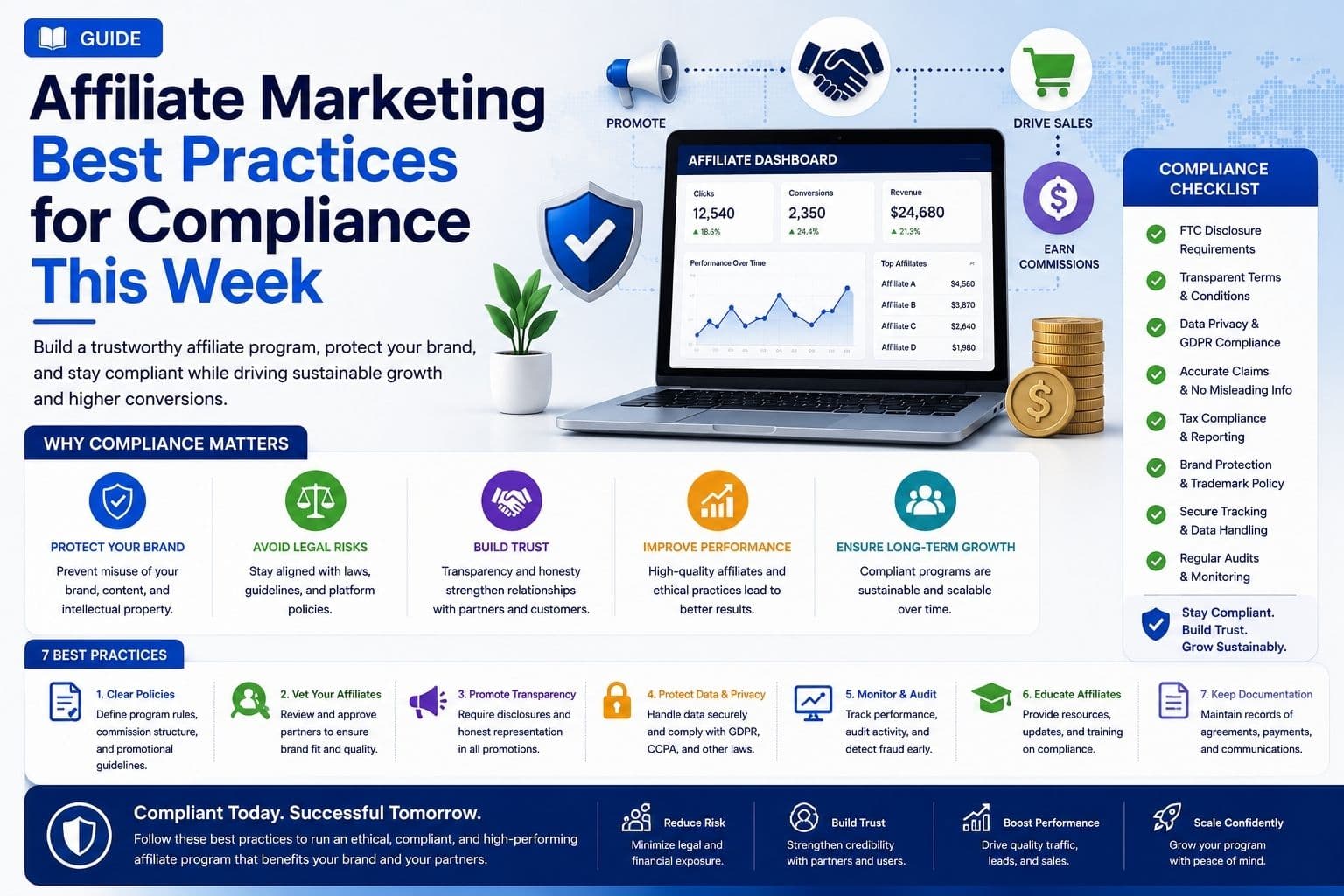
Affiliate marketing best practices for compliance this week are not just about following rules; they are about protecting your revenue streams and partner relationships. In live campaigns, we often see teams focus solely on conversion rates, only to have a promotion pulled because a disclosure was buried in a footer. The primary risk here is that non-compliance doesn't just invite regulatory scrutiny; it erodes the trust that makes performance marketing viable in the long term. I've seen it happen more times than I'd like to admit — a partner gets excited about a launch, shortcuts the review, and suddenly we're all scrambling to explain ourselves to a platform.
Defining Compliance in Current Affiliate Programs
Compliance in affiliate marketing means adhering to a patchwork of regulations, including the FTC's guidelines on endorsements and the specific terms of service set by platforms like Google and Meta. The operational reality is that what was acceptable last quarter may be flagged this week, especially as AI-driven detection tools become more sophisticated at identifying undisclosed partnerships. Teams often overlook the fact that compliance isn't a static checklist; it is a live operational constraint that requires daily monitoring of network policies and platform updates. And honestly, that daily monitoring part is where most programs start to slip — not because people are lazy, but because there's always a fire somewhere else burning brighter.
What Actually Happens in Live Compliance Audits
When we audit affiliate programs that are under pressure, we see the same pattern: the sales team pushes for aggressive copy while legal reviews it days later. This workflow dependency creates a bottleneck where assets go live before they are vetted, leading to sudden takedowns and withheld commissions. A non-obvious detail that catches many managers off guard is that compliance applies not only to the affiliate's website but also to the creative assets, landing pages, and even the email sequences the partner uses to promote the offer. That last one keeps biting people — they check the blog post and the social caption, but nobody thinks to look at the nurture sequence until a subscriber reports it.
Common Missteps Leading to Affiliate Account Bans
The most common mistake is assuming that a simple "affiliate link" tag is sufficient disclosure. In practice, regulators and platforms are looking for clear, unambiguous language that a consumer cannot miss, placed near the call-to-action, not just in a terms page. Another failure pattern involves using tracking parameters that bypass a partner's required click-through process, which is a direct violation of most network agreements and a primary cause of sudden commission clawbacks. It's the kind of thing that feels like a clever workaround at 11pm when you're trying to hit a deadline, but it reads as intentional deception when the network's compliance bot picks it up three weeks later.
Need Bringmark's engineers to implement this for you?
Get a free 30-minute architecture & growth review tailored to your stack.
Making the Decision: Internal Review vs. Partner Liability
When deciding how to structure compliance this week, the key is to determine who holds the liability if a partner violates a rule. Many brands mistakenly shift all responsibility to the affiliate, only to find that the brand is still named in the complaint. To mitigate this, establish a clear escalation path where flagged content is reviewed and corrected within 24 hours, rather than waiting for the network to step in. This is where a cross-discipline approach, similar to how production teams handle code deploys, becomes essential; having a performance marketing specialist review assets before launch prevents costly rework and protects the program's integrity. The 24-hour window matters too — drag it out to 48 or 72 and you're basically inviting the network to make the decision for you, and they rarely rule in your favor.
FAQ
q: What is the single most important rule for affiliate disclosure?
a: The most important rule is that disclosure must be clear and conspicuous to the consumer, placed near the endorsement or link, and not hidden in fine print. A best practice is to use plain language like "We may earn a commission" directly above the affiliate link, ensuring it is visible without requiring a click. Though honestly, depending on who you ask, even that phrasing might not be enough — some platforms are pushing for more explicit wording these days.
q: How can I monitor affiliate compliance without a full legal team?
a: You can monitor compliance by scheduling weekly spot-checks of your top affiliates' content and using automated alerts for new promotional materials. A practical first step is creating a simple checklist that reviews disclosure placement, claim accuracy, and adherence to your brand guidelines, which can flag 80% of common issues before they escalate. Start with your top 10 partners — the ones driving 90% of your revenue — and then work your way down as you build momentum.
q: Does compliance risk increase as my affiliate program scales?
a: Yes, scaling increases risk because you lose visibility into every partner's tactics, and a single bad actor can jeopardize your entire network's status. To manage this boundary, tier your affiliates and apply stricter manual reviews to high-volume partners while using automated tools to screen the long tail of smaller publishers. That tiering approach has saved us more than once — the small publishers are where the weird stuff tends to hide, but you can't hire enough people to manually check all of them.
q: What should I do if an affiliate violates a compliance rule?
a: If a violation is found, immediately remove the affiliate's access to your creatives and issue a formal warning, documenting the issue for your records. For severe or repeated breaches, terminate the partnership to protect your brand, and consider consulting with a specialist, such as those at bringmark, to ensure your enforcement process aligns with legal and platform standards. And keep that documentation tight — if the network asks questions later, you want to show that you acted swiftly and consistently, not that you let it slide for weeks before doing anything.
The core engineering, AI, cloud, and product development team at Bringmark Private Limited. We architect and operate production SaaS platforms, enterprise web applications, and resilient cloud infrastructure.