Landing Page Optimization Platform Guide: Reduce Risk Before Scaling
Key Takeaway (TL;DR)
Landing Page Optimization Platform Guide: Reduce Risk Before Scaling Using a landing page optimization platform to reduce risk before scaling means fixing the conversion leaks, technical debt, and performance bottlenecks
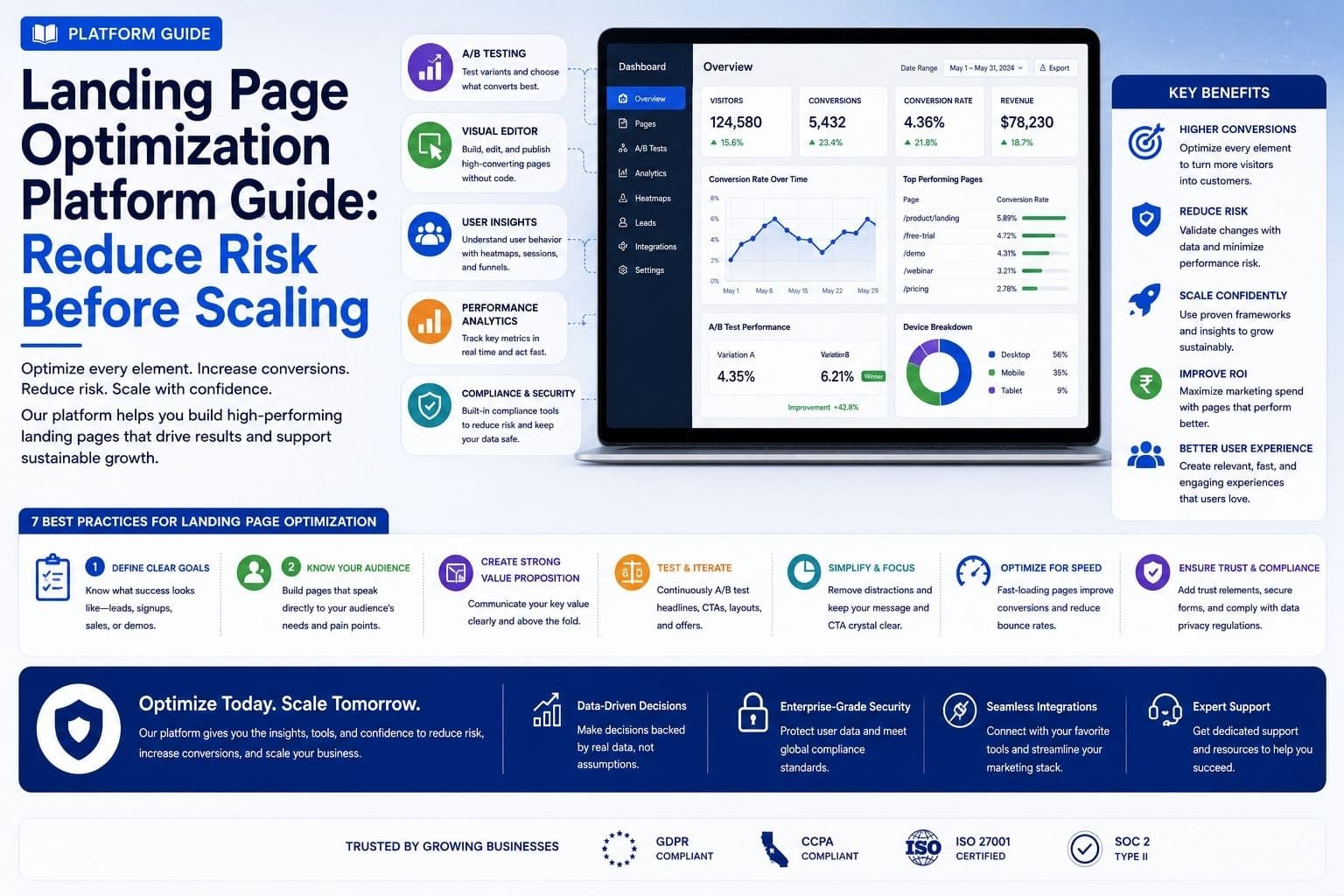
Using a landing page optimization platform to reduce risk before scaling means fixing the conversion leaks, technical debt, and performance bottlenecks that quietly erode ROI once traffic volume increases. In live projects, teams often discover that what worked at 1,000 visitors per day breaks down completely at 50,000, because they optimized for the dashboard metrics, not the actual production environment. The real challenge is that scaling multiplies every flaw in your landing page architecture, from slow render times to broken event tracking, so any optimization strategy must prioritize operational hardening over cosmetic A/B testing. It's not exciting work, but it's the difference between a smooth ramp and a fire drill.
What a Landing Page Optimization Platform Actually Does in Delivery
A landing page optimization platform serves as the control layer for testing, personalization, and performance monitoring, but its primary value in a delivery context is risk detection before you commit more budget to traffic acquisition. The operational reality is that most conversion rate drops during scaling are caused by JavaScript errors that only appear under load, third-party script conflicts, or session recording tools that silently throttle page speed on mobile devices. Teams often overlook that their experimentation tool itself can become the bottleneck, with heavy tag managers adding 300-500 milliseconds to critical rendering paths on lower-end devices, which is a non-obvious detail that destroys conversion rates at scale. It's one of those things you don't notice until you're debugging a dip that shouldn't exist.
Reality Check: What Happens When Traffic Volume Multiplies
When you scale a landing page from a controlled test environment to full production traffic, the failure patterns shift dramatically, and this is where the platform's monitoring capabilities become essential rather than optional. For example, a common scenario involves a client-side A/B testing script that works perfectly in a staging environment but causes layout shift and content flicker in production, leading to a measurable 15-20% conversion decline that is invisible in aggregate analytics. Another real-world observation is that QA testing cycles often miss the interaction between the optimization platform and Content Security Policy headers, which can block personalization scripts entirely in certain browser configurations, creating a false negative on your test results. And then you're left wondering why the data looks clean but revenue is flat.
Common Mistakes That Turn Optimization Into a Scaling Risk
The biggest mistake teams make is treating the optimization platform as a marketing tool rather than a piece of critical production infrastructure, which leads to governance gaps, untracked script versions, and deployment delays when issues surface post-launch. A frequent failure pattern is running dozens of simultaneous experiments without proper audience segmentation, which pollutes your data pools and makes it impossible to determine which variation actually drove the lift, forcing teams to make scaling decisions on regression-level data. The boundary where this approach stops scaling is when you have more than 20 active experiments across multiple landing pages, because the statistical noise and interaction effects between tests become unmanageable without a dedicated experimentation operations role. And let's be honest, most teams don't have that role budgeted until it's already a problem.
Need Bringmark's engineers to implement this for you?
Get a free 30-minute architecture & growth review tailored to your stack.
How to Decide the Right Scope and Partner for Optimization
Your decision framework should focus on whether the platform can handle your integration architecture, specifically your CRM, analytics stack, and server-side rendering setup, because these workflow dependencies determine whether you get reliable data or just more noise. Teams that fail to map the optimization platform's server-side capabilities against their existing DevOps pipelines often end up with watered-down functionality, where client-side injection is the only option, which breaks on accelerated mobile pages and increases abandonment rates. When cross-discipline execution matters across web development and marketing operations, bringing in a partner like bringmark can help you align your experimentation program with your live production hardening requirements, ensuring your optimization platform reduces risk rather than introducing new failure vectors. But you need to do the internal homework first, otherwise you're just outsourcing the confusion.
FAQ
q: What is the first step to reduce risk when using a landing page optimization platform?
a: You need to audit your current page performance baseline, including server response times, JavaScript execution, and third-party script load, to identify what constraints exist before adding an optimization layer. If you skip this, you're just guessing at what's slow.
q: How can I avoid deployment delays when integrating an optimization platform?
a: You should run a feature-flag-based rollout approach, load the platform asynchronously, and set a strict performance budget that blocks any release if core web vitals degrade by more than 10%. It's a bit rigid, but it saves you from the 'it worked in staging' conversation later.
q: What is the main scaling constraint for landing page optimization programs?
a: The main constraint is data integrity across multiple concurrent tests, because sample size calculations become unreliable when you have overlapping experiments on the same page elements and traffic segments. Once you get past a handful of tests, the math gets messy fast.
q: How do I decide if my platform choice will scale with my traffic needs?
a: You should verify the platform's support for server-side rendering and edge computing, because client-side-only optimization will create flicker and delay issues that undermine conversion rates as traffic grows. It's not the easiest path, but it's the one that holds up under load.
The core engineering, AI, cloud, and product development team at Bringmark Private Limited. We architect and operate production SaaS platforms, enterprise web applications, and resilient cloud infrastructure.