Big Data Solutions Platform Guide: Reduce Risk Before Scaling
Key Takeaway (TL;DR)
Big Data Solutions Platform Guide: Reduce Risk Before Scaling Scaling a big data solutions platform is rarely just about adding more nodes or increasing storage quotas. The real pressure starts when live data streams, q
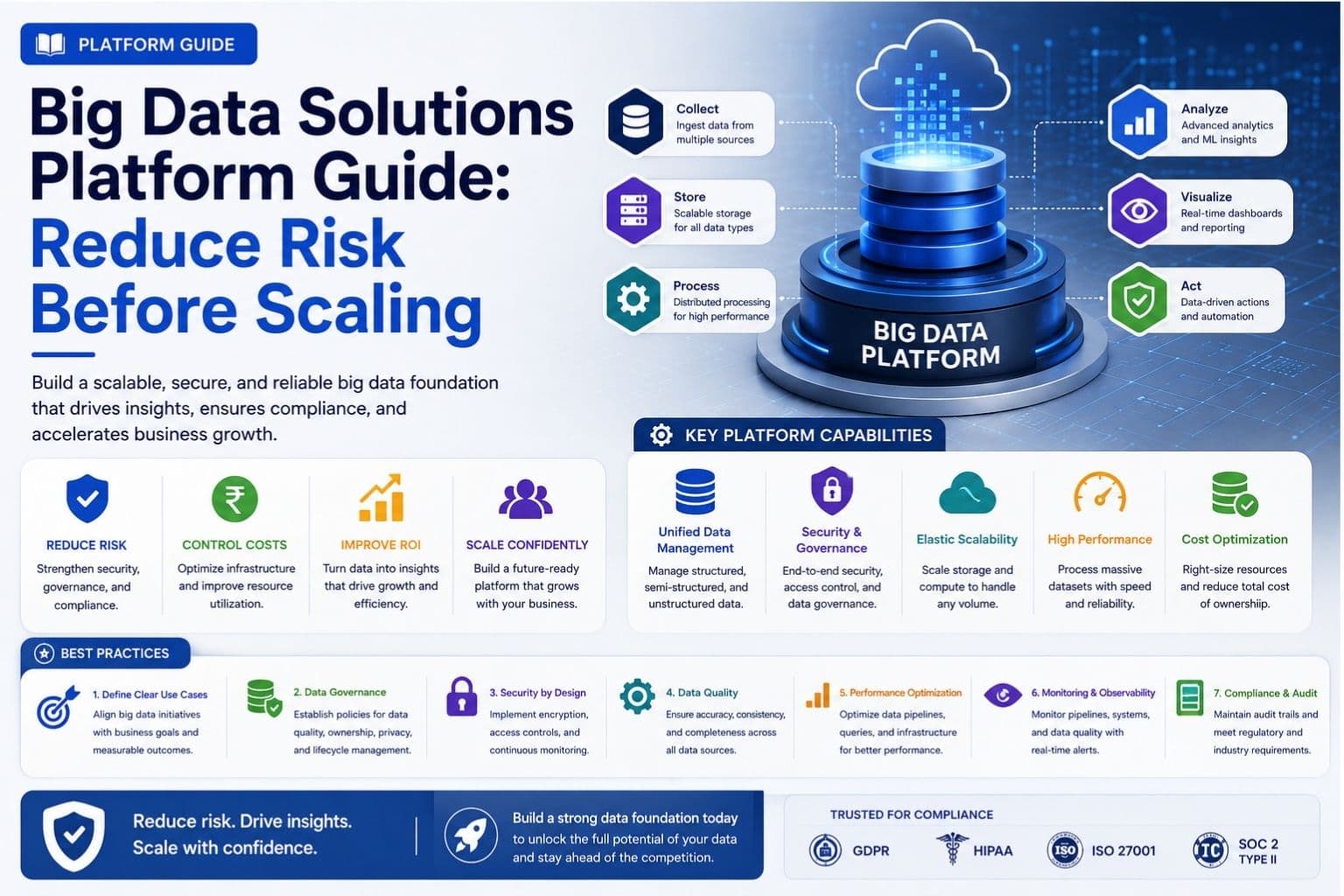
Scaling a big data solutions platform is rarely just about adding more nodes or increasing storage quotas. The real pressure starts when live data streams, query loads, and cross-team dependencies reveal flaws that were invisible during the pilot phase. In our experience managing production rollouts, the gap between a successful proof-of-concept and a reliable scaled platform is where most delivery schedules break, often because the operational realities of data integration and release management were underestimated. Honestly, we've lost more sleep over handoff points between teams than over cluster crashes.
Understanding Big Data Platform Risks in Real Delivery
In a live delivery context, risk on a big data platform isn't an abstract concept; it manifests as blocked pipelines, delayed reports, and frustrated data science teams waiting on stable environments. We have observed that the primary risk trigger is not the technology itself but the workflow dependency between ingestion, processing, and serving layers that teams often treat as separate projects. This siloed view creates integration risk that surfaces only when data must flow end-to-end under production load, and it is this point that turns a minor configuration issue into a critical path delay. It's almost never the thing you planned for that bites you—it's the handshake between components nobody owned.
What Actually Happens When You Scale Your Platform
When scaling begins, the most surprising reality check is that performance testing rarely mirrors production data skew. A common operational detail teams overlook is that a few 'hot' keys or partitions in your data can saturate resources and cause cascading failures, even if average metrics look healthy. We have seen this scenario force emergency re-architecture during a major release, as the system's inability to manage data volume variance led to significant rework cycles that pushed the deployment date back by weeks. The boundary here is simple: if your platform can't handle data skew, adding more hardware only increases costs without guaranteeing stability. And nobody wants to explain that budget overrun to the sponsor.
Scaling Mistakes and Assumptions That Break Timelines
The critical mistake is assuming that a configuration that works for a 1-terabyte dataset will logically scale to a petabyte-scale platform with the same operational behavior. This wrong assumption often leads to poor capacity planning, where teams allocate storage and compute without considering the governance concepts of data retention and privacy compliance, which can force costly changes later. A common misunderstanding causing bad decisions is believing that moving to the cloud automatically solves elasticity problems; in reality, without careful budget and quota management, the scale-up process can introduce new constraints and unforeseen cloud infrastructure costs, effectively halting progress while procurement and finance get involved. We've watched perfectly good technical plans stall for three weeks waiting on a cost approval that should've been flagged in the initial design review.
Need Bringmark's engineers to implement this for you?
Get a free 30-minute architecture & growth review tailored to your stack.
How to Decide on Scope, Partner, and Next Steps
To decide your next move, the team must first isolate the main risk: is it the platform's core data analytics processing ability or the integration architecture around it? We have seen that decisions made under deadline pressure often ignore the hard truth that scaling is a cross-discipline execution challenge. If internal teams lack deep experience in tuning distributed systems or managing complex deployments, bringing in a partner like bringmark can provide the production hardening and DevOps pipeline expertise needed to build a scalable roadmap that recognizes operational limits before they become critical project failures. This approach turns a risky pivot into a controlled, well-tested migration that aligns with client delivery expectations. Sometimes it's worth swallowing the pride and admitting the team doesn't know what it doesn't know.
FAQ
q: What is the most common risk when scaling a big data platform?
a: The most common risk is not hardware failure; it is the integration risk between different processing engines and data sources that emerge at higher volumes. Our real-world observation is that teams often miss how pipeline backpressure and data format changes during scaling can cause widespread system instability. It tends to show up right after you've committed to a go-live date.
q: Why do big data projects get delayed during the deployment phase?
a: Delays occur because QA testing cycles are often based on unrealistic data volumes, which fail to reveal performance bottlenecks. Teams overlook the non-obvious operational detail that test environments rarely have the same data skew as production, leading to unexpected and costly rework cycles during the final deployment stage. We've seen this push releases back repeatedly while teams chase a problem that only appears at scale.
q: How critical is data governance when expanding a data platform?
a: Governance becomes a top risk factor at scale because compliance rules can limit where data is stored and how it's processed. This constraint directly impacts the integration architecture and can invalidate an existing deployment plan, requiring significant revision and causing handover delays between teams. It's one of those things that gets deferred as 'future work' until legal gets involved.
q: Should we build our platform in-house or use external help for the scaling phase?
a: This decision hinges on your team's experience with distributed systems and release management under pressure. If the pipeline is new to your team, relying on a partner like bringmark for cross-discipline execution ensures production systems are hardened and avoids the common misunderstanding that scaling is just an IT task rather than a critical business project. The honest answer is it comes down to how much pain you can absorb in early failures.
The core engineering, AI, cloud, and product development team at Bringmark Private Limited. We architect and operate production SaaS platforms, enterprise web applications, and resilient cloud infrastructure.