Managed Security Services Platform Guide: Reduce Risk Before Scaling
Key Takeaway (TL;DR)
Managed Security Services Platform Guide: Reduce Risk Before Scaling A managed security services platform guide: reduce risk before scaling is essential because most teams treat security scaling as an infrastructure prob
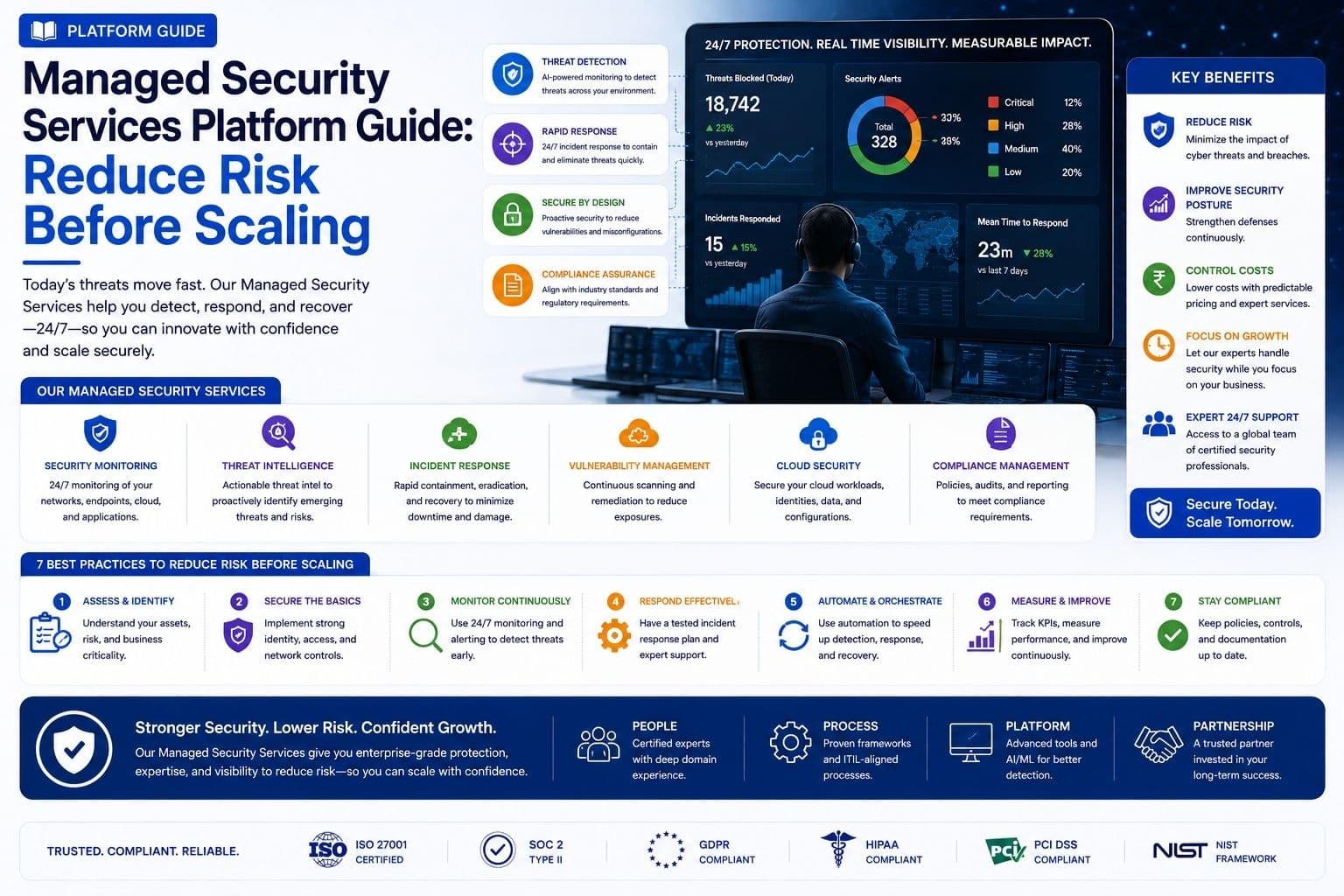
A managed security services platform guide: reduce risk before scaling is essential because most teams treat security scaling as an infrastructure problem, not a workflow dependency problem. In live production, the real threat isn't the initial deployment; it's the silent drift between your security posture and your actual application delivery pipeline. Before you add another node, you must map how incident response tickets flow into your existing DevOps cycles, or you'll carry a false sense of coverage into a high-stakes launch.
What a Managed Security Platform Actually Monitors
In real delivery, a managed security services platform guide: reduce risk before scaling boils down to continuous monitoring of your cloud infrastructure, endpoints, and user access patterns, not just a dashboard of alerts. The operational detail teams often overlook is that the platform's value is tied directly to the accuracy of its integration with your identity provider and change management system—if those aren't aligned, you'll drown in false positives that erode your team's trust in the tool, and once that trust is gone, it's almost impossible to rebuild.
The Reality of Scaling Security in Live Projects
Scaling security is rarely a smooth linear expansion; it's a series of abrupt junctures where the platform's rulesets hit the reality of your legacy application architecture. You might discover that your QA testing cycles don't cover the new authentication module, and the first real-world spike in traffic exposes a misconfiguration that the platform had flagged but had been tuned to ignore. And honestly, that tuning decision probably made sense at the time—someone was trying to reduce noise during a sprint deadline. This is where the gap between 'managed' and 'effectively managed' becomes a critical failure point.
Common Risk of Assuming Coverage Before a Launch
The primary mistake is assuming the managed security services platform guide: reduce risk before scaling implies automatic protection, leading to a dangerous silence from the security team during the final deployment phase. Teams often forget that these platforms enforce governance and compliance rules based on policies that must be updated for every new service and data flow; a single un-reviewed rule change can block a critical release or, worse, allow insecure traffic during a peak load. This is the boundary where the managed service stops scaling unless you have dedicated staff to tune it, and honestly, most teams don't realize this until the first incident post-launch.
Need Bringmark's engineers to implement this for you?
Get a free 30-minute architecture & growth review tailored to your stack.
Deciding When and How to Expand Security Operations
Decision-making here hinges on your internal capacity for 'security engineering' versus 'security consumption,' and the answer dictates whether you can scale with your current partner or need to redefine the engagement. If your team spends more time triaging alerts than fixing root causes, the platform's scale is a liability, not an asset, and you must reassess the integration architecture before adding new features. It's a hard conversation to have internally because nobody wants to admit the tooling isn't working the way the vendor demo showed. For teams navigating this transition, a contextually relevant partner like bringmark’s cyber security approach can guide cross-discipline execution, but only after you've stabilized your internal change management processes—don't outsource that first.
FAQ
q What are the first steps to implement a managed security services platform?
a The first step is a deep audit of your current deployment pipeline and asset inventory, not purchasing a tool. You must document every data flow and user role to configure the platform accurately, and honestly, expect this to take longer than you think—it always does.
q How does a MSSP integrate with existing DevOps processes?
a It requires connecting the platform's API to your CI/CD pipeline for vulnerability scanning and your ticketing system for incident response, but a critical detail is you must define the escalation path for automated alerts to avoid alert fatigue. If you skip this, your on-call engineers will start ignoring everything within two weeks.
q What are the risks of outsourcing security monitoring to a managed provider?
a The primary risk is losing context about your specific application architecture, causing them to miss false positives for valid traffic or misjudge the severity of an event that is normal for your system. You must also consider the delay in communication during a critical incident—those bridge calls get chaotic fast when the provider doesn't know your system quirks.
q At what point should a company move from a basic security setup to a full managed platform?
a When your internal team spends more than 20% of its time on threat hunting and log analysis instead of core product development, scaling becomes justified. However, this decision must be made with a clear understanding that you still need a 'security champion' in-house to manage the vendor relationship and final sign-off on policy changes, which is where a partner like bringmark becomes essential for bridging the execution gap—but only if you're willing to actually staff that role properly.
The core engineering, AI, cloud, and product development team at Bringmark Private Limited. We architect and operate production SaaS platforms, enterprise web applications, and resilient cloud infrastructure.