Careers in Karawalnagar: Skills to Build for Frontend Developer Interviews
Key Takeaway (TL;DR)
Careers in Karawalnagar: Skills to Build for Frontend Developer Interviews This guide sets out the skills, portfolio talking points and practice steps to prepare before applying for frontend developer roles. It is writt
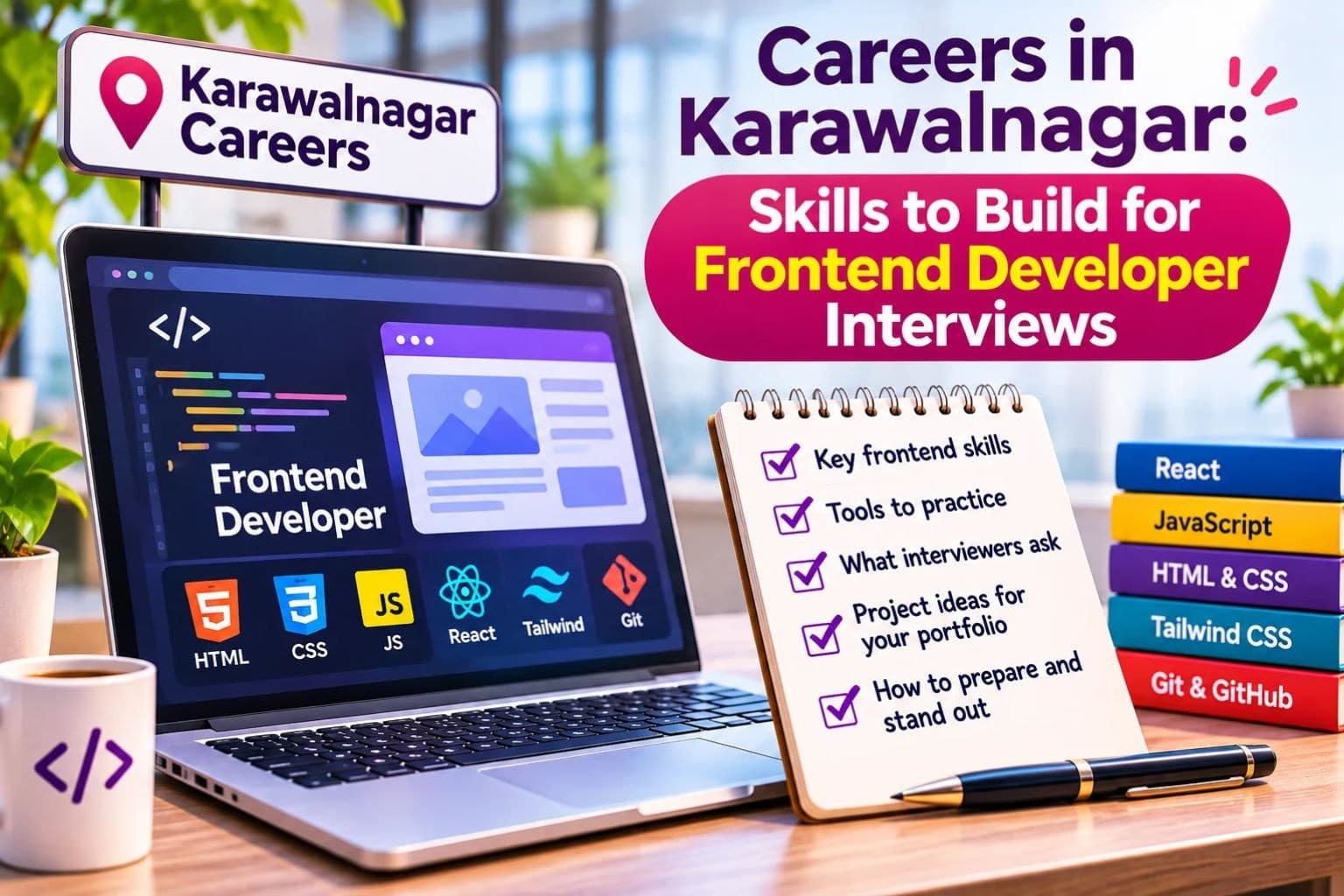
This guide sets out the skills, portfolio talking points and practice steps to prepare before applying for frontend developer roles. It is written for early-career candidates in Karawalnagar and across Delhi who want a clear preparation path rather than a list of shortcuts. It makes no claim about local hiring demand, employers, salaries, open roles or any interview process in the area.
Start with what you can demonstrate, then decide what to build, then rehearse how you explain it. That order keeps preparation honest. Many candidates begin by collecting frameworks and finish with a portfolio no reviewer can verify. The section order below is a diagnostic path: skills first, portfolio second, practice last.
You can view published openings on the Bringmark jobs page to see how role titles and skill lists are described. Treat it as a reference for reading requirements, not as an announcement.
Which React and TypeScript skills should you demonstrate first?
Demonstrate the skills you can explain end to end, starting with React state, TypeScript types and Next.js data fetching. Reviewers tend to trust depth over a long list of tools.
React state and rendering: show one screen where data changes while it is open, and explain how you keep the display consistent.
TypeScript discipline: describe how you typed props, API responses and form values, and where a type caught a real mistake.
Next.js rendering choices: say in two sentences whether a page is server-rendered or client-rendered, and why that suited the task.
Tailwind CSS layout: be ready to explain one responsive layout decision and what you did to keep it readable at small widths.
Framer Motion interaction: describe an animation you added and the reason it helped the user rather than decorating the page.
Error states: show what the screen does when an API returns an error mid-session, and why you handled it that way.
If you have touched test tooling such as Playwright, say where it sat in your workflow. Do not claim coverage you cannot walk through.
Why does a smaller frontend portfolio often read better to reviewers?
It reads better because one deployed project with a clear story can be checked, while six half-built screens cannot. Reviewers need something concrete to question.
Pick one application you can defend from first screen to a known bug fix.
Remove unfinished work from the front of your portfolio, or label it honestly as a study.
Write a short note beside each project: the problem, the choice you made, and what you would change now.
Record one measured improvement, such as a slower first load you fixed, and keep the method you used to check it.
Prepare one failure story: what broke, how you found it, and what the fix changed.
Need Bringmark's engineers to implement this for you?
Get a free 30-minute architecture & growth review tailored to your stack.
A single honest narrative beats a crowded showcase. Depth in one stack also travels better than shallow coverage of many.
How do accessibility and performance become interview talking points?
They become talking points when you tie each one to a specific screen and a specific change you made. General statements about quality rarely survive a follow-up question.
Focus management: explain how a modal keeps keyboard focus inside it and returns focus when closed.
Error messaging: describe how a failed form submission tells the user what happened, without relying on colour alone.
Loading states: walk through a skeleton or placeholder screen and how you avoided a layout jump when real data arrived.
Page weight: name one asset or script you removed or deferred, and how you checked the effect.
You do not need invented numbers. A plain account of the change and your check is enough.
What should you verify before applying from Karawalnagar?
Verify that your work, your notes and your explanations line up before you send an application. Small gaps in the story cost more than gaps in tool coverage.
Your main project opens correctly on a fresh browser and on a phone-sized screen.
Each project note names the problem, the trade-off and one thing you would change.
You can explain your data-fetching choice in two sentences without notes.
You can show one accessibility decision and one error-handling decision.
Your resume skills match what you can actually walk through in a review.
You have read the published role description and matched its listed skills to your own examples.
Bringmark is a software engineering company in New Delhi that builds web platforms, mobile apps, AI automation and cloud systems, and operates ParlourTime and VefDoc. Its published frontend role lists React, Next.js, TypeScript, Tailwind CSS and Framer Motion, which gives you a useful sample of how requirements are written. For related production context, see website development services. Neither page implies any office, partner or hiring activity in Karawalnagar.
What does a useful week of frontend interview practice look like?
A useful week is short and repetitive: one project, one explanation, one rehearsal, then a review of your own answers. Practice should sharpen what you already understand.
Day one: rewrite your project note as three short paragraphs covering the problem, the choice and the result.
Day two: rehearse the rendering and data-fetching explanation out loud, then cut it to under a minute.
Day three: add or fix one error state, then describe the change in two sentences.
Day four: check keyboard navigation on your main screen and note what you corrected.
Day five: ask someone to interrupt your project story with follow-up questions, and note where it thinned out.
Day six: compare your resume skills against your project walkthrough and remove anything you cannot defend.
Repeat this cycle rather than adding new tools. Consistency in what you can explain is the preparation you control, and it is what carries into a real conversation.
The core engineering, AI, cloud, and product development team at Bringmark Private Limited. We architect and operate production SaaS platforms, enterprise web applications, and resilient cloud infrastructure.