Hashtsal Engineering Jobs: Interview and Portfolio Questions for Full-Stack Roles
Key Takeaway (TL;DR)
Hashtsal Engineering Jobs: Interview and Portfolio Questions for Full-Stack Roles If you are searching for Hashtsal engineering jobs, the practical starting point is your portfolio and how you talk about it.
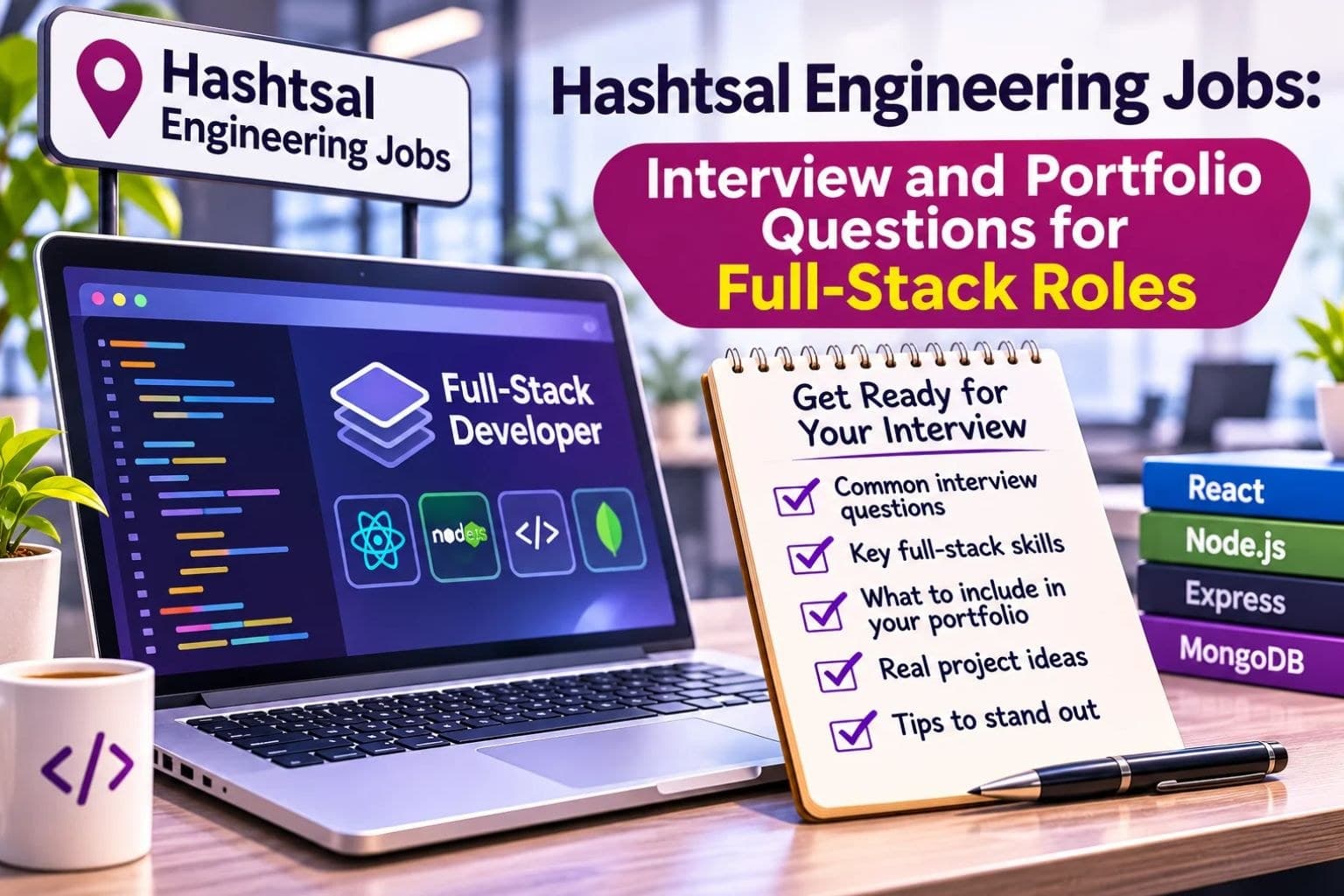
If you are searching for Hashtsal engineering jobs, the practical starting point is your portfolio and how you talk about it. This guide covers what to put in project write-ups, which interview areas to prepare, how to show code review and testing habits, and a checklist you can use this week. The advice is generic preparation guidance for full-stack roles, wherever the job sits.
What your full-stack portfolio should prove
Your portfolio should prove that you carried one system through delivery, not that you can list frameworks. A reviewer opening your project page needs three things fast: the problem, your specific role, and what happened after launch.
A strong project write-up stays short but concrete. State the problem in one line. Then name the parts you owned, such as the API contract, the database schema, or the checkout flow. Add one number or observation from real use, like a slow query you fixed or a timeout you traced. Finish with what you would change now.
Weak write-ups share a pattern. They show screenshots and a feature list, but no architecture, no failure, and no evidence of users. If your project never went live, say so plainly and describe the testing you did instead. Honesty reads better than an inflated claim, and interviewers usually find the gap in the first five minutes.
Which interview areas should you prepare for?
Prepare for four areas: architecture trade-offs, data handling, release and incident stories, and communication during delivery. Most full-stack interviews draw questions from these four, even when the wording changes.
For trade-offs, have one worked example ready. Walk through a decision such as choosing a single deployable app over separate services, and explain what you gave up. Cost, team size, and timeline are all fair reasoning. A candidate who says "we picked microservices because they are modern" loses ground quickly; one who explains why a monolith was enough at the time gains it.
For data handling, expect questions about migrations, secrets, and access. Be ready to describe how environment variables were managed, who could reach the production database, and what happened when a migration failed. Small details like rollback steps separate people who touched real systems from people who only cloned a repo.
For release and incident stories, prepare one calm narrative. Name the release, what broke, how you noticed, and what you changed afterward. Interviewers are listening for whether you had monitoring and whether you told anyone. Vague answers here cost more than a slow answer.
For communication, expect a question about disagreement or a missed deadline. Answer with what you said, to whom, and how early. Delivery is a team activity, and interviewers weigh whether you keep people informed.
How do code review and testing habits show up as candidate evidence?
Code review and testing habits show up best as artifacts you can point to, not as claims about being careful. Bring links, not adjectives.
Useful artifacts include a pull request where a reviewer caught something real and you changed the design, a test suite you added before a risky change, and a short note on how you checked a feature before release. If your repositories are private, describe the work and offer a redacted example in the interview.
Need Bringmark's engineers to implement this for you?
Get a free 30-minute architecture & growth review tailored to your stack.
Testing conversations go better when you speak about risk. Explain which paths you tested by hand, which ones had automated checks, and where you accepted a gap because of time. That kind of answer shows judgment, and it holds up when the interviewer asks a follow-up.
One practical limit: reviewers rarely read long documentation during screening. Keep the artifact close to the project page and one click away. A short paragraph plus a working link beats a long essay that nobody opens.
What should you settle before you apply?
Before you apply, settle the role shape and your own story. Full-stack titles vary widely, so spend an hour reading the listing closely and matching your evidence to it.
Ask yourself whether the role leans frontend, backend, or genuinely split, and then lead with your strongest matching project. Check the verified careers page at Bringmark jobs to see how one engineering team describes its roles and expectations; use it as a reference for the kind of detail a listing may ask for. For context on how delivery work is usually scoped, the Bringmark homepage and the services overview describe typical project areas.
Then prepare your questions for the interviewer about team structure, release rhythm, and who reviews code. A decision boundary worth respecting: no amount of preparation guarantees an offer, and a good interview does not fully predict how someone settles into a team. Treat the process as a two-way check and ask for the details you would need to do the job well.
Your full-stack preparation checklist
Use this numbered checklist in the week before an interview. Each item should take under an hour, and each one produces something you can show or say.
Finish one project write-up: problem, your owned parts, one real observation from use, and what you would change now.
Rehearse one trade-off walkthrough out loud, including what the chosen option cost you in time or flexibility.
Pick one pull request that shows review feedback you acted on, and be ready to explain the change.
Summarize your testing approach for one feature: what was automated, what was manual, and where you accepted a gap.
Write a three-sentence incident or release story with the detection, the fix, and the follow-up.
Prepare two questions about release rhythm and code review ownership for the interviewer.
Portfolio check: if a reviewer cannot tell what you personally built within one minute, rewrite the top of the page.
Skill signal: naming a rollback you performed and who approved it shows release exposure better than a tool list.
If answers stay inside the framework and never reach deployment or data handling, practice one written systems walkthrough before the next round.
Common misread: a long technology list is not breadth of experience. Time each system spent in production and your ownership matter more.
Scenario to practice: a queue added after checkout timeouts rose. Explain how you measured the problem and what you watched afterward.
Role scope: confirm whether the job is split full-stack or a specialized hire in disguise, because that changes every answer you give.
Closing step: collect your requirements, verify the provider's actual services and team structure, and prepare your own checklist of questions before you commit time to a long process.
The core engineering, AI, cloud, and product development team at Bringmark Private Limited. We architect and operate production SaaS platforms, enterprise web applications, and resilient cloud infrastructure.