Jobs in New Delhi G.P.O.: Interview and Portfolio Questions for Full-Stack Engineer Roles
Key Takeaway (TL;DR)
Jobs in New Delhi G. P. O. : Interview and Portfolio Questions for Full-Stack Engineer Roles This is a preparation guide for candidates applying to full-stack engineer roles, not a vacancy listing. It covers what a prod
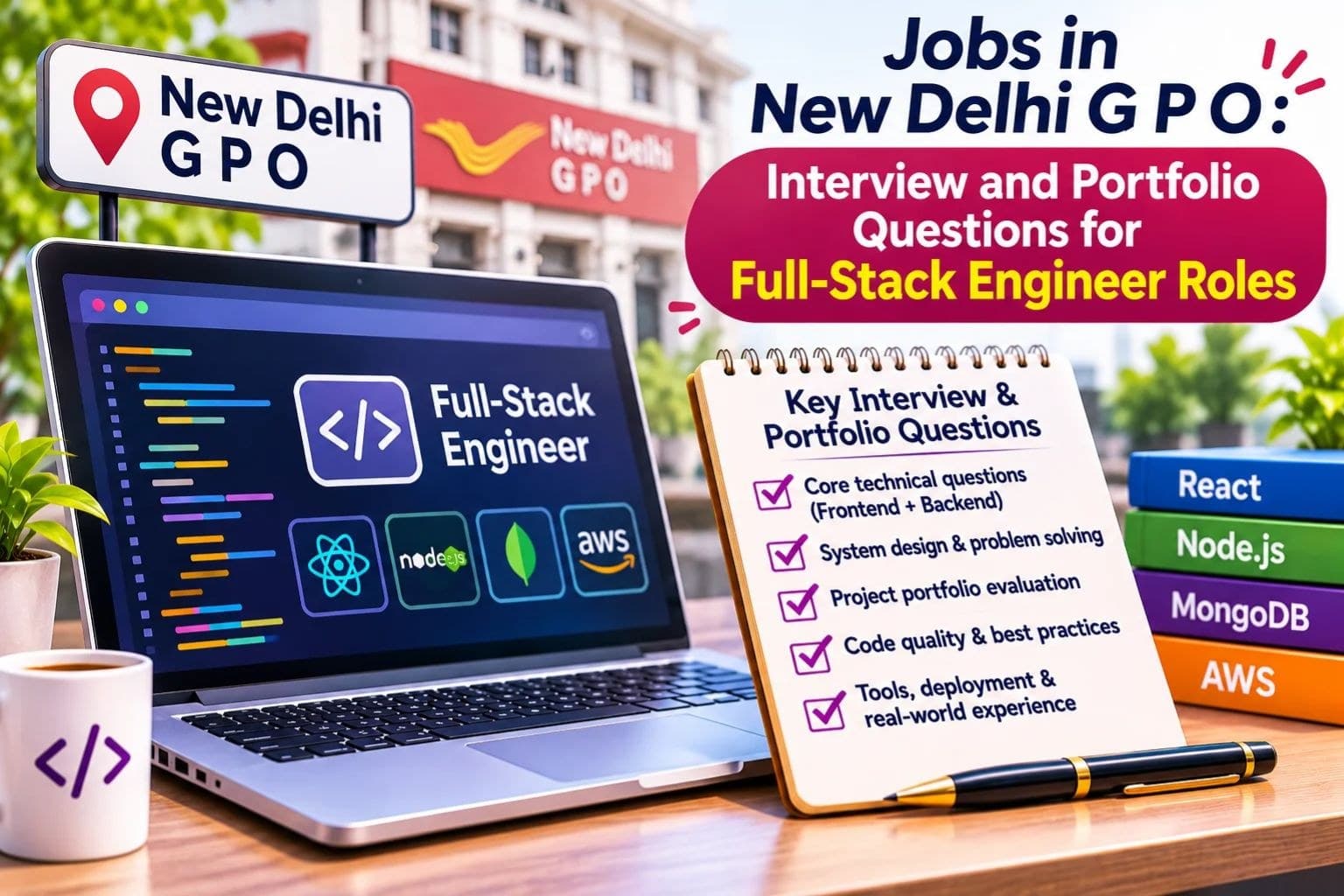
This is a preparation guide for candidates applying to full-stack engineer roles, not a vacancy listing. It covers what a production portfolio should show, the interview topics worth rehearsing for the Senior Next.js & Full-Stack Engineer, Frontend Developer (React / Next.js / Tailwind) and Node.js & Cloud Backend Engineer roles, plus how to describe ownership and what to ask an employer. Current openings are listed on the Bringmark jobs page. New Delhi G.P.O. here describes where you are searching from, not a Bringmark office, branch, event or service location.
Why does a tool-list portfolio stall before the interview?
The most common symptom is a portfolio that names frameworks but never shows a shipped outcome. A reviewer sees Next.js, React and TypeScript on a resume and nothing about what went live, what broke, or who used it. That gap is what stalls candidates first.
Production portfolio means evidence that your work ran for real users. Ownership means you can trace a decision from the ticket to the deployment and the follow-up fix. Both are cheap to show if you actually did the work, and hard to fake in conversation.
The fix is not more projects. It is one project documented deeply enough that a stranger can follow your reasoning, the deployment, and the moment something needed repair.
What should a production portfolio show for these three roles?
Use only the stack listed on the verified job pages: Next.js, TypeScript, React and Tailwind CSS for frontend work, plus Node.js, PostgreSQL and MongoDB for backend and data work. One well-documented project per role type is usually enough.
For Senior Next.js & Full-Stack Engineer roles, frame one deployment decision: how you split server and client rendering, why you chose a particular caching approach, and what changed after launch.
For Frontend Developer (React / Next.js / Tailwind) roles, show an accessible component pattern and one interaction you simplified after testing, not just a visual gallery.
For Node.js & Cloud Backend Engineer roles, describe one API or webhook design: how a failure retried, how a PostgreSQL transaction was kept consistent, and how MongoDB reads were indexed.
A second useful artifact is a short written note on a migration that ran late or a release you held back. Keep the note factual, name the measurement you used, and stop before the story turns into a boast.
Need Bringmark's engineers to implement this for you?
Get a free 30-minute architecture & growth review tailored to your stack.
Which interview topics deserve the most rehearsal?
Questions tend to sit where the roles meet: how a Next.js page fetches from a Node.js service, how a failed request is retried without duplicating a write, and how a PostgreSQL transaction behaves under concurrent updates. Rehearsing these aloud is different from reading about them.
Expect questions about rendering strategy, API contracts, and query performance. A useful boundary: if you cannot explain a tradeoff in two minutes without opening a laptop, treat it as revision you still owe yourself.
How do you describe ownership of shipped work?
Do it as a short narrative with three parts. First the situation, stated plainly. Second the decision you made and the alternative you rejected. Third the outcome you measured and what you would do differently.
Keep in mind that a candidate-side story is a witness account, not proof of skill. An interviewer will probe the details, so review your own past work honestly and keep the boundary clear between what you did and what a team did around you.
What practical checks help before applying?
Run these checks before you send an application, then run them again before the technical round.
Repository walk-through. Read your own commit history as if you were reviewing someone else. If a merge, a regression and its fix are not visible, prepare that narrative now.
Two-minute tradeoff test. Say out loud why you chose a caching layer, a database index or a rendering mode. If the answer wanders, that is the topic to prepare next.
Stack breadth over depth. Narrow the portfolio to the stacks the listed roles ask for, and deepen the story behind each one rather than listing every tool you have touched.
Role scope questions to ask any employer. Ask who owns a feature from design to deployment, whether review happens before merge, and how on-call work is divided. These answers tell you more than any job description.
Learning support question. Ask how the team handles its own incidents and what happened after the last one. A genuine answer signals a delivery process you can grow inside.
Current openings check. Read the live engineering team and hiring pages before applying, so your preparation matches the role scope actually published.
The practical outcome is a portfolio and a story that survive a difficult technical round, and a short list of questions that lets you judge whether a team is worth joining. Start with one deployment you can explain end to end, then check the published roles and apply where the scope matches.
The core engineering, AI, cloud, and product development team at Bringmark Private Limited. We architect and operate production SaaS platforms, enterprise web applications, and resilient cloud infrastructure.