Chanakya Puri teams and AI output governance: questions before trusting automated reports
Key Takeaway (TL;DR)
Chanakya Puri teams and AI output governance: questions before trusting automated reports An automated report should be trusted only after you can confirm where its data came from, what audit trail it leaves, who reviews
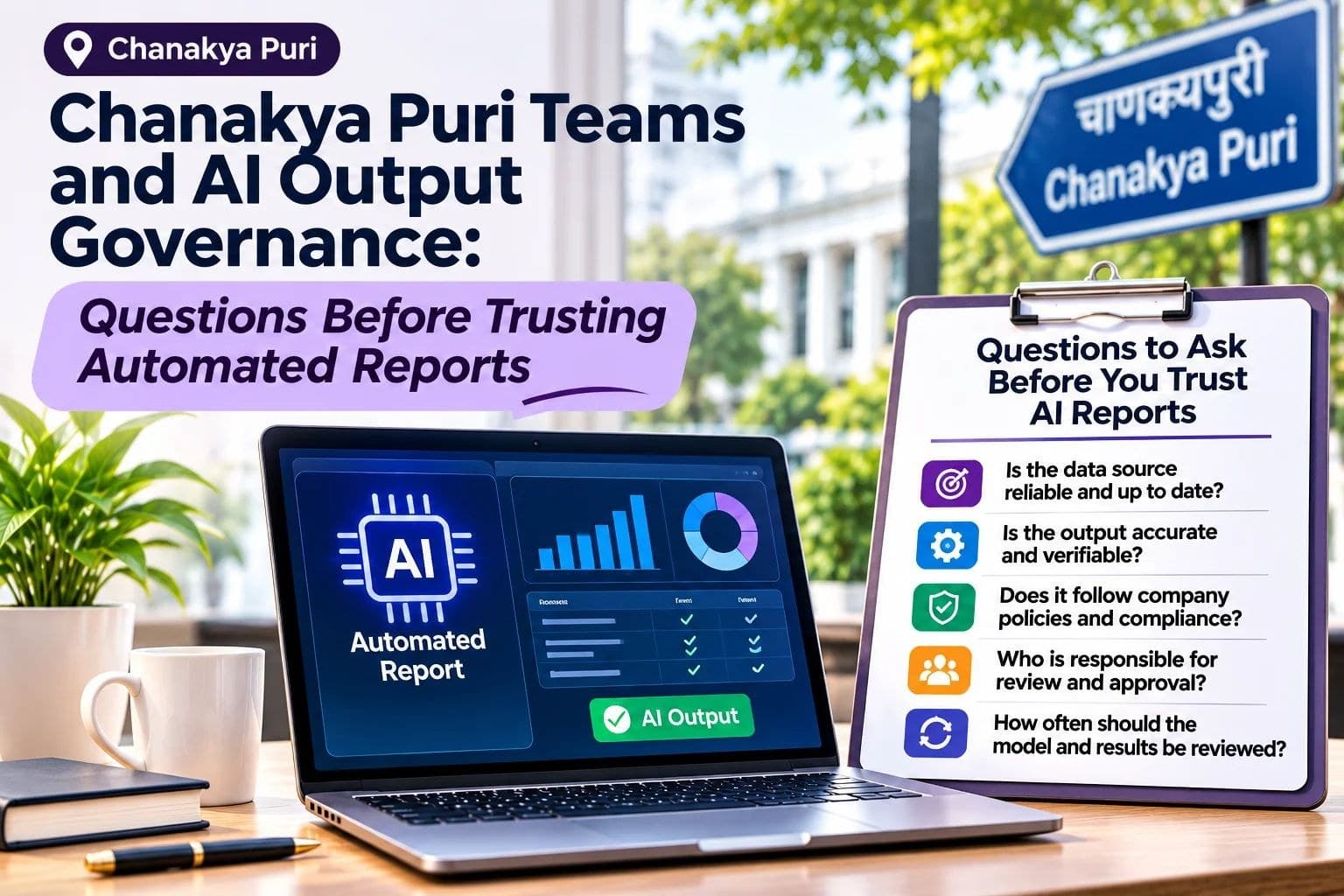
An automated report should be trusted only after you can confirm where its data came from, what audit trail it leaves, who reviews it, who owns a wrong number, and what your implementation partner has agreed to. For teams in Chanakya Puri receiving reports from an internal build or an outside vendor, those five checks matter more than any accuracy score on a slide, because they decide whether a number can be acted on at all.
This is a question-first checklist, not a product review. Work through it before you extend any reporting layer into client commitments or release approvals.
Why do AI-generated outputs need a review and ownership model?
Because a report with no named owner has no one positioned to stop it. Accuracy metrics describe how a system performed in testing; they say nothing about who acts when a live output drifts.
- Ask who is accountable, by name, when an automated figure turns out wrong.
- Ask how often that person actually reviews output, and what volume they can still read closely.
- Ask what happens to a disputed number between review cycles.
- Ask whether the current review model survives a doubling of report volume, or quietly turns into rubber-stamping.
If nobody can answer the first item, the rest are decoration. Ownership comes before accuracy.
What should we ask about data sources and audit trails?
An audit trail is the record that shows how a number was produced, from raw source record to final figure. Plain language matters here: if tracing a report back to its source takes an afternoon rather than minutes, treat the output as unverified rather than approximate.
- Which exact source tables or systems feed this report, and who controls changes to them?
- Can one figure be traced from the final report back to a single raw record, and how long does that take?
- Does the trail cover the transformation logic, or does it stop at ingestion?
- Where does that logic live, and who maintains it if that person is unavailable?
- Are we permitted to use each source under our own contracts and obligations?
That last point is a legal and contractual question, not a technical one. Confirm your specific obligations with qualified advisers rather than treating any single framework as sufficient. Pages on research insights can help you frame the data questions, but they do not replace your own legal review.
Which human-in-the-loop checkpoints suit a small team?
Human-in-the-loop simply means a person inspects or approves output at defined points before it is used. Small teams cannot review everything, so the skill is choosing checkpoints that scale.
Need Bringmark's engineers to implement this for you?
Get a free 30-minute architecture & growth review tailored to your stack.
- Put one checkpoint where data enters, to catch source changes early.
- Put a second before any output leaves the team and reaches a client or a release decision.
- Set a volume threshold: when weekly report counts pass what one reviewer can genuinely read, add tiered approval rather than skipping review.
- Log every override, so a reviewer's correction becomes part of the audit trail.
- Name a fallback reviewer for absences, since a single point of failure is not a checkpoint.
To make these steps stick, they usually need to sit inside the delivery pipeline rather than beside it. That is where deployment and pipeline practice and review design overlap.
What should we agree with an implementation partner?
Partner accountability is a contract question dressed as a technical one. Before work starts, agree on five dimensions: data provenance, audit trail completeness, review checkpoints, ownership and escalation paths, and who answers for a wrong output. A vendor with a managed-review workflow may cover some of these in their standard terms; your job is to check which, and to write down the gaps.
Useful questions in that conversation: which reports will be delivered with a traceable source link, how many review checkpoints are included, who is named on the escalation path, and what documentation changes hands at handover. Review work of this kind also benefits from pairing reporting design with AI and ML implementation support, so the review layer is built in from the start rather than bolted on later.
What does a practical trust check look like before the next report ships?
Short answer: decide the trust level of each report before it reaches a decision-maker, not after someone questions a number. As an illustrative example only, imagine a weekly forecast feeding a client commitment while a source table changes without notice; the output could stay plausible and wrong for several cycles unless a reconciliation step exists. Use that picture to test your own setup, not as a claim about any team.
Collect requirements first: list every downstream consumer of each automated report, since the riskiest one usually assumed the figure was already validated.
Prepare a checklist per report covering source, trail, reviewer, owner, and escalation contact.
Verify a provider's actual services against those five dimensions rather than relying on a summary deck.
Pause expansion when the ownership question has no clear answer; adding another report will not fix a missing reviewer.
Re-check the framework whenever a data source or transformation script changes, because governance is a live checkpoint, not a document signed at kickoff.
The core engineering, AI, cloud, and product development team at Bringmark Private Limited. We architect and operate production SaaS platforms, enterprise web applications, and resilient cloud infrastructure.