Cloud Security Guide: Cut Cost and Risk This Week for Business Teams
Key Takeaway (TL;DR)
Cloud Security Guide: Cut Cost and Risk This Week for Business Teams This cloud security guide for business teams shows how overlooked operational gaps in identity management and unused compute resources simultaneously i
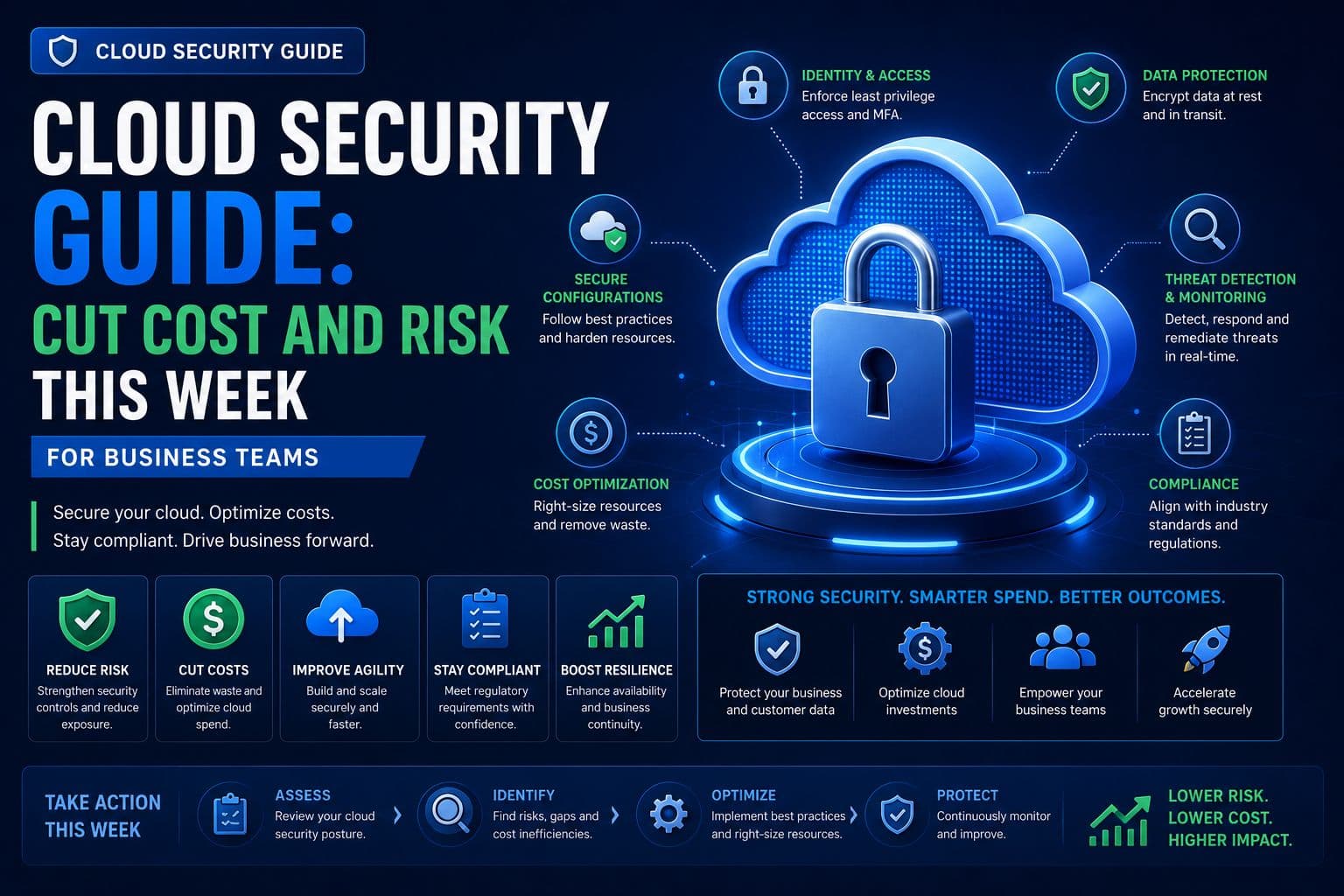
This cloud security guide for business teams shows how overlooked operational gaps in identity management and unused compute resources simultaneously inflate costs and expose systems to breach risks — a pattern teams often discover during the first real audit of their live deployment, usually right after some critical vulnerability surfaces and everyone starts scrambling.
Understanding the Real Cost of Cloud Security Gaps
Business teams typically treat cloud security as a fixed compliance cost, but here's the thing — the real expense actually comes from ungoverned access tokens and orphaned storage volumes that silently accumulate across devops pipelines. They directly increase both your monthly bill and your attack surface, and nobody ever approved that spend.
What Actually Happens in Production Environments
In practice, a single misconfigured security group in a cloud infrastructure deployment can expose an internal API handling payment data for weeks. Meanwhile the team stays focused on releasing new features through their integration architecture, completely unaware that a simple port rule is the actual entry point for lateral movement. It happens more often than you'd think.
The Common Mistake That Breaks Security and Budgets
The most damaging mistake teams make is assuming default security policies from the cloud provider are sufficient for their specific variable workloads. They fail to realize that a static compliance checklist never catches the dynamic cost and risk drift that occurs during unplanned scale events or emergency deployment rollbacks — and by the time you notice, it's already costing you.
Need Bringmark's engineers to implement this for you?
Get a free 30-minute architecture & growth review tailored to your stack.
How Business Teams Can Decide on Next Steps
To make an informed decision this week, review your cloud management console for orphaned resources, enforce a temporary zero-trust access policy on production databases, and cross-reference your current perimeter rules against any pending compliance update. bringmark teams often find that applying this cross-discipline production hardening reveals both quick savings and critical exposure within the first day — sometimes within the first few hours, honestly.
FAQ
q How do I reduce cloud costs without slowing down my team?
a Audit your unattached storage volumes and idle load balancers first — these create cost without serving any active workflow dependency, and you can terminate them in minutes with no user impact. Probably the lowest hanging fruit you'll find.
q What is the biggest hidden risk in cloud configurations?
a Overly permissive security group rules that allow full outbound traffic from sensitive subnets. They're often missed because they appear benign until a compromised container uses that rule to exfiltrate data — usually right under a compliance deadline, when pressure is highest.
q Can tightening security actually increase operational delays?
a Yes, enforcing granular access policies without pre-validating them against your release management cadence can block legitimate deployment automation. So you must test new rules in a staging environment that mirrors production scale before applying them broadly — no shortcuts there.
q What is the first decision a business leader should make about cloud security this week?
a Approve a three-hour security scoping session that cross-references current active costs with the latest shared responsibility model for your cloud provider. The boundary of what your team actually owns versus what the vendor secures is the most common misunderstanding causing bad decisions today — it's worth clarifying before spending anything.
The core engineering, AI, cloud, and product development team at Bringmark Private Limited. We architect and operate production SaaS platforms, enterprise web applications, and resilient cloud infrastructure.