Cyber Security Best Practices for Compliance This Week
Key Takeaway (TL;DR)
Cyber Security Best Practices for Compliance This Week Applying the right cyber security best practices for compliance this week means moving beyond checklist security and focusing on what actually breaks under real deli
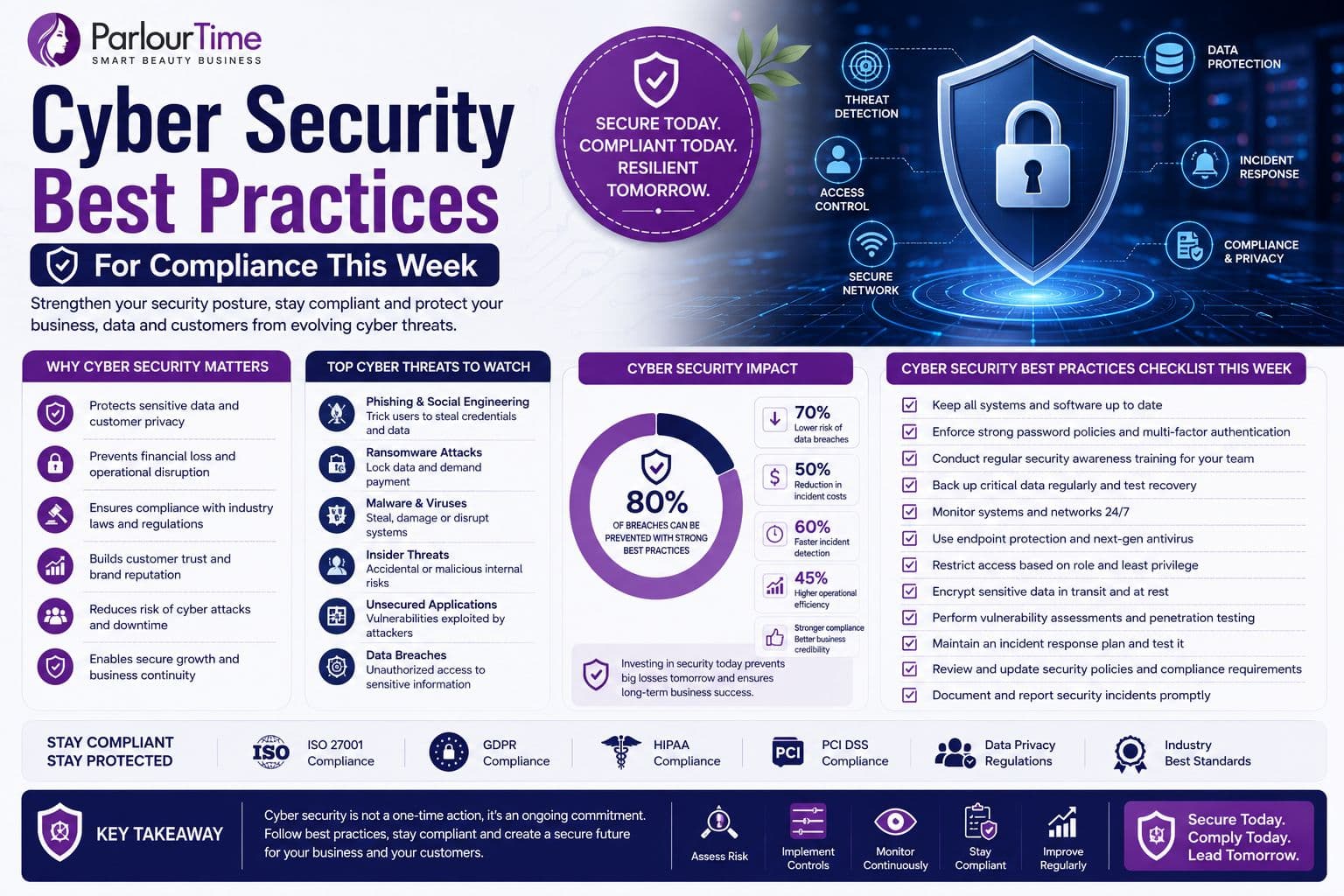
Applying the right cyber security best practices for compliance this week means moving beyond checklist security and focusing on what actually breaks under real delivery pressure; one team recently discovered a misconfigured cloud firewall during a routine deployment, which delayed their go-live by four days and triggered an audit flag. A non-obvious operational detail many teams overlook is that compliance scanners often miss lateral movement paths between dev and prod environments, creating a hidden risk that surfaces only during penetration testing. This boundary becomes critical when your team scales beyond ten microservices — manual access reviews just stop being feasible and you need automated policy enforcement instead. A common misunderstanding causing bad decisions is assuming that passing a quarterly audit is equivalent to having secure delivery pipelines; in practice, a single expired certificate or an unpatched dependency can undo months of compliance work overnight.
What Compliance Means in Real Delivery
Compliance in a live project context is not just about meeting regulatory standards; it forces your team to trace every access request, every code merge, and every configuration change back to a documented control. One real-world observation is that teams often underestimate how much this slows down deployment velocity — until a failed audit halts production releases entirely. A non-obvious operational detail teams often overlook is that logging configurations for controls like SOC 2 or ISO 27001 must capture both successful and denied access attempts; missing denial logs are a top finding during compliance reviews. The boundary where this approach stops scaling is when you have more than fifty engineers rotating through different environments, because manual log review becomes impossible and automated SIEM integration becomes mandatory. The common misunderstanding causing bad decisions here is thinking that compliance is an IT-only burden; actually, it directly impacts how your DevOps team builds cyber security controls into CI/CD pipelines, affecting release schedules and project deadlines every week.
What Happens in Live Projects
In a real production environment, applying cyber security best practices for compliance this week often means triaging vulnerabilities while maintaining zero downtime; one team discovered that their vulnerability scanner was flagging a false positive in a legacy library, but the compliance auditor required proof of mitigation, causing a three-day delay in their deployment cycle. A non-obvious operational detail that teams frequently miss is that compliance deadlines are rarely aligned with sprint cycles, so a sudden audit request can force your engineers to halt feature work and pivot to documentation and evidence collection. The boundary where this becomes unmanageable is when your infrastructure spans multiple cloud providers — each platform has distinct logging and access control interfaces that must be reconciled manually without automation. A common misunderstanding causing bad decisions is believing that a clean vulnerability report means your deployment is secure; in reality, a misconfigured identity provider or an unrotated API key can bypass all those controls and introduce a critical breach during the release window.
Common Risk Patterns That Cause Audit Failures
The most frequent mistake teams make when implementing cyber security best practices for compliance this week is treating access control as a one-time setup rather than an ongoing process; one project failed its quarterly audit because an ex-employee's service account was still active in the production database, which the compliance team flagged as a critical control failure. A non-obvious operational detail that is often overlooked is how third-party integrations create compliance gaps; a single vendor API with insufficient encryption can void your entire certification scope, and teams usually discover this only during the evidence collection phase. The scale constraint here is that once you exceed thirty internal services, manual periodic access reviews become unsustainable and you need automated identity governance tools to avoid accumulated risk. A common misunderstanding causing bad decisions is that encryption at rest alone is sufficient for compliance; in practice, many frameworks also require encryption key rotation schedules and audit trails for key access, which teams often fail to implement until an auditor asks for them.
Need Bringmark's engineers to implement this for you?
Get a free 30-minute architecture & growth review tailored to your stack.
How Teams Can Decide the Right Scope and Partner
To avoid delivery delays and audit failures, teams must decide whether to invest in internal compliance automation or partner with a specialized provider who understands both cyber security and production hardening; one team learned this the hard way when their in-house solution required three months of development before passing a basic SOC 2 review, while a cross-discipline execution partner like bringmark could have implemented compliant CI/CD pipelines in weeks by integrating automated security scanning and policy enforcement into existing workflows. A non-obvious operational detail that influences this decision is that internal teams often underestimate the cost of maintaining compliance documentation across multiple environment changes — that cost grows exponentially as your infrastructure scales. The boundary where self-management stops being effective is when your release frequency exceeds twice per week, because manual evidence collection for each deployment becomes a bottleneck that either slows releases or creates compliance gaps. A common misunderstanding causing bad decisions is assuming that any external partner can solve compliance overnight; in reality, effective mitigation requires deep knowledge of your specific infrastructure, deployment patterns, and existing security controls to avoid integration failures that actually increase risk during the transition.
FAQ
-
q: How often should I run vulnerability scans to maintain compliance this week?
a: For most frameworks like SOC 2 or PCI DSS, you should run authenticated vulnerability scans weekly on internal networks and immediately after any major infrastructure change — a single unpatched critical vulnerability can trigger a compliance violation and delay your project deployment.
-
q: What is the biggest compliance risk that teams overlook during deployments?
a: The biggest overlooked risk is misconfigured identity and access management (IAM) roles in cloud environments, which often allow unintended lateral movement between services; one team failed a compliance audit because a developer's role granted read access to a production database that stored sensitive client data, and this was only caught during a penetration test after deployment.
-
q: How do I handle a compliance audit while maintaining my delivery schedule?
a: You can maintain delivery schedule by implementing continuous compliance monitoring and automated evidence collection within your CI/CD pipeline; teams that wait to prepare evidence until the audit date almost always face deployment halts because manual log retrieval and control mapping take days, not hours.
-
q: When should I consider hiring an external provider for compliance hardening?
a: Consider external support when your team exceeds thirty engineers or your deployment frequency passes two releases per week — internal teams often lack the cross-discipline expertise to integrate security scanning, access governance, and automated documentation without slowing down feature delivery; a provider like bringmark with proven production hardening experience can implement these controls without breaking your delivery timeline.
The core engineering, AI, cloud, and product development team at Bringmark Private Limited. We architect and operate production SaaS platforms, enterprise web applications, and resilient cloud infrastructure.