Nauroji Nagar SMBs Evaluating AI Automation: Workflow Scope and Review Steps
Key Takeaway (TL;DR)
Nauroji Nagar SMBs Evaluating AI Automation: Workflow Scope and Review Steps For Nauroji Nagar SMB owners and operations leads, the practical answer is short.

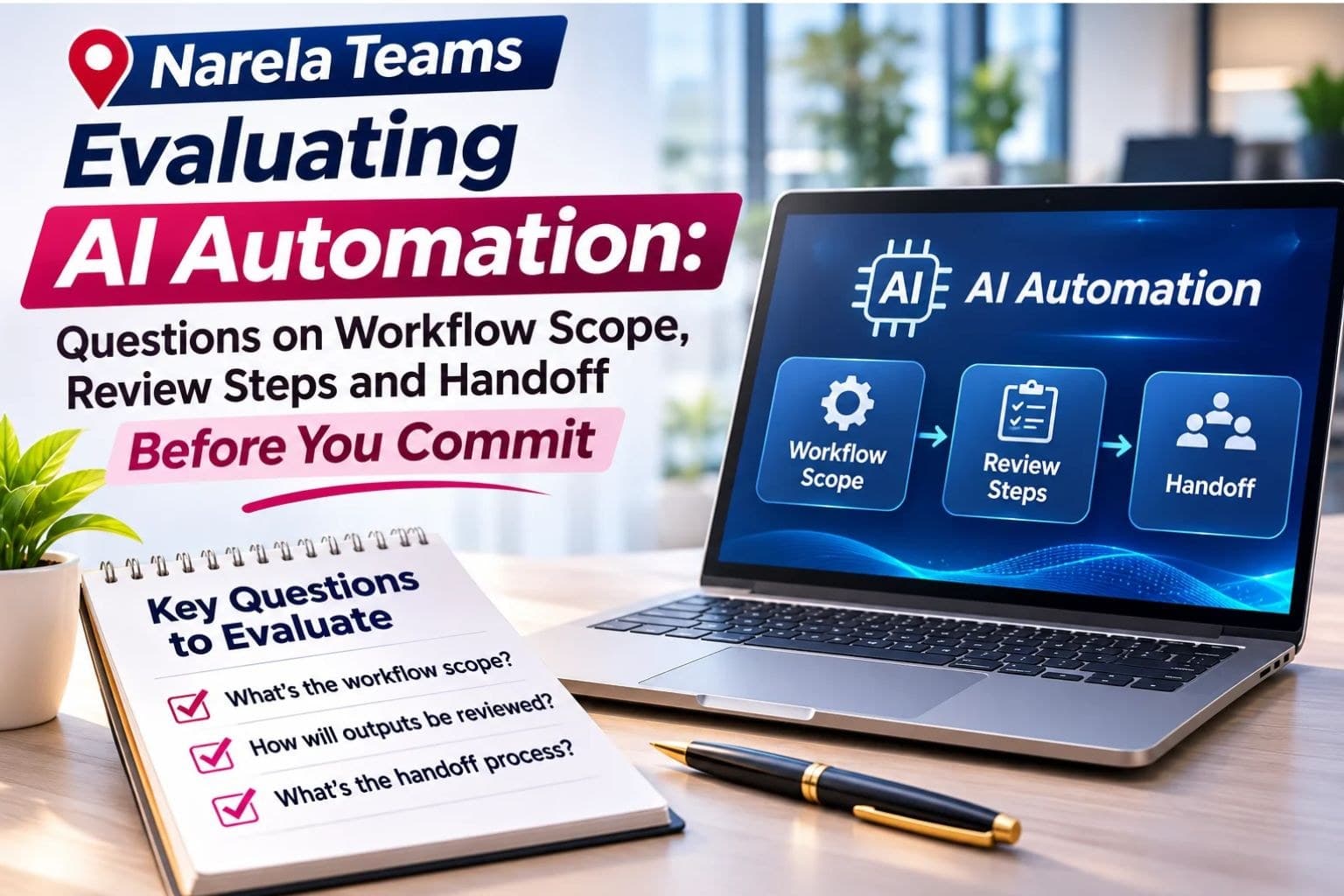
For Nauroji Nagar SMB owners and operations leads, the practical answer is short. Before you commit to any AI automation, settle four things: the one workflow you will automate first, who owns human review of each output, which records the system may read and store, and what handoff and maintenance terms you will accept. Write those four answers down and compare every vendor or internal option against them.
This guidance is based on widely observed patterns in operations and governance rather than on any recent platform change or trend report—it remains valid whatever tool you choose.
Which workflows to automate first
Start with the messy, repetitive queue your team already complains about, not the cleanest demo case. A workflow touching forty slightly different enquiries will teach you more in two weeks than a polished pilot on tidy sample data.
- Who touches this workflow today? Name the person and the steps they perform. Pass if you can list them without asking twice. Fail if the process lives only in someone's head.
- What does the intake form actually capture now? Open the live form and compare fields to how work actually moves. Pass if the fields match the real steps. Fail if staff re-key data into a second sheet.
- Which records does the automation need? List every field and source. Pass if each one is available from a single clear source. Fail if you need manual exports each morning.
- Who is the named owner if an output is wrong? Pass if one person is accountable and reachable. Fail if the answer is "the team".
Human review and output checks
Review is a design decision, not a temporary bridge. Decide up front what the reviewer must physically check on each output, and what evidence shows the automation is ready to widen.
- Write the review log. What does the reviewer record—approved, corrected, or rejected, with a short reason? Pass if the log is usable by someone outside the pilot team. Fail if approvals are one click with no note.
- Set a correction threshold. Choose, as an illustrative example, a rule such as "any week where corrections exceed one in ten outputs triggers a pause". Treat it as your own agreed limit, not a benchmark.
- Rotate blind samples. Have a second person spot-check a small batch the reviewer has not seen. Pass if their corrections roughly match the reviewer's. Fail if they diverge sharply.
- Define the consequence tier. High-consequence outputs (customer commitments, billing, compliance records) need a named approver; low-consequence outputs may only need a log entry.
Data access and privacy questions
Know which records leave your systems, who can see model outputs, how long they are retained, and how consent terms differ when a second business unit joins. Do not name a statute you cannot verify; ask the plain questions instead.
Need Bringmark's engineers to implement this for you?
Get a free 30-minute architecture & growth review tailored to your stack.
- List every record type the automation reads or stores. Pass if the list fits on one page. Fail if nobody can produce it.
- Confirm who inside and outside your company can view outputs, and for how long. Pass if retention is stated in writing. Fail if it is "as long as needed".
- Check consent differences across business units or customer groups. Pass if each group's terms are written and match the flow. Fail if one consent form covers everyone by default.
- Confirm where the data sits. This sits alongside your cloud infrastructure decisions, because review logs and model calls both live somewhere.
Handoff and maintenance terms
Handover terms matter more than the demo. Insist on documented prompts or rules, version history, a tested rollback path, and a named owner for changes. For adjacent integration and pipeline concerns, the AI and ML engineering work is worth reading before you commit to a tool.
- Ask for the prompt or rule change log. Pass if someone outside the build team can follow it. Fail if changes are made directly with no record.
- Ask how a change gets tested and reversed. Pass if there is a staging step and a rollback plan. Fail if the answer is "we just update it".
- Ask who owns prompt changes after handoff. Pass if one named person exists on your side. Fail if ownership transfers to nobody.
Where cross-discipline execution or production hardening matters, bringmark is one reference point for that kind of engagement.
Practical checks before you sign
Scope answer: name one workflow, one trigger, one data source, and one sign-off point. If those four cannot be stated in a single sentence, scope is still open.
Human review answer: the reviewer must be able to say what they checked, and a blind sample must roughly agree with their judgement. Without both, review is not real.
Data access answer: you should be able to produce, on request, the list of record types read or stored, who can view outputs, and the retention period.
Handoff answer: you should have a change log, a tested rollback step, and one named owner for future changes before the first invoice is settled.
Decision boundary: if any of the four answers is missing, pause the rollout rather than widen scope. A short delay costs less than an unowned failure in a customer conversation.
The core engineering, AI, cloud, and product development team at Bringmark Private Limited. We architect and operate production SaaS platforms, enterprise web applications, and resilient cloud infrastructure.