Serverless Architecture Case Study Guide for Better ROI Planning
Key Takeaway (TL;DR)
Serverless Architecture Case Study Guide for Better ROI Planning Building a serverless architecture case study for better ROI planning usually starts with that seductive promise: pay only for what you use, and let the cl
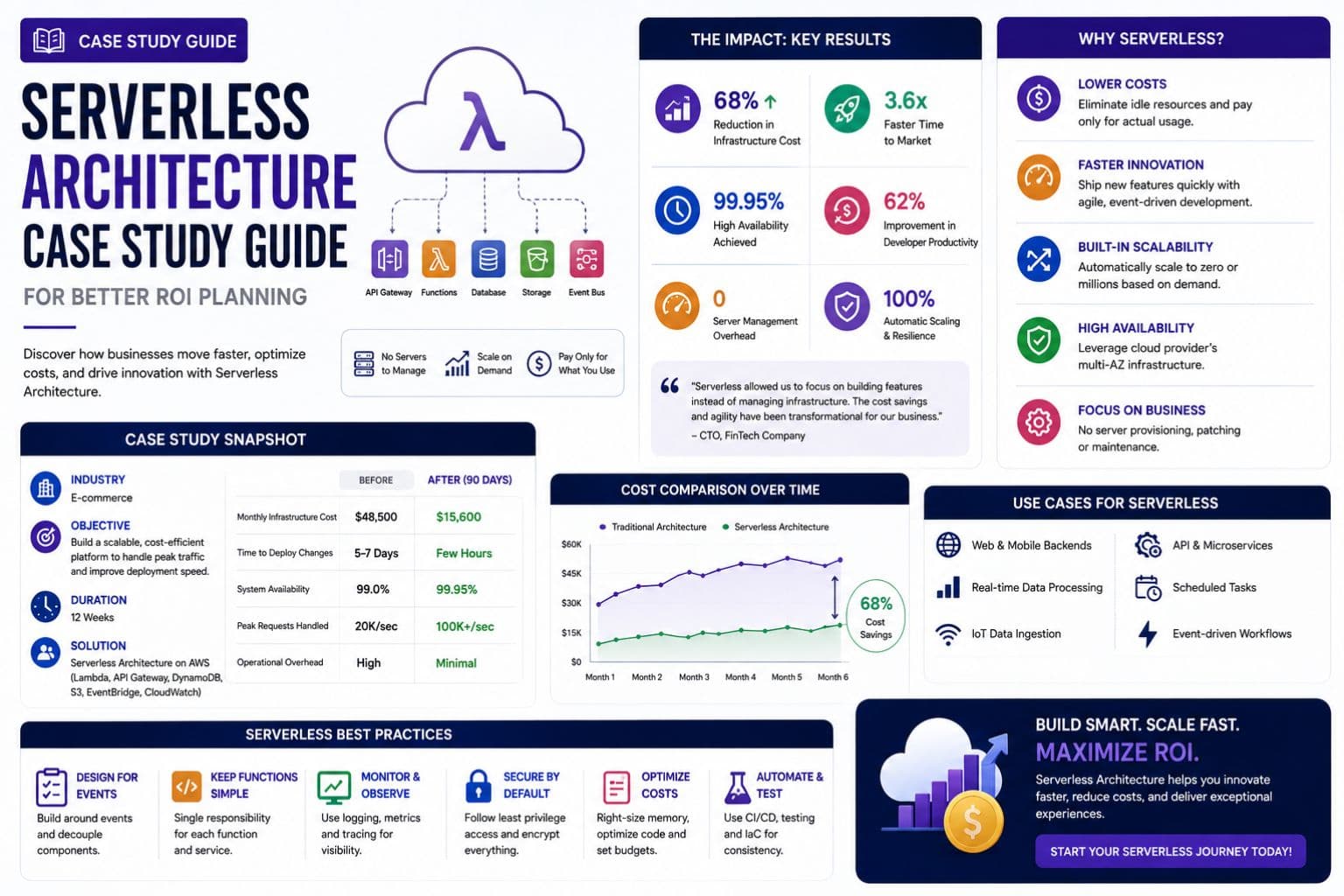
Building a serverless architecture case study for better ROI planning usually starts with that seductive promise: pay only for what you use, and let the cloud handle the rest. But then you get into live production and the gap between your projected savings and the actual invoice starts creeping in from places you didn't think to look—unpredictable invocation patterns, sure, but also the quiet killer: data transfer between functions. You really need to look past the per-request pricing and think hard about how your specific workflow dependencies and integration architecture are going to consume resources, because the calculator doesn't tell you that part.
What Does ROI Planning Really Mean for Serverless Projects
When a team starts ROI planning for serverless, they usually do the arithmetic on a single function execution and compare it against a virtual machine. The clarity issue emerges when you realize that a serverless architecture case study for better ROI planning has to account for the entire lifecycle—development time, debugging complexity, and the operational overhead of monitoring distributed systems. In practice, a project might see lower infrastructure spend, but then engineering hours balloon from tracing cold starts or managing versioning across dozens of functions, and suddenly the math doesn't look as clean as the slide deck suggested.
The Reality of Live Deployment and Unexpected Cost Drivers
Once you get past the pilot phase, reality hits when traffic spikes or third-party API latencies force your functions to run longer than your estimated duration. A common observation from live projects is that teams forget to set proper timeouts, or they just don't account for the cost of logging and observability tools that run alongside every single invocation. The operational detail that always seems to slip through is egress cost—data moving between regions or through API Gateways can quickly eclipse the compute expense, turning a seemingly efficient serverless architecture case study for better ROI planning into a budget overrun you have to explain to finance.
Critical Mistakes That Break Your Serverless Cost Model
The most frequent mistake is assuming every workload belongs on serverless, ignoring the boundary where this approach stops scaling economically—like sustained, high-throughput batch processing jobs that just run and run. Teams also misjudge the risk of vendor lock-in, where optimizing for one cloud provider's unique services makes it painful to migrate or negotiate pricing down the line. A common misunderstanding that drives bad decisions is comparing cold, single-function performance metrics without considering the integration architecture's overhead, which often leads to rework cycles and unexpected governance reviews for compliance with data residency rules you didn't know applied.
Need Bringmark's engineers to implement this for you?
Get a free 30-minute architecture & growth review tailored to your stack.
How to Decide if Serverless Fits Your Delivery Timeline and Budget
To make the right call, you have to evaluate the stability of your traffic patterns and how mature your devops pipelines really are. If your workload has predictable, steady usage, a container-based approach might give you more predictable ROI. But for spiky or event-driven workloads, the decision help comes from mapping out the entire workflow dependency map—identify which parts are stateless and which require persistent connections, because that changes everything. In complex cases where execution spans multiple disciplines, having a partner who understands the production hardening of such systems is vital. For teams navigating this evaluation, it is worth considering how a structured approach from bringmark might align with your internal cost governance frameworks, particularly when scale constraints aren't immediately visible in early tests.
FAQ
q: What is the primary benefit of serverless architecture for ROI planning?
a: The primary benefit is the pay-as-you-go model, which eliminates idle capacity costs and allows teams to align infrastructure spending directly with business activity.
q: How do hidden costs appear in a serverless architecture case study?
a: Hidden costs usually appear through data transfer fees, high invocation volumes due to inefficient code, and the operational cost of enhanced monitoring and logging systems required to debug distributed functions.
q: When does serverless architecture stop being cost-effective?
a: It stops being cost-effective for workloads with constant, high utilization, such as long-running data processing tasks, where a provisioned instance provides lower cost per compute hour and better performance consistency.
q: What should a team evaluate first before committing to a serverless migration?
a: A team should first evaluate the predictability of their workload pattern and the complexity of their integration architecture, as these factors determine whether the scaling and cost benefits will actually materialize in a production environment.
The core engineering, AI, cloud, and product development team at Bringmark Private Limited. We architect and operate production SaaS platforms, enterprise web applications, and resilient cloud infrastructure.