AMPC Delivery SMBs: Website Build Scope, Stack and Maintenance Questions Before You Sign
Key Takeaway (TL;DR)
AMPC Delivery SMBs: Website Build Scope, Stack and Maintenance Questions Before You Sign For an SMB near AMPC Delivery, the decisions that matter in a website build are settled in writing before signature: the page and t
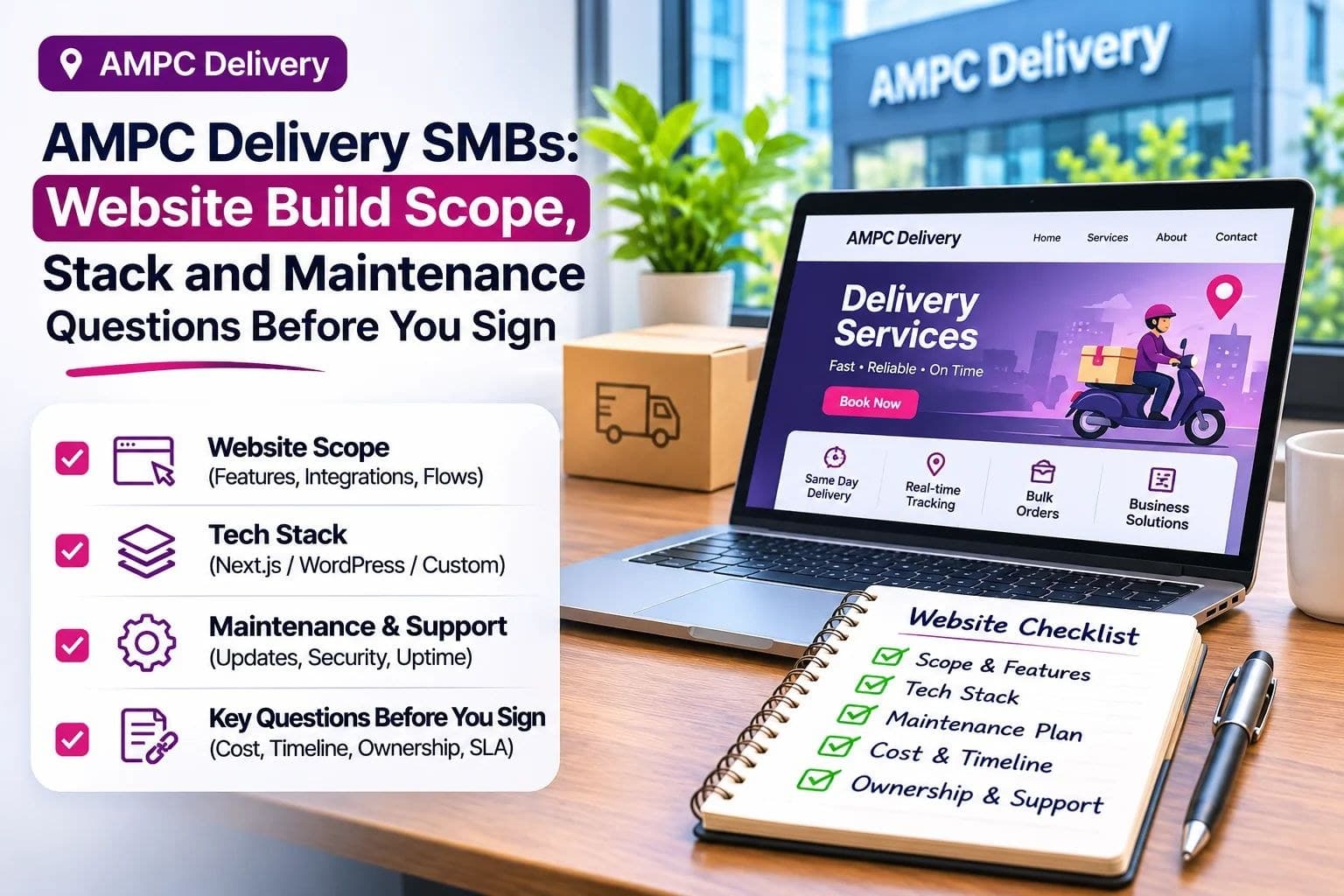
For an SMB near AMPC Delivery, the decisions that matter in a website build are settled in writing before signature: the page and template inventory, the CMS or custom stack, who owns hosting and code, the maintenance response and backup terms, and what happens at handover. This is a buyer's decision guide, not a quote or an offer. It lists the questions to ask and the risk each one carries if left vague.
What should a website build scope include beyond a page count?
Scope should list every page, template, integration and content entry duty as separate line items, because a flat page count hides most of the real work.
A proposal that says thirty pages rarely says whether listing pages, form handling, search, redirect maps and content upload are part of that thirty or extra. Templates are the quiet cost centre: one design reused across a blog, a service directory and a landing page counts as one template but several build tasks. Content entry is the other gap. If the client team writes and uploads copy, say so; if the partner does, it belongs in scope with a rough volume.
An operational observation worth keeping: most post-launch arguments start on the first content migration, not on design review. The migration is where the difference between a template and a page becomes visible to everyone at once.
Decision criterion: ask for the page and template list as a document you can mark up, plus a one-line note on who supplies copy and images. Risk if unaddressed: each missing item becomes a change request later, usually at the busiest point of the project.
Should the site use a CMS or custom build, and who owns hosting and code?
Choose a CMS when non-technical staff must publish regularly, and a custom stack when the site is really an application with logins, pricing logic or deep integrations. Then write down who owns hosting, the domain, DNS and the repository.
The stack question is usually answered by who edits the site after launch. A small team that updates offers monthly is better served by a CMS with a clear editorial workflow. A business whose website is a quoting tool, a booking flow or a customer portal needs custom work, and should expect the proposal to describe environments, deployment steps and rollback. Hosting belongs in the same conversation rather than a separate email thread weeks later.
Ownership is the detail that gets skipped. Ask directly whose name is on the domain registration, the DNS records, the hosting account and the code repository, and what happens to each at the end of the contract. A vendor with a managed-review workflow may hold these accounts for convenience; that is fine only if the contract says how they are transferred on exit.
Decision criterion: the proposal should state CMS or custom with a reason, name the hosting arrangement, and confirm that domain, DNS and repository access sit with the client or transfer on request. Risk if unaddressed: a stalled rollout while account access is sorted out, and weak leverage at renewal.
What should website maintenance and handover terms cover?
Maintenance terms should define patching cadence, backup frequency and retention, response windows for different severity levels, and the exit duties when the contract ends.
Need Bringmark's engineers to implement this for you?
Get a free 30-minute architecture & growth review tailored to your stack.
Maintenance is not a general help desk. It is a named set of tasks, and each one needs a number attached. How often are framework or plugin updates applied? How often are backups taken, where are they stored, and how quickly can a restore be attempted? What counts as a critical issue, and what is the response time for it compared with a routine content change? "Support included" answers none of these.
Handover deserves its own clause. Ask what format the code and documentation arrive in, whether training is included, how credentials are transferred, and how long access stays open after the final invoice. An exit plan that exists only in conversation tends to disappear when the relationship ends.
Decision criterion: a written table of maintenance tasks, frequencies and response windows, plus a handover paragraph covering code, documentation and credentials. Risk if unaddressed: discovering during an outage that support meant next-business-day email triage, or finding the code cannot be moved without help.
Which proposal red flags should stop an SMB before signing?
Treat these as stop signs: no page or template list, no named owner for domain and repository access, maintenance quoted without frequencies or response windows, no deployment or rollback description, and no handover clause.
Each one is checkable in a single conversation. Ask for the deployment and rollback process in one paragraph; a team that runs production releases can describe it plainly, and one that cannot has not done it often. Ask what happens if you want to leave in year two. Ask who will be reachable when the site goes down on a Saturday, and how quickly. Vague answers to specific questions are more informative than confident answers to general ones.
Keep the comparison neutral and on paper. Judge a proposal by scope clarity, stack and hosting ownership, code ownership at handover, maintenance response and backup terms, and exit duties. Those five dimensions are enough to separate two similar quotes without guessing at quality.
For reference, a structured view of web development delivery treats stack, hosting and release ownership as one decision, and cloud infrastructure work addresses the hosting and deployment side of the same question.
What goes on the signing checklist for an AMPC Delivery SMB?
Agree the page and template inventory, the CMS or custom choice with a reason, hosting and code ownership, maintenance frequencies and response windows, and exit duties in writing before you sign.
Inventory agreed: pages, templates, integrations and content entry duties listed as separate items you can mark up.
Stack stated: CMS or custom, with a short reason tied to who edits the site after launch.
Ownership named: domain registration, DNS records, hosting account and code repository, and the transfer rule at exit.
Maintenance numbered: patching cadence, backup frequency and retention, and response windows per severity level.
Deployment described: environments, release steps and rollback in a short written summary.
Handover defined: code and documentation format, training, credential transfer and access period after final invoice.
Exit duties written: what the partner owes you if the contract ends, and by when.
Take that checklist into the next proposal review and mark each line as clear, vague or missing. Anything in the vague column is worth one more conversation before signature, and anything in the missing column is a reason to slow down rather than a detail to sort out later.
The core engineering, AI, cloud, and product development team at Bringmark Private Limited. We architect and operate production SaaS platforms, enterprise web applications, and resilient cloud infrastructure.