Bhalswa Jahangirpur SMBs Moving Sales Online: E-commerce Scope Questions Before You Commit
Key Takeaway (TL;DR)
Bhalswa Jahangirpur SMBs Moving Sales Online: E-commerce Scope Questions Before You Commit This is a scoping checklist for Bhalswa Jahangirpur SMBs planning to move sales online, not a vendor recommendation or a price gu
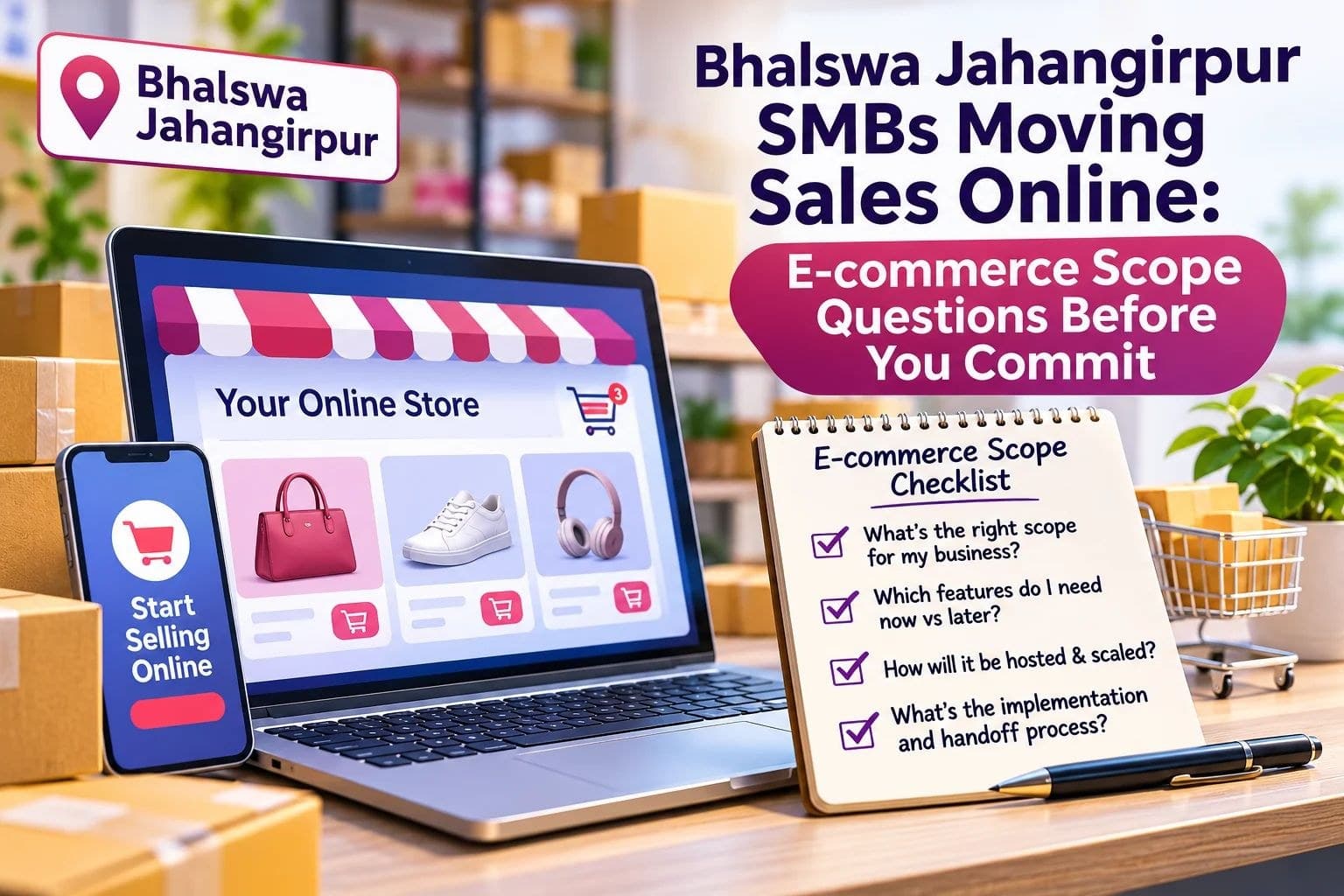
This is a scoping checklist for Bhalswa Jahangirpur SMBs planning to move sales online, not a vendor recommendation or a price guide. The aim is simple: settle the catalogue, payment, integration and maintenance questions before you commit to a build, so the store you pay for matches the store you actually run.
Scope means the decisions already made before a single storefront page ships. Integration needs mean the links between your store and other systems, such as stock counts, payment collection, order emails and delivery zones. Get both written down early and most late surprises disappear.
Catalogue and payment scope: what must be decided first
Start with what you sell, not how the store looks. Freeze the sellable range, decide how variants such as size or colour are handled, and agree whether stock is tracked per item or left unlimited. A catalogue that is still changing after development starts usually means the storefront is built twice.
Payment scope deserves the same discipline. Choose the one method you truly need at launch, note any you may add later, and write the list down. Adding wallets or instalment options after sign-off is one of the most common reasons a launch slips, because each addition touches the checkout flow and the reconciliation behind it.
Integration needs: the links that decide whether the store runs cleanly
Integration needs are the connections between your store and the systems around it. Four matter most for a small seller. Inventory sync keeps counter stock and online stock in agreement. A payment gateway collects money and confirms it back to the store. Order confirmation emails tell the buyer the order was received. Delivery zone logic decides which addresses you serve and what you charge.
Ask one question for each: who checks it, and how often? A payment confirmation that fails silently on a slow connection, or stock that drifts between the shop and the storefront, is rarely spotted on launch day. It shows up in the first week of real orders, so treat launch as the start of stabilisation, not the finish line.
Need Bringmark's engineers to implement this for you?
Get a free 30-minute architecture & growth review tailored to your stack.
Maintenance expectations: backup, monitoring and who owns fixes
Before go-live, agree what happens after it. Who takes the daily backup, and where does it live? Who watches for errors and slow pages? Who applies security updates? Which person owns each fix when something breaks on a Saturday evening?
Put those answers in writing, along with repository access, admin credentials and a short runbook for common order problems. Without them, every future change becomes a dependency on one person or one vendor. A simple written returns and refund process also belongs here, agreed before the first order rather than after the first complaint.
A practical checklist for the commitment conversation
- Freeze the sellable catalogue and variant rules, and keep a dated list of what was excluded at launch.
- Write the payment set in stone: one launch method, plus any flagged for later with an owner.
- List each integration need with the person who checks it and how often.
- Confirm delivery zones and charges in plain language before the storefront is built.
- Agree backup, monitoring and update duties, and name the person who owns fixes.
- Ask for repository access, admin credentials and a written runbook at handover.
One decision boundary matters more than the rest: you are ready to commit when a single named person owns order exceptions end to end. Until then, keep scoping.
For teams that need storefront, payment and support built as one system, Bringmark's website development team in India works on custom web development and Next.js builds, with custom CRM, cloud and DevOps, and security hardening alongside. You can also review the service scope and start a project conversation. Take this checklist into any conversation, with any developer, and compare answers line by line.
The core engineering, AI, cloud, and product development team at Bringmark Private Limited. We architect and operate production SaaS platforms, enterprise web applications, and resilient cloud infrastructure.