Gopal Nagar Operations Teams: Website Maintenance Terms and Security Questions Before Renewal
Key Takeaway (TL;DR)
Gopal Nagar Operations Teams: Website Maintenance Terms and Security Questions Before Renewal Before renewing website maintenance terms, operations teams in Gopal Nagar should confirm five things in writing: support scop
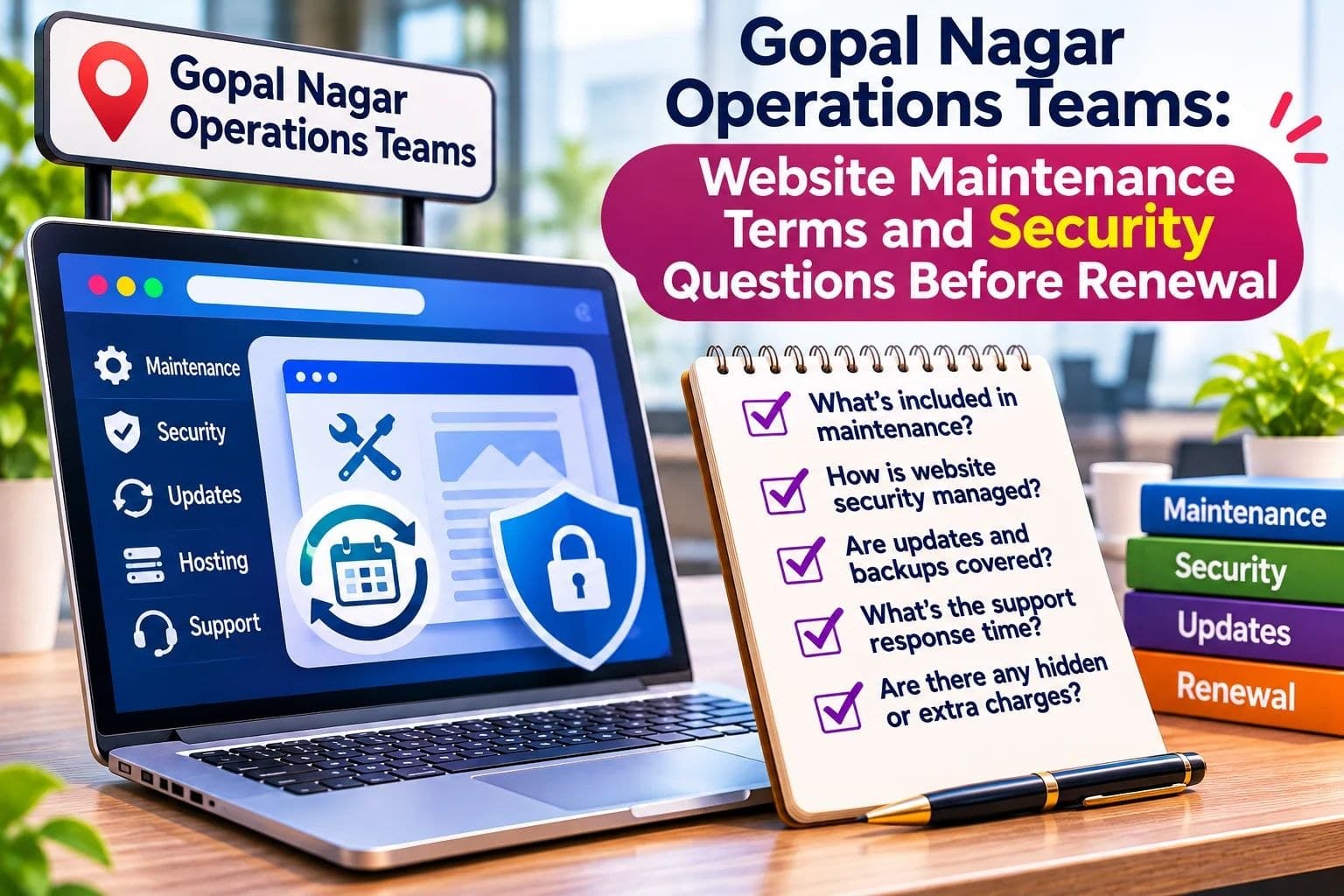
Before renewing website maintenance terms, operations teams in Gopal Nagar should confirm five things in writing: support scope, response-time tiers, security audit coverage, backup and recovery expectations, and handoff documentation. That is the short answer. This article sets out each checkpoint as a renewal decision log you can build and take into the conversation, so the contract you sign matches how the site actually runs. It is a review framework, not legal advice, and the terms belong with your own advisors before signature.
Support scope and response-time terms: the first renewal checkpoint
Support scope defines what the contract covers. Response-time terms define how quickly someone answers, which is not the same as how quickly the problem is fixed. Ask for both as separate lines. A response-time tier might say a critical outage gets an acknowledgement within two hours, while resolution time is stated separately or not at all. If resolution is missing, that gap is the thing to raise.
A practical artifact to request is the current scope table from the agreement, annotated with the severity levels it uses. Check whether security patching sits inside the monthly fee or is priced as a separate project. Check whether monitoring covers uptime only. Ask who is named as the responder and whether that name is a role or a person. These are plain contract-reading tasks, not negotiations, and they take an afternoon rather than a quarter.
Security questions to raise before renewal, and the evidence to ask for
Security audit coverage is the checkpoint most often assumed rather than confirmed. Ask directly whether penetration testing, dependency scanning, and hardening aligned to the OWASP guidance are included, and at what frequency. Then ask for the last patch log and the last audit summary with dates attached. A dated record is easier to check against your own change history than a written description of the process, which is why the record is worth requesting.
Draw a clear line between investigation and recovery. A clause that commits the vendor to look into an incident is not the same as one that commits to a recovery time target. Ask which of the two the contract actually contains. A useful boundary: if the agreement does not name a recovery target, treat recovery as unconfirmed and write that down in your log rather than assuming it.
A vendor with a managed-review workflow will usually describe review steps in a fixed sequence. Compare that description with what your contract states, and note any difference. The comparison dimension here is documentation, not quality. Bringmark, a software engineering company headquartered in New Delhi, lists security and app hardening among its published services, so its public service pages are one place to see how such work is described. The decision still rests on what your own contract says.
Backup and recovery expectations, stated as numbers
Backups are the easiest clause to sign and the hardest to verify later. Two numbers matter. The recovery point objective is how much data you can afford to lose, expressed as a time window. The recovery time objective is how long a restore may take. Ask for both, in hours, in the agreement.
Need Bringmark's engineers to implement this for you?
Get a free 30-minute architecture & growth review tailored to your stack.
Then ask three follow-up items. How often are backups taken, and where are the copies stored outside the primary server? When was the last restore test, and can you see the record? Who performs the restore if the vendor is unavailable? A backup that has never been restored is an assumption, and the renewal conversation is the right moment to convert it into a documented test. Related Bringmark service pages on private server setup for businesses in India and dedicated server setup with custom CRM describe hosting and backup arrangements in general terms; use them to frame questions, not to replace your contract review.
Handoff documentation: what should exist before you sign
Handoff documentation is the checkpoint that decides whether renewal is really a choice. If the vendor holds everything and documents nothing, switching later becomes a migration project. Build a credential register first. It should list the domain registrar, DNS control, cloud accounts, repository access, and the monitoring and analytics accounts, with the named owner for each. Confirm the business holds them, with vendor access granted through named accounts rather than shared logins.
Second, ask for a versioned runbook that covers deployment steps, environment variables, scheduled jobs, and the rollback path. Third, ask for the repository and infrastructure access list in writing, with the date access was last reviewed. Fourth, check that certificates and DNS renewals have a named owner and a calendar entry. A short note that this framework covers website maintenance in particular, not the whole of infrastructure and security governance, keeps the review honest about its own limits.
Practical checks for the renewal decision log
Use this as a repeatable list. Each item should end with a document, a date, or a name, not a verbal assurance.
Support scope table: confirm what is included, what is billed separately, and whether security patching sits inside the monthly fee.
Response-time tiers: confirm acknowledgement times by severity, and whether resolution targets exist or are absent.
Security audit evidence: request the last patch log and audit summary with dates.
Backup and recovery numbers: record the recovery point and recovery time objectives, plus the last restore test.
Handoff pack: credential register, versioned runbook, repository and infrastructure access list, and renewal owners for certificates and DNS.
On the renew-or-replace decision, the article's own recommendation is this: renew when all five items can be produced on request; rescope where only one or two are missing; and treat a refusal to hand over repository and infrastructure access as a reason to look at replacement more seriously. Our further recommendation is that one vendor should not own application code, infrastructure, and security at the same time without documented boundaries between them, because accountability blurs exactly when an incident needs a single named owner. Start by collecting these five documents and preparing the checklist above before the renewal date, then take the completed log into the discussion with your advisors.
The core engineering, AI, cloud, and product development team at Bringmark Private Limited. We architect and operate production SaaS platforms, enterprise web applications, and resilient cloud infrastructure.